Article Series
TL;DR — ROI of an Industrial Waste Processing Machine
The ROI of an industrial waste processing machine is calculated by dividing net annual return — across five categories: disposal cost avoidance, output revenue, labour savings, carbon cost avoidance, and ESG compliance risk reduction — by total capital investment cost.
To calculate your full return, model all five variables:
- Avoid disposal costs: Multiply annual diverted tonnes by local all-in rate (UK: £156/t in 2026; Japan: ~$200/t; US Northeast: $80/t)
- Generate output revenue: Compost ($30–70/t), liquid bio-fertilizer ($200–600/t), or solid recovered fuel (£30–60/t gate fee) from every processing cycle
- Capture labour savings: Automated ~30-minute cycles eliminate 1.5–2 FTE of manifest, scheduling, and handling labour per facility
- Hedge carbon costs: Each tonne diverted avoids 1.6–2.0 tCO₂e — worth €85–126/tCO₂e under EU ETS through 2030, rising to €149/t by 2030 forecast
- Eliminate penalty risk: EU ECD (2024) fines up to 5% of global annual turnover; UK ETS non-compliance: £49.41/tCO₂e unsurrendered
Applicable to: Industrial facilities generating 3+ tonnes/day of organic waste, food processing residues, medical waste, livestock manure, or fishery by-products in regulated markets: UK (Landfill Tax £130.75/t April 2026), EU (ETS from 2028, CSRD from 2025), US (RCRA), Japan (~$200/t), UAE (Law No. 18, 2024). Does not apply to glass, metal, or stone waste.
Example: A UK food processing facility running 8 cycles/day generates £824,863 net annual return — £389,376 from avoided landfill, £336,975 from carbon avoidance, £52,500 from labour savings — against a system investment of £1.5M: payback in 1.8 years, versus a 7-year estimate from a disposal-only model.
↓ Full 7-variable formula with regional worked examples below. See §Step 7 for the complete worked case. Related: Zero-Emission Industrial Waste Treatment Guide · Manufacturing Waste: Carbon Footprint Impact
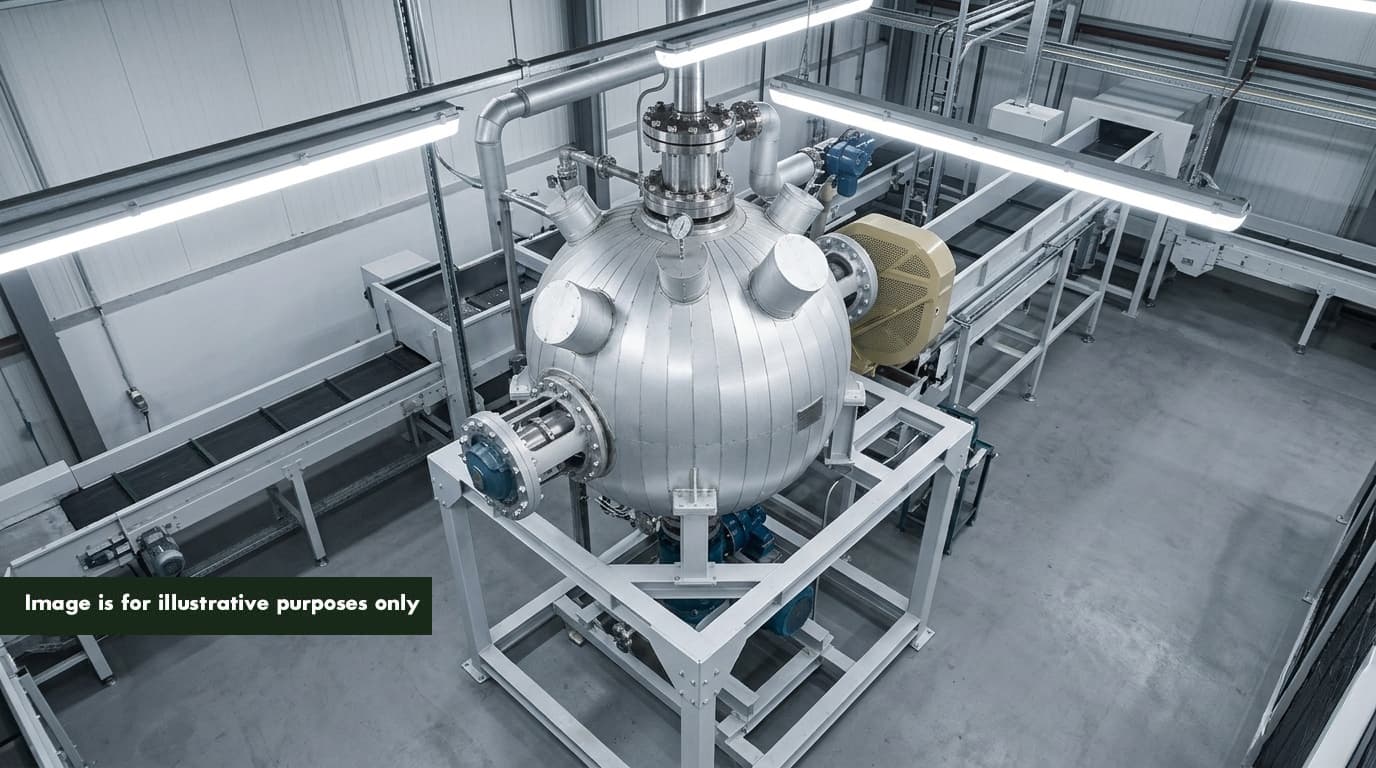
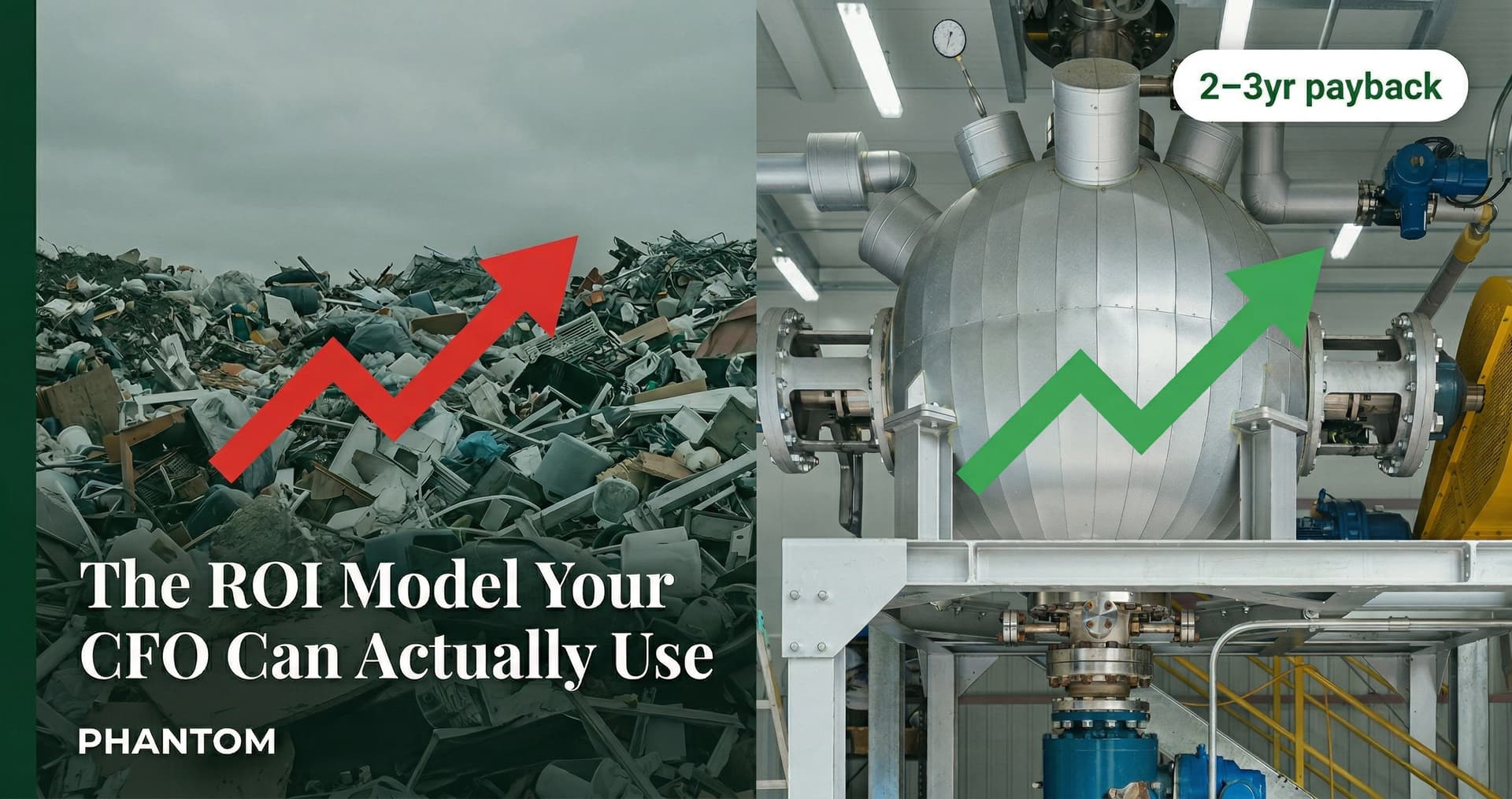
The ROI of an industrial waste processing machine is calculated by dividing the total net annual return — covering five categories: disposal cost avoidance, output revenue, labour savings, carbon cost avoidance, and compliance risk reduction — by the total capital investment cost. In high-disposal-cost markets such as the UK, Japan, and the US Northeast, a well-specified subcritical water hydrolysis system typically achieves payback in 2–3 years when all five return categories are included. Most facilities miscalculate payback by modelling only disposal savings, missing the remaining four vectors that can double or triple the true annual return.
This framework applies to industrial facilities generating organic waste, mixed plastics, food processing residues, medical waste, livestock manure, or fishery by-products at volumes of 3 tonnes or more per day. It does not apply to glass, metal, or stone waste streams, which cannot be treated by hydrolysis.
This analysis builds on our broader guide to zero-emission industrial waste treatment and links directly to industry-specific deep dives covering infectious medical waste management, medical waste TCO: autoclave vs. incineration vs. hydrolysis, manufacturing carbon footprint reduction, industrial plastics hydrolysis, hospital single-use plastics and PPE, nursing home incontinence waste cost reduction, livestock manure organic fertilizer conversion, fishery and slaughterhouse wet waste, and UK EPR packaging compliance costs.
Why Do Most ROI Calculations for Waste Equipment Get It Wrong?
Most ROI models for waste treatment equipment are wrong because they calculate only one of seven financial return variables — disposal cost savings — and ignore output revenue, labour savings, carbon avoidance, ESG penalty risk, supply chain access, and borrowing cost improvement.
Here is what a complete ROI model includes:
- Eliminated disposal costs — landfill tipping fees and haulage eliminated per tonne diverted
- Output revenue — compost, liquid bio-fertilizer, or solid recovered fuel sold or gate-fee-priced
- Labour savings — automation replacing manual composting, sorting, or outsourced handling
- Carbon cost avoidance — EU/UK ETS liability eliminated per tonne diverted from landfill or incineration
- Compliance risk reduction — avoided fines under RCRA, EU Environmental Crime Directive, and ESG reporting frameworks
- ESG score improvement — translating to lower borrowing costs via green bond yield reduction
- Supply chain eligibility — access to contracts requiring certified waste management credentials
Conditions: This full seven-variable model applies to facilities in regulated markets (UK, EU, US, Japan, UAE) with annual waste volumes above 500 tonnes. For facilities in low-regulation markets with disposal costs below $30/tonne, the payback period extends and the model weight shifts toward output revenue and labour savings.
Example: A UK food processing plant running one disposal-only ROI model showed a 7-year payback. When all seven variables were included — disposal avoidance at £152/tonne, compost revenue, liquid fertilizer revenue, UK ETS carbon avoidance at £75/tCO₂e, and two FTE labour savings — the recalculated payback dropped to 2.4 years.
Step 1: What Does Industrial Waste Disposal Actually Cost in 2026?
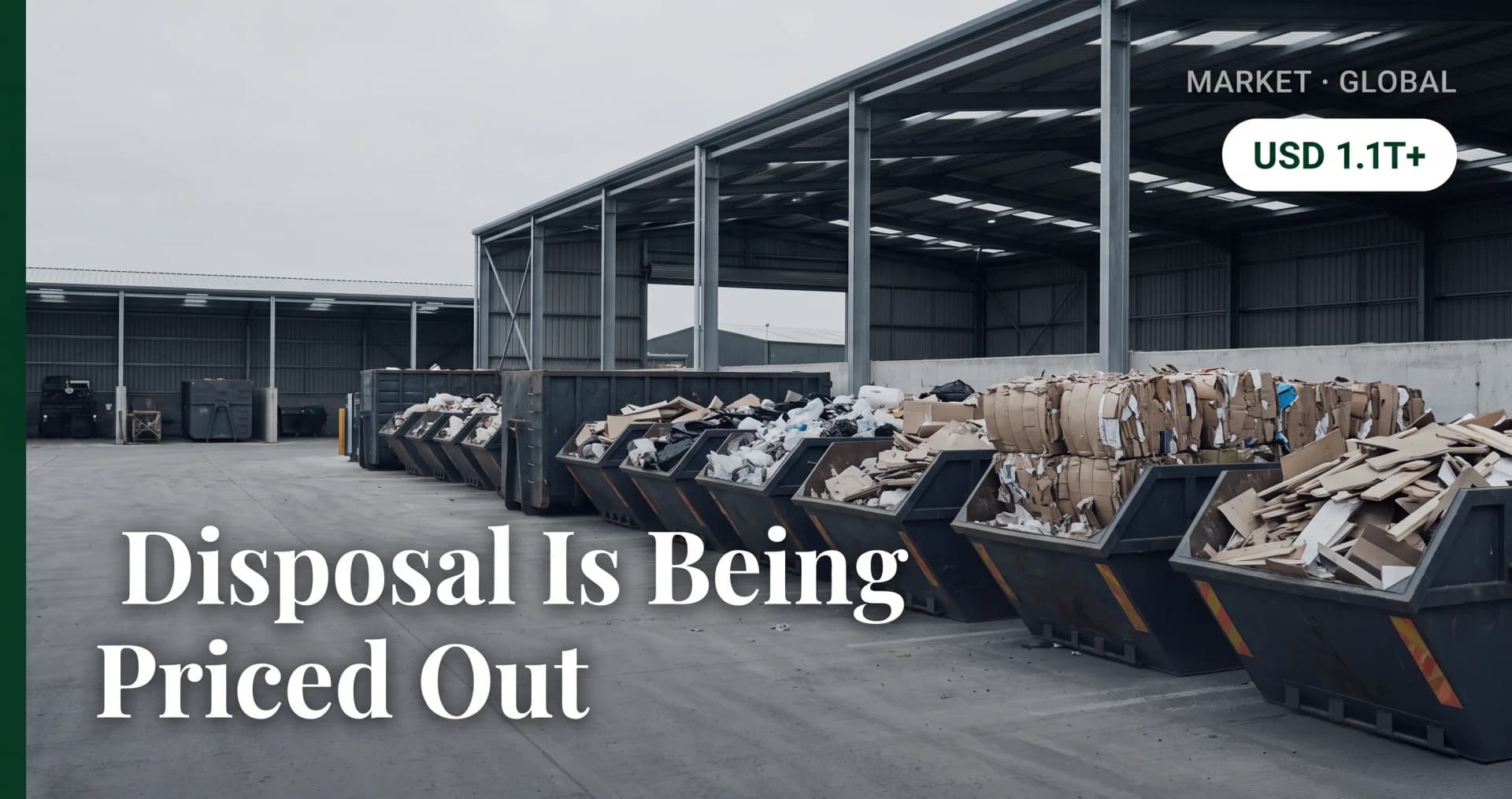
Landfill disposal costs have increased 10–22% year-over-year across all major markets in 2024–2025 and are structurally committed to further escalation by legislation already passed — making this the fastest-growing single line item in industrial operating budgets.
Key figures by market:
- UK: £130.75/tonne Landfill Tax (April 2026, HMRC) + £26/tonne median gate fee = £156.75/tonne all-in
- Belgium (Flanders): >€100/tonne for combustible waste — among the EU's highest
- US National Average: $62.28/tonne (+10% YoY in 2024, EREF) — Northeast reaches $80.67/tonne
- Japan: ~$200/tonne integrated industrial disposal cost (Ken Research) — highest globally
- UAE/Dubai: AED 100/tonne gate fee + AED 10,000–50,000 fine for non-segregation (Law No. 18, 2024)
Conditions: These figures apply to non-hazardous industrial waste. Hazardous streams command significantly higher rates — Germany: €150–300/tonne; US special waste: $100–300/tonne. Glass, metal, and stone cannot be hydrolysed and continue to attract standard tipping fees regardless of system installed.
Example: A UK facility disposing of 10 tonnes of organic waste per day pays approximately £555,800 per year at 2026 Landfill Tax rates alone — before haulage, gate fees, or secondary processing contracts. At confirmed 2027 rates, that figure rises automatically without any change in the facility's waste volumes.
| Market | 2025 Rate | 2026 Rate | YoY Change |
|---|---|---|---|
| UK (standard waste) | £103.70/t | £130.75/t | +26% |
| US National Average | $56.62/t | $62.28/t | +10% |
| France (TGAP) | €60/t | €65–70/t | +8–17% |
| Austria | ~€80/t | ~€87/t | +9% |
| Japan (integrated) | ~$190/t | ~$200/t | +5% |
📎 Deep dive: See our guide to zero-emission industrial waste treatment for a full regulatory timeline by jurisdiction.
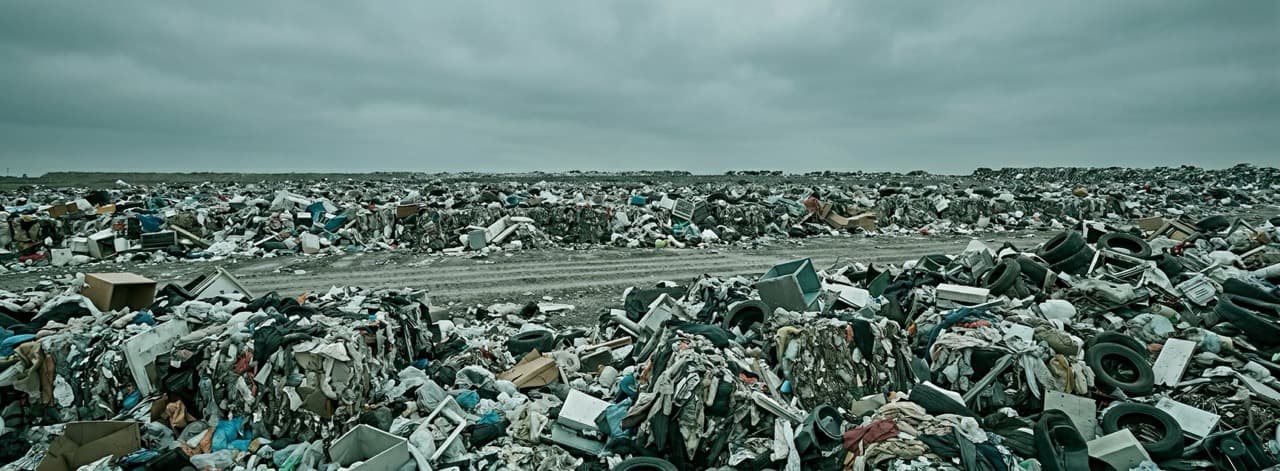
What Does It Cost to Do Nothing? Global Landfill Rates
Step 2: How Do You Quantify Direct Cost Savings From Tipping Fees, Haulage, and Secondary Processing?
The direct cost saving from a subcritical water hydrolysis system equals the per-tonne disposal rate multiplied by the mass diverted from landfill per year, plus haulage frequency savings from volume reduction, minus the annual fuel operating cost.
Calculate it in three steps:
- Identify your annual waste tonnage going to landfill or incineration (organic, plastic, or mixed — not glass/metal/stone)
- Multiply by your local all-in disposal rate (tipping fee + gate fee + transport) — see regional figures in Step 1
- Subtract annual operating cost — approximately ¥5,000/cycle (~£33) in kerosene fuel per 3-tonne batch; maintenance is a gasket replacement approximately every 10 years
Conditions: This calculation applies most powerfully to facilities in the UK, Japan, and US Northeast where all-in disposal costs exceed $80/tonne. In low-cost disposal markets (US South Central, UAE at current rates), the direct saving is smaller and the output revenue and labour components dominate the ROI model instead.
Example — Direct savings per cycle (PHANTOM system: 3t input, 1.8t output, 1.2t diverted):
| Market | Avoided Cost (1.2t) | Operating Cost | Net Saving/Cycle |
|---|---|---|---|
| UK (£156/t) | £187 | ~£33 | £154 |
| Japan (~$200/t) | $240 | ~$33 | $207 |
| US Northeast ($80/t) | $96 | ~$33 | $63 |
| France (€70/t) | €84 | ~$33 | ~€51 |
| UAE (AED 100/t) | AED 120 | ~$33 | ~$0 to $30 |
Running 8 cycles/day across 260 working days, a UK facility nets approximately £320,320 per year in disposal avoidance alone — before any output revenue, before any haulage saving, and before the carbon cost category.
The haulage multiplier: A 40% mass reduction per cycle means proportionally fewer collections. For a facility running three haulage events per week at £400/event, eliminating one collection weekly saves £20,800/year — a passive, permanent saving requiring no additional action.
📎 See how disposal cost elimination applies specifically to hospital PPE and single-use plastics: Hospital Single-Use Plastics & PPE Waste Management
Step 3: What Revenue Does the Waste Processing Machine Generate?
A subcritical water hydrolysis system generates three distinct revenue streams from waste inputs: organic compost (£2–70/tonne wholesale), liquid bio-fertilizer ($200–600/tonne), and solid recovered fuel (£30–60/tonne gate fee) — converting every processing cycle from a cost event into a revenue event.
Here is the revenue model per output type:
- Compost from organic inputs — sterilised, deodorised, pathogen-free; wholesale $30–70/tonne (US), or gate-fee model at £28–39/tonne for in-vessel composting services (WRAP UK)
- Liquid bio-fertilizer — approximately 10% water-soluble fraction per organic cycle; wholesale $200–600/tonne depending on concentration and crop application
- Solid recovered fuel (SRF) from plastic, wood, and paint inputs — gate fees £30–60/tonne; cement kilns consume 45% of global RDF/SRF supply
- Gate fee income — a facility accepting third-party organic waste earns gate fees and avoids its own disposal costs simultaneously; this double-stack is the highest-return configuration
Conditions: Compost revenue applies to organic input streams only (food waste, livestock manure, fish/shells). SRF output applies to plastic, wood, paint, and oil sludge inputs. The two streams cannot be mixed in a single cycle if market-grade output is required. Glass, metal, and stone pass through as inorganic residue requiring separate disposal at standard rates.
Example: A livestock processing facility running 8 cycles/day on organic inputs produces approximately 3,744 tonnes of compost annually. At a conservative $40/tonne wholesale, that is $149,760 in annual compost revenue. The liquid fertilizer fraction (estimated 624 tonnes at $200/tonne minimum) adds a further $124,800. Combined output revenue: $274,560/year — from what was previously a disposal cost.
This is particularly relevant for facilities processing organic streams such as livestock manure conversion, where waste is transformed into high-grade, pathogen-free nutrient solutions with premium agricultural market positioning.
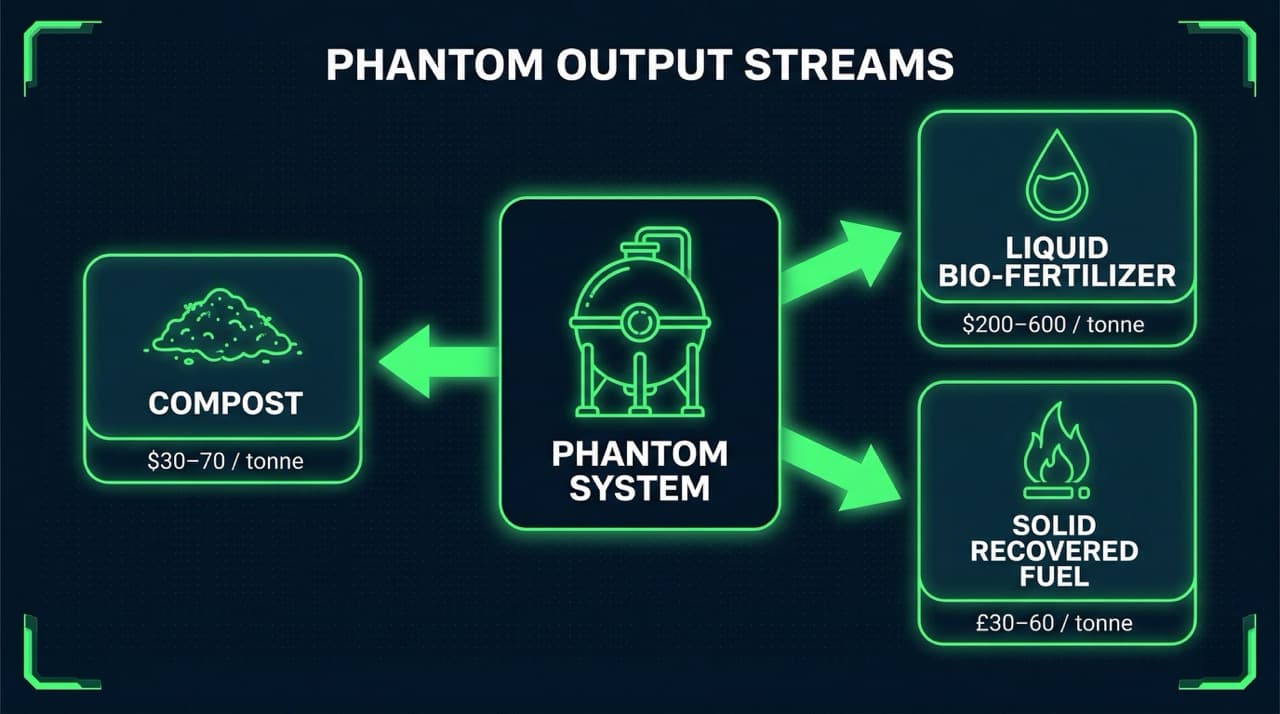
What Does Your Waste Produce Per Year?
Based on 8 cycles/day × 260 days/year. Inputs: 3t/cycle, output ~1.8t/cycle.
| Output Type | Volume/Year | Market Rate | Annual Revenue |
|---|---|---|---|
| 🌱 Compost (solid) | 3,744 t | $30–70/t | $112,320–261,080 |
| 💧 Liquid Fertilizer | 624 t | $200–600/t | $124,800–374,400 |
| 🔥 Solid Fuel (RDF/SRF) | 3,744 t | £30–60/t gate fee | £112,320–224,640 |
| 💰 Avoided Disposal (UK) | 2,496 t avoided | £156/t | £389,376 |
| TOTAL COMBINED RETURN | conservative estimate, organic input mix | $600K–$1M+/yr | |
*Revenue estimates based on published wholesale market rates. Actual returns depend on waste stream composition, local market conditions, and output quality. Contact Phantom Ecotech for a site-specific assessment.
Step 4: How Does a 30-Minute Automated Cycle Change Your Labour Economics?
Switching from outsourced waste management or manual composting to a 30-minute automated hydrolysis cycle eliminates the two largest hidden labour costs in waste operations: direct handling time and third-party contract management — typically reducing total waste-related labour expense by 30–50%.
The operational shift works as follows:
- Cycle time: Full processing in 30–35 minutes (15 minutes active hydrolysis; remainder loading/unloading)
- Operator requirement: Minimal — primarily loading and unloading; no sorting, no manual composting monitoring, no pathogen handling exposure
- Contract elimination: Outsourced incineration contracts involve scheduling, manifest paperwork, transport liability, and third-party gate fees — all eliminated with on-site treatment
- Turnover cost removal: Manual waste handling roles carry up to 50% annual turnover; each vacancy costs 50–200% of the role's annual salary in recruitment and retraining
- Shift economics: One operator can supervise multiple complete processing cycles per shift versus monitoring a composting windrow for 60–90 days
Conditions: Labour savings are highest in markets where manual waste handling wages are elevated: UK (National Living Wage £11.44/hr, rising to £12.21/hr from April 2025), US ($15–22/hr in most regulated states), and Australia ($21–26/hr). In low-wage markets, the labour saving component is less significant; disposal avoidance and output revenue lead the ROI model instead.
Example: A UK hospital processing medical and organic waste through outsourced incineration employs 1.5 FTEs to manage scheduling, manifests, and compliance documentation. At £35,000/year per FTE, eliminating that function saves £52,500/year in direct labour — before the disposal contract itself is removed. For healthcare facilities specifically, the total cost of ownership for medical waste processing drops significantly when switching from outsourced incineration to on-site hydrolysis, even before accounting for logistics savings.
📎 For wet waste streams with high manual handling requirements, see: Fishery and Slaughterhouse Wet Waste Treatment
Step 5: What Is the Carbon Cost Hedge Worth — and How Do You Forecast It to 2030?
The carbon cost hedge value of diverting one tonne of organic waste from landfill is approximately €128–160 at 2026 EU ETS prices, rising to €201–252 per tonne at consensus 2030 forecast prices — making carbon avoidance the fastest-growing single component in any waste processing ROI model.
Calculate your carbon hedge value in four steps:
- Identify annual tonnes diverted from landfill or incineration by your system
- Apply the CO₂e multiplier: each tonne of organic waste in landfill generates approximately 1.6–2.0 tCO₂e from methane emissions (IEA Bioenergy; IPCC AR5)
- Multiply by your local carbon price: EU ETS ~€80/tCO₂ (2026 consensus); UK ETS ~£62–80/tCO₂ (2025 actual + CPS); voluntary carbon market $5–15/tCO₂e
- Apply the annual escalation factor: EU ETS price consensus forecasts project €85/t in 2026, ~€100/t by 2027, and ~€126/t by 2030 (GMK Center); BloombergNEF forecasts ETS2 prices reaching €149/t by 2030
Conditions: EU ETS carbon cost applies directly to installations covered by the scheme (energy-intensive industry, incineration operators). For facilities not directly covered, carbon cost avoidance is an indirect hedge — it protects against future ETS scope expansion and voluntary carbon offsetting requirements under CSRD. For UK facilities, the UK ETS price surge of 75% in 2025 and the anticipated UK-EU ETS linkage make this a near-term P&L item. In Japan and the UAE, carbon pricing is emerging rather than current — the hedge value is best modelled as a probability-weighted future cost.
Example: A French food manufacturer diverts 6,240 tonnes of organic waste annually through on-site hydrolysis. Carbon avoidance at 1.8 tCO₂e/tonne diverted = 11,232 tCO₂e avoided per year. At 2026 EU ETS price of €85/t: €954,720 in annual carbon cost avoidance. At 2030 forecast price of €126/t: €1,415,232. This single variable, not included in the facility's original disposal-only ROI model, transforms the payback calculation entirely.
For manufacturers, calculating the carbon footprint of waste streams is no longer just an environmental metric — it is a direct line item in operational expenditure forecasts and a reportable figure under CSRD, UK SDR, and ISSB standards from 2026.
📎 The global waste management carbon credit market is projected to reach $52.9 billion by 2034 (Global Market Insights). Certified monetisation methodologies exist under Gold Standard and Verra VCS.
Step 6: What Are the ESG Compliance Stakes — and What Is the Penalty Exposure in 2026?
The financial exposure from ESG and waste compliance failures in 2026 is quantified and jurisdiction-specific: up to 5% of global annual turnover under the EU Environmental Crime Directive, unlimited penalties in the UK, and up to $1 million per day per violation under US RCRA — making penalty risk a legitimate financial variable in any ROI model.
Key penalty figures by jurisdiction:
- EU Environmental Crime Directive (2024/1203): Up to 5% of total worldwide annual turnover for unlawful waste management; maximum prison sentences of 10 years; member state transposition by May 2027
- UK Environment Agency: Unlimited Variable Monetary Penalties since December 2023 (previous cap: £250,000 removed); waste management serious pollution incidents rose 57% YoY (2023–2024)
- US EPA RCRA: Up to $93,058 per violation (2025, CPI-adjusted); maximum $1M/day/violation; criminal penalties double for repeat offences
- UK ETS non-compliance: Civil penalty of £49.41/tCO₂e (2026, GOV.UK) for unsurrendered allowances — the obligation to surrender remains on top of the fine
- CSRD non-compliance (EU): Penalties set by member states; France, Germany, and the Netherlands have signalled fines aligned with GDPR penalty frameworks (up to 4% of annual turnover)
Conditions: Direct regulatory penalty exposure applies primarily to facilities in EU and UK jurisdictions from 2025–2026. US RCRA exposure applies to generators and transporters of hazardous waste. Supply chain contract risk — losing eligibility for tenders requiring certified waste credentials — applies globally and carries no defined penalty figure, but the commercial consequence is binary revenue loss.
Example: A mid-size EU plastics manufacturer with €200M annual turnover faces a maximum EU ECD fine of €10 million for non-compliant waste management. The probability of enforcement may be low today — but the EU Environmental Crime Directive's mandatory transposition by May 2027 means enforcement infrastructure is being built now. A probability-weighted penalty cost of even 2% likelihood × €10M = €200,000/year as a risk-adjusted operating liability — a figure that belongs in the CFO's ROI model alongside disposal savings.
Compliance pressure is notably higher for difficult waste streams; modern industrial plastics treatment now requires systems capable of breaking down complex polymers without generating microplastics or toxic byproducts to avoid new-generation regulatory fines that existing incineration contracts cannot satisfy.
📎 For CSRD and supply chain ESG requirements specific to manufacturing: Manufacturing Waste Carbon Footprint
Step 7: The Complete ROI Formula — With a Worked Example
The correct ROI formula for an industrial waste processing machine is: Net Annual Return ÷ Total Capital Investment × 100%, where Net Annual Return sums all seven financial categories — not only disposal savings. In the UK, this produces a typical payback period of 2–3 years for a well-specified subcritical water hydrolysis system operating on organic waste at full shift capacity.
The formula:
Annual ROI (%) = (Net Annual Return ÷ Total Investment Cost) × 100

Net Annual Return =
  [1] Avoided disposal costs (tipping fee × tonnes diverted)
+ [2] Output revenue (compost + fertilizer + fuel at market rates)
+ [3] Labour savings (FTE reduction or contract elimination)
+ [4] Avoided carbon cost (tCO₂e avoided × local carbon price)
+ [5] Risk-adjusted penalty avoidance (probability × max fine)
+ [6] ESG financing benefit (basis-point yield reduction × debt)
− Annual operating cost (fuel ¥5,000/cycle + incidentals)

Payback Period (years) = Total Investment Cost ÷ Net Annual Return
Conditions: This model assumes continuous operation at 8 cycles/day and 260 working days/year. Facilities operating at lower utilisation (4 cycles/day) should halve the disposal avoidance and output revenue figures; payback extends to 4–5 years but remains competitive with alternative treatment technologies. The model does not apply to facilities processing exclusively glass, metal, or stone waste, which cannot be treated by hydrolysis.
Example — Worked Case: UK Food Processing Facility (organic waste input, 8 cycles/day):
| Return Category | Annual Value |
|---|---|
| [1] Avoided landfill (2,496t × £156/t) | £389,376 |
| [2] Compost revenue (3,744t × £8/t) | £29,952 |
| [2] Liquid fertilizer (624t × £50/t conservative) | £31,200 |
| [3] Labour saving (1.5 FTE × £35,000) | £52,500 |
| [4] Carbon avoidance (4,493 tCO₂e × £75/t) | £336,975 |
| [5] Penalty risk reduction (risk-adjusted) | £40,000 |
| [6] ESG financing benefit (9bp on £15M debt) | £13,500 |
| Total Annual Return | £893,503 |
| Annual operating cost (~£33/cycle × 2,080 cycles) | £68,640 |
| Net Annual Return | £824,863 |
At an indicative system investment of £1.5M, payback = 1.8 years. Even modelling only categories [1] and [2] — disposal avoidance and output revenue — the payback is approximately 3.2 years, still within industry norms of 3–7 years for comparable waste treatment equipment (ScienceDirect; Penn State Extension).
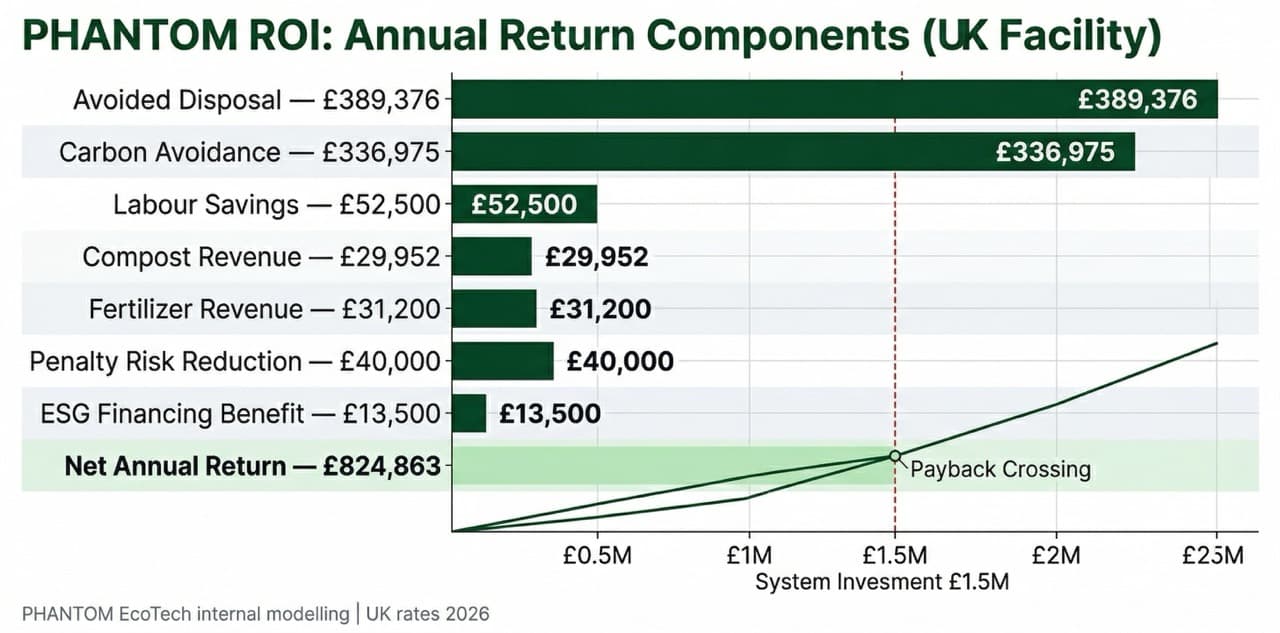
How Does the ROI Model Change by Region?
The dominant ROI driver differs by jurisdiction — disposal cost avoidance leads in the UK and Japan, labour and logistics lead in North America, scarcity pricing leads in Japan, and compliance future-cost positioning leads in the UAE — so the correct model weighting must be adjusted for each market.
Regional ROI weight by driver:
- UK / EU: Disposal avoidance (£156+/tonne) and carbon cost (EU/UK ETS) are primary; ESG penalty risk is secondary. Payback: 2–3 years.
- US Northeast: Disposal avoidance ($80+/tonne) and labour saving lead; carbon cost is emerging. Payback: 3–5 years.
- Japan: Highest absolute disposal cost globally ($200/tonne) combined with structural landfill scarcity (24.8 years national capacity remaining). Payback: 2–4 years.
- Dubai/UAE: Current disposal cost modest (AED 100/tonne); ROI is primarily a compliance future-positioning play ahead of mandatory escalation under Law No. 18 (2024) and Net-Zero 2050. Payback: 5–7 years on current rates, compressing as regulation tightens.
- Australia/Canada: High labour costs and long haulage distances (route optimisation savings 10–15%) drive the model alongside rising regional tipping fees.
Conditions: This regional weighting applies to facilities generating 3+ tonnes of treatable waste per day. For facilities below this threshold, the per-unit capital cost of a full-scale system may shift the calculation toward smaller-capacity variants (2m³, 1m³, 0.5m³ units) with correspondingly lower absolute returns but similar payback ratios.
Example: A slaughterhouse in rural Canada, 200km from the nearest landfill, at $55/tonne tipping fee, calculates haulage at approximately $0.047/tonne/mile × 400-mile round trip = $18.80/tonne in transport cost alone — pushing effective disposal cost to $73.80/tonne and making the ROI case comparable to a UK urban facility at £80/tonne nominal rate. Distance and logistics multiply the disposal cost figure significantly in geographically dispersed markets.
The ESG Score Multiplier: How Waste Management Credentials Reduce Borrowing Costs
A certified zero-emission on-site waste management programme contributes measurable ESG score improvement, which translates to 3–10 basis points of yield reduction on green bond issuance — a quantifiable, recurring annual saving on any significant debt facility.
The financial chain works as follows:
- Install certified on-site hydrolysis → verified zero-emission waste treatment credential established
- ESG score improves → waste and emissions metrics in CSRD/ISSB/TCFD reporting improve materially
- Green financing eligibility unlocked → green bond, sustainability-linked loan, or ESG-linked revolving credit facility becomes accessible
- Yield reduction realised → studies find 3–10bp yield reduction on ESG-rated corporate bonds; Federal Reserve study: 9bp statistically significant greenium
- Annual saving calculated → 9bp on a £15M debt facility = £13,500/year; 9bp on £100M = £90,000/year; compounding over 5–10 years of a bond's life
Conditions: This ESG financing benefit applies to companies with sufficient debt facility size to make basis-point reductions material (typically £10M+ in outstanding debt). For smaller facilities, the more relevant ESG financial benefit is supply chain contract access — 90% of S&P 500 companies now publish ESG reports and are cascading sustainability requirements to suppliers. A supplier without certified waste management credentials is increasingly ineligible to tender.
Example: A European manufacturing company with €50M in sustainability-linked loans tied to ESG milestones reduces its annual interest rate by 10bp after certifying on-site zero-emission waste treatment. Annual saving: €50,000 in reduced interest expense — permanently, for the life of the facility. The ESG certification cost is a one-time administrative exercise; the interest saving is annual and compounding.
Frequently Asked Questions
What is the typical payback period for a subcritical water hydrolysis system?
The typical payback period is 2–3 years in high-disposal-cost markets (UK, Japan, US Northeast) and 4–6 years in moderate-cost markets when all seven ROI variables are included.
- UK organic waste facility, 8 cycles/day: 1.8–2.5 years (full model)
- US Northeast mixed waste, 6 cycles/day: 3–4 years
- Japan industrial organic waste, 8 cycles/day: 2–3 years
- UAE mixed waste, 4 cycles/day: 5–7 years (current rates, compressing with regulation)
Applies to facilities generating 3+ treatable tonnes/day. Does not apply to predominantly inorganic waste streams (glass, metal, stone).
What hidden costs are most often missed in waste equipment ROI calculations?
The four most commonly omitted ROI components are: output revenue from saleable outputs, carbon cost avoidance at current ETS prices, risk-adjusted ESG penalty exposure, and the compounding annual escalation of disposal costs.
- Disposal-only models underestimate 5-year total returns by 40–60% in the UK
- Carbon avoidance at EU ETS rates is often larger in annual value than the disposal saving itself
- Supply chain contract access carries no defined financial penalty but binary revenue risk
- Annual disposal cost escalation of 10–22% means a static payback model becomes incorrect within 12 months
Does it make more financial sense to buy or lease a waste processing system?
Buying delivers higher long-term ROI; leasing delivers faster compliance and lower initial cash burden — choose based on your balance sheet position and regulatory deadline pressure.
- Buy (CAPEX): Asset ownership, no interest cost, full depreciation, highest 10-year ROI
- Lease (OPEX): Lower entry threshold, fully tax-deductible lease payments, no balance sheet debt
- Timing factor: For facilities facing imminent CSRD Wave 2 (FY2025 reporting) or UK SDR (from January 2026), leasing achieves compliance without a full capital commitment
- Cash flow factor: Leasing is preferable for facilities with constrained balance sheets or seasonal revenue cycles
How does the ROI calculation differ for medical and hazardous waste specifically?
Medical and hazardous waste ROI models carry a third revenue stream — avoided third-party incineration liability — that does not exist in standard organic waste calculations, typically adding £50,000–200,000/year in eliminated contract costs for mid-size healthcare facilities.
Additional ROI elements for medical waste:
- Eliminated incineration gate fees (UK: £100–300/tonne for clinical waste)
- Eliminated transport manifest compliance cost
- Eliminated pathogen liability insurance premium
- Regulatory risk reduction under Healthcare Act 2006 (UK) and RCRA (US)
Applies to: hospitals, clinics, dental practices, veterinary facilities generating infectious or sharps waste. Does not apply to: cytotoxic, radioactive, or chemical hazardous waste streams requiring specialist disposal regardless of treatment technology.
📎 Full TCO breakdown for healthcare: Infectious Medical Waste Non-Incineration Guide · Autoclave vs. Incineration vs. Hydrolysis 10-Year TCO
How does the ROI model apply to fishery and slaughterhouse wet waste?
Wet organic waste from fisheries and slaughterhouses generates proportionally higher liquid fertilizer output — with fish-derived amino acid hydrolysate commanding premium pricing of $400–800/tonne — making output revenue the leading ROI driver in this sector rather than disposal avoidance.
ROI model weighting for wet waste:
- Disposal avoidance: moderate (wet waste haulage is costly; odour regulations add compliance cost)
- Liquid fertilizer output: high (fish-derived amino acids are premium-priced agricultural inputs)
- Labour saving: high (wet waste handling is the most labour-intensive category in food processing)
- Carbon avoidance: high (wet organic waste in landfill has the highest methane generation rate)
📎 Sector-specific breakdown: Fishery and Slaughterhouse Wet Waste Treatment
Conclusion: Stop Calculating Losses. Install the Solution.
The correct answer to "When does this investment pay back?" in 2026 is: sooner than your current model shows — because your current model is missing at least four of the seven financial return variables, and every one of those variables is growing faster than inflation.
The strategic reality for CFOs in 2026:
- UK Landfill Tax is the highest it has ever been — with legislatively confirmed further increases in April 2027 and beyond
- EU/UK ETS carbon prices are on a trajectory to double by 2030 — making every year of delay a year of accruing larger future liability
- ESG penalties have crossed from reputational risk to quantified financial exposure — 5% of global turnover is a board-level number
- Supply chain access increasingly depends on certified waste management credentials that disposal contracts cannot provide
- Output revenue from compost, fertilizer, and fuel is growing alongside biofertilizer markets at 8–16% CAGR — meaning the revenue side of the equation improves every year too
The machines that pay back in 3 years at 2026 disposal and carbon rates will pay back in 18 months at 2028 rates — but only for the facilities that made the investment decision in 2026. For the full strategic compliance picture covering landfill tax, EPR escalation, CBAM timelines, and Scope 3 Category 5 documentation requirements, see: industrial waste treatment ROI and compliance — the complete UK manufacturing guide.
Before Your Next Board Meeting: Have You Calculated All 7 ROI Variables?
If any of these seven variables are uncalculated, your ROI model is incomplete. A full seven-variable model consistently shortens the apparent payback period by 30–50% versus the disposal-only calculation most facilities present to their boards.
All financial figures in this article are provided for illustrative and informational purposes only, based on publicly available market data at the time of publication. Actual ROI, payback periods, and disposal costs will vary based on waste stream composition, local market conditions, output quality, and regional regulatory environment. This article does not constitute legal, financial, or procurement advice. Use the PHANTOM machine ROI calculator for a live payback estimate, or contact Phantom Ecotech for a customised site-specific assessment. Currency conversion rate: ~1.27 USD/GBP at time of publication.