Article Series
What Is the UK Landfill Tax?
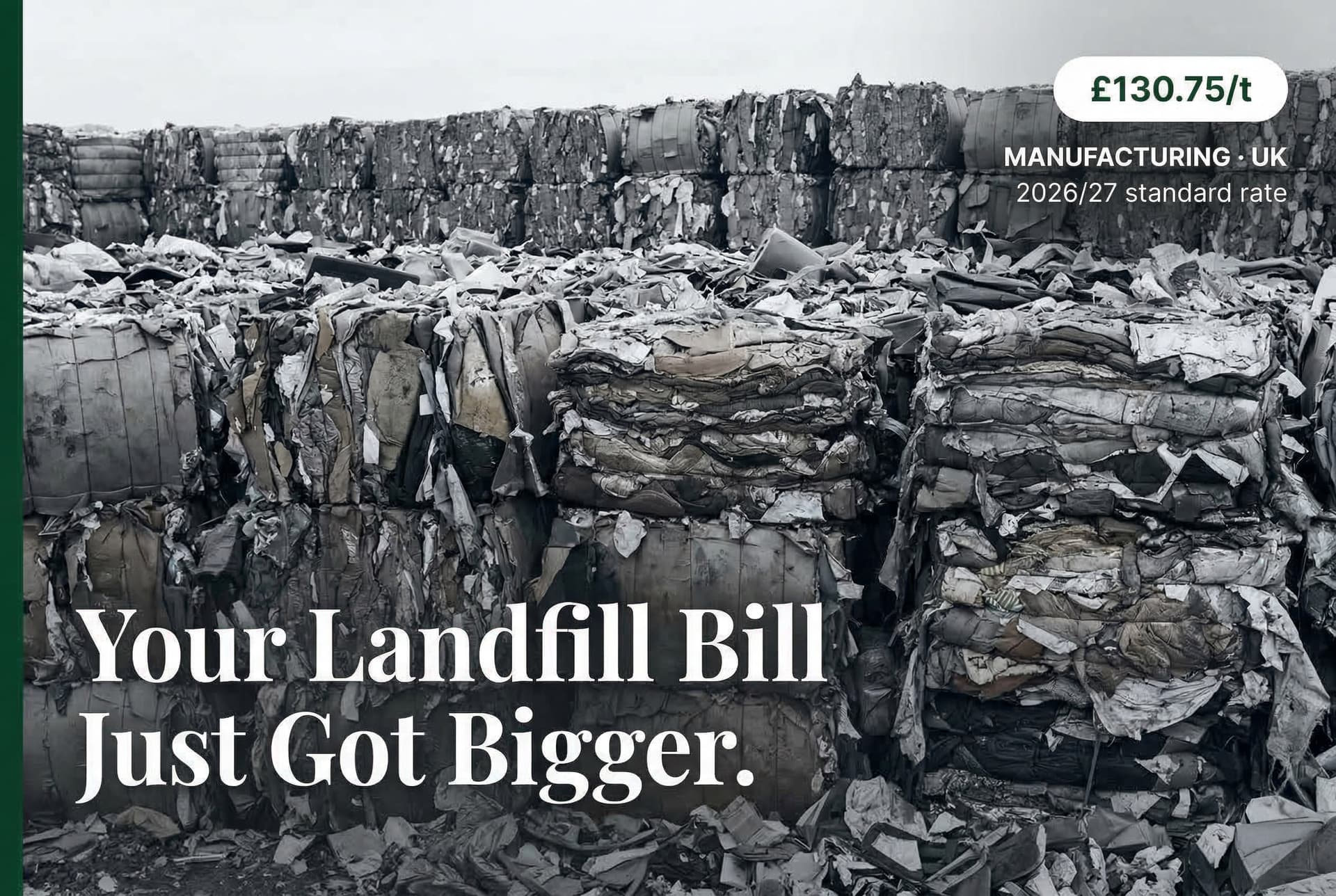
The UK Landfill Tax is an environmental excise duty charged on every tonne of waste disposed of at a permitted landfill site — set at £130.75/t (~$166/t) for standard-rate (active/biodegradable) waste in 2026/27, and £8.65/t (~$11.00/t) for lower-rate (inert) waste.
Three things to understand about how it works:
- Who is charged: landfill site operators (who hold an EA environmental permit) are the statutory taxpayer — but they pass the full cost to waste producers via the gate fee
- What triggers it: disposal of taxable waste at a permitted landfill site — not haulage, not storage, not treatment
- What reduces it: keeping waste out of landfill entirely via certified treatment routes (composting, AD, incineration-as-recovery, or on-site treatment)
Applies to: all UK waste producers sending active, biodegradable, or mixed industrial waste to permitted landfill sites.
Does NOT apply to: waste sent to permitted composting, anaerobic digestion, or material recovery facilities — treatment (not disposal) is outside the tax scope.
Example: A food manufacturer sending 200 tonnes/year of mixed organic waste to landfill pays approximately £26,150/year (~$33,211) in landfill tax alone — before gate fees, haulage, or contractor fees that bring the total to £41,000–57,000/year (~$52,070–72,390/year).
The UK Landfill Tax was introduced in 1996 as an environmental disincentive — the world's first such tax on waste disposal. Its original purpose was simple: make landfill expensive enough that businesses would seek alternatives. Three decades on, it has achieved its behavioural objective to a degree: UK landfill volumes have fallen sharply since peak years in the early 2000s. But for the waste streams that have no easy alternative route — mixed industrial organic waste, certain healthcare waste residues, contaminated process materials — the tax has become a significant and growing operational cost.
The 2025/26 increase of 21.6% in a single financial year was the largest in the tax's 30-year history. For any facility whose waste management strategy still relies on landfill as a primary or backup route, the financial trajectory is now clearly upward with no regulatory ceiling in sight.
Current Rates and Historical Trajectory
The rate history tells the story directly:
| Year | Standard rate | Lower (inert) rate | Year-on-year change |
|---|---|---|---|
| 2020/21 | £94.15/t (~$120/t) | £3.00/t (~$3.81/t) | — |
| 2022/23 | £98.60/t (~$125/t) | £3.15/t (~$4.00/t) | +2.3% |
| 2024/25 | £103.70/t (~$132/t) | £3.30/t (~$4.19/t) | +5.2% |
| 2025/26 | £126.15/t (~$160/t) | £4.05/t (~$5.15/t) | +21.6% — largest single-year rise |
| 2026/27 | £130.75/t (~$166/t) | £8.65/t (~$11.00/t) | +3.6% (std); +113.5% (lower) |
| 2027+ (projected) | £140–160/t (~$178–203/t) | TBC | Upward trajectory expected |
Source: HMRC Landfill Tax guidance / OBR Autumn Budget 2024.
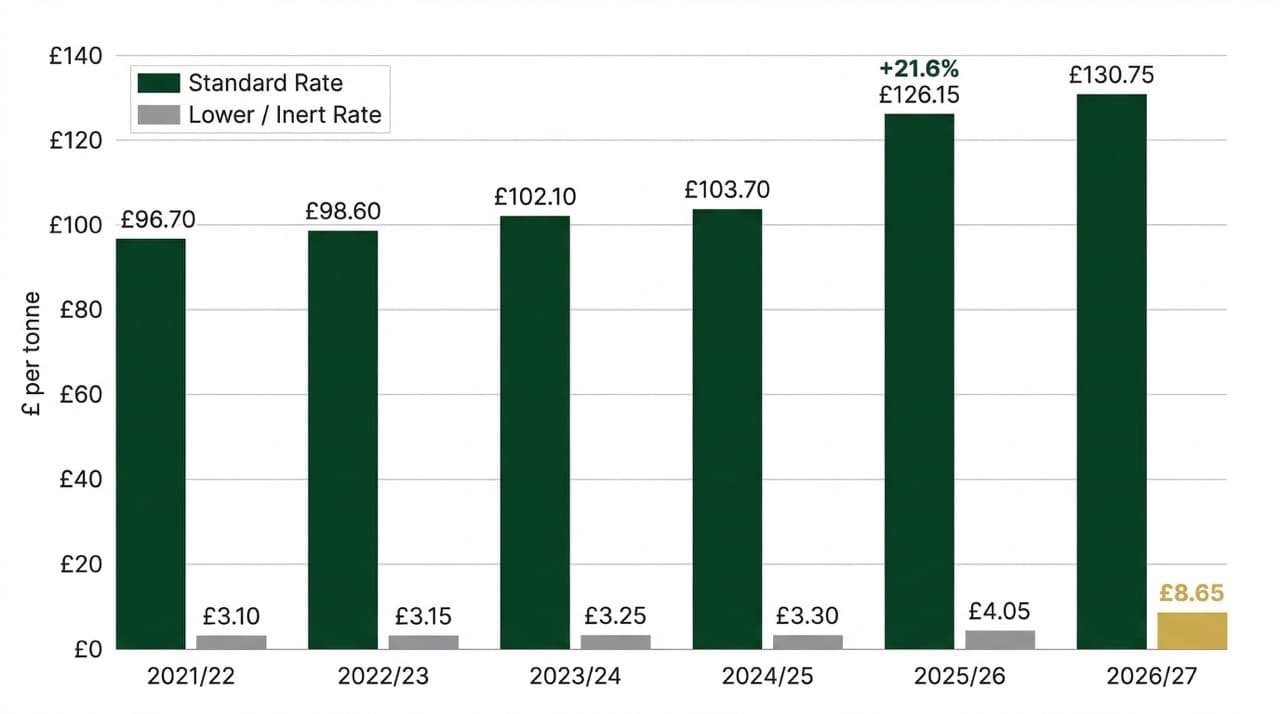
The 2025/26 single-year increase of 21.6% was confirmed in the Autumn Budget 2024 and exceeded every previous year-on-year rise by a substantial margin. The lower rate underwent an equally significant adjustment: the UK Government increased it to £8.65/t for 2026/27 — up from £4.05/t in 2025/26, a 113.5% rise — to prevent the price gap between standard and lower rates from widening to a degree that creates misclassification incentives. The stated policy rationale was two-fold: alignment with the Environmental Improvement Plan 2023 targets for diverting biodegradable waste from landfill, and closing the cost gap between landfill and alternative treatment routes that had narrowed due to energy-from-waste gate fee inflation.
The OBR projects continued increases. There is no regulatory mechanism that reduces the standard rate — only policy decisions that could accelerate it further. Facilities relying on landfill as a cost backstop are operating with an embedded and growing liability in their waste budgets. See the full PHANTOM vs Landfill cost analysis for the all-in 2026 disposal cost breakdown across waste stream types.
Who Pays the Landfill Tax — and Who Bears the Burden
The statutory obligation falls on landfill site operators — the entities holding EA environmental permits for permitted landfill sites. They are legally responsible for registering with HMRC, accounting for taxable disposals, and remitting the tax quarterly.
In practice, none of this matters to the waste producer. Operators pass the full tax through to customers in the gate fee. The waste producer — the manufacturer, hospital, food processor, construction firm, or agricultural business — bears the entire economic burden. The distinction between statutory taxpayer and economic burden bearer is important only in one context: HMRC enforcement and evasion liability, which is discussed below.
The all-in cost of landfill disposal in 2026, once all cost components are aggregated, is substantially higher than the tax rate alone suggests:
| Cost component | Per tonne (2026) |
|---|---|
| Landfill tax (standard rate) | £130.75/t (~$166/t) |
| Landfill gate fee | £20–40/t (~$25–51/t) |
| Haulage | £30–60/t (~$38–76/t) |
| Contractor margin and management | £15–30/t (~$19–38/t) |
| All-in total | £205–285/t (~$260–362/t) |
For comparison: on-site subcritical water hydrolysis treatment with PHANTOM operates at approximately £11–33/t (~$14–42/t) — roughly a 7–25x cost reduction on a per-tonne basis, without the tax liability, haulage cost, or contractor dependency.
HMRC investigation alert: HMRC actively investigates landfill tax evasion — including misdescription of waste (falsely classifying active or biodegradable waste as inert to pay the lower rate of £8.65/t instead of £130.75/t). Penalties include the full underpaid tax, interest, and a surcharge of up to 100% of the tax due. The Landfill Tax Compliance Programme has resulted in criminal prosecutions of both operators and the waste producers who knowingly submitted false descriptions. Waste producers who provide inaccurate descriptions to their contractor are not insulated from liability.
Who Is Exempt
The exemptions from UK Landfill Tax are narrow and specific. Most industrial, commercial, and medical waste streams fall squarely within the standard rate.
The recognised exemptions covering common waste streams are:
- Dredging waste: waste from the dredging of inland waterways, canals, harbours, rivers, and estuaries — exempt where the dredging is carried out to maintain or improve the waterway
- Naturally occurring rock and soil: inert material extracted during construction, mining, or quarrying operations — exempt where it meets the inert definition and goes to permitted restoration activities
- Pet cemeteries: small-scale pet burial — a narrow and largely administrative exemption
- Inert waste at the lower rate: rocks, concrete, bricks, ceramics, and other genuinely inert materials that qualify for the £8.65/t (~$11.00/t) lower rate rather than the standard rate
Materials that do not qualify for exemption or the lower rate, regardless of how they are described, include: mixed organic waste, food processing waste, municipal solid waste, healthcare waste residues, agricultural waste, and mixed industrial waste containing any biodegradable fraction. Attempting to characterise these streams as inert to access the lower rate is the misdescription offence prosecuted by the Landfill Tax Compliance Programme.
How to Reduce or Eliminate Landfill Tax Liability
There are five substantive routes to reducing or eliminating landfill tax liability, ranging from operational changes to technology investment.
1. Source reduction: waste that is not generated cannot be taxed. Lean manufacturing, process optimisation, and input substitution all reduce the quantum of waste requiring disposal. This is the waste hierarchy's top tier for a reason — it avoids the cost entirely rather than managing it.
2. Reuse: materials reused within the operation, or passed to a reuse recipient without disposal, do not trigger landfill tax. Internal reuse programmes — particularly for packaging, pallets, and process materials — can remove significant tonnages from the taxable stream.
3. Recycling and material recovery: waste sent to permitted composting, anaerobic digestion (AD), or material recovery facilities is not subject to landfill tax. The gate fees at these facilities (typically £40–120/t (~$51–152/t)) are materially lower than the all-in landfill cost of £205–285/t (~$260–362/t).
4. On-site treatment via hydrothermal processing: PHANTOM subcritical water hydrolysis converts organic waste into sterile outputs that can pursue end-of-waste classification under EA Quality Protocol or PAS 110 assessment — removing material from the taxable waste stream at the point of treatment. Because the output is no longer legally classified as waste (once end-of-waste status is achieved), it cannot attract landfill tax on any subsequent movement. Operating cost approximately £11–33/t (~$14–42/t) versus £205–285/t all-in landfill. See the PHANTOM organic waste treatment machine for throughput specifications, footprint data, and ROI modelling by facility type.
5. Incineration-as-recovery (energy-from-waste): facilities operating as recovery (R1 operation classification) rather than disposal (D10) are not subject to landfill tax — but they incur gate fees of £80–180/t (~$102–229/t) and growing EU ETS carbon costs from 2028 as the UK ETS expands. The carbon trajectory makes energy-from-waste a transitional rather than permanent solution. See PHANTOM vs Incineration for the 10-year financial comparison.
For a facility-specific ROI calculation comparing current landfill costs against on-site treatment — including capital payback period, OPEX delta, and carbon cost avoidance — see the industrial waste processing machine ROI guide or request a free site assessment. Once all landfill routes are eliminated, Zero Waste to Landfill certification provides the independently audited claim that CSRD disclosures, supplier questionnaires, and procurement requirements rely on.
For the underlying legal obligations that make every waste producer liable for their entire disposal chain — including carrier authorisation and consignment note requirements — see UK waste generator duty of care and landfill tax liability.
The CSRD Scope 3 Dimension
The landfill tax creates a direct cash cost. From 2025, it also creates an indirect but growing financial liability through mandatory climate reporting.
Under the Corporate Sustainability Reporting Directive (CSRD), companies above EU disclosure thresholds are required to report Scope 3 greenhouse gas emissions — including Category 5 (waste generated in operations). Landfill creates two separate GHG liabilities: carbon dioxide from the decomposition of organic material, and methane from anaerobic decomposition in the landfill body. Methane has a global warming potential of 84× CO₂ over a 20-year horizon (GWP20, IPCC AR6). A tonne of organic food waste landfilled generates approximately 0.5–0.8 tonnes of methane over its decomposition lifetime — equivalent to 42–67 tonnes CO₂e on a GWP20 basis.
This means a facility sending 500 tonnes/year of organic waste to landfill carries:
- A direct cash cost of approximately £102,500–142,500/year (~$130,175–180,975/year) in landfill tax alone
- A Scope 3 Category 5 disclosure liability of approximately 21,000–33,500 tonnes CO₂e/year — which, under internal carbon pricing at £50–100/tCO₂e, represents a notional cost of £1.05–3.35 million/year (~$1.33–4.25 million/year)
The cash cost is real and immediate. The carbon cost is disclosed and subject to investor scrutiny, ESG rating penalties, and — as carbon pricing matures — future regulatory exposure. The combination means landfill is increasingly mispriced at the invoice level: the £205–285/t gate fee reflects only the immediate disposal cost, not the full financial and reputational liability.
CSRD reporting applies to large EU-listed companies and large non-EU companies with significant EU turnover from financial years beginning on or after 1 January 2025. UK companies operating under the UK Sustainability Disclosure Standards (SDS) framework face equivalent Scope 3 reporting requirements with similar timelines. Both frameworks require third-party assurance of GHG data from 2028.
For the full Scope 3 analysis — including calculation methodology for waste-generated emissions, CSRD Category 5 reporting requirements, and the avoided-emissions value of on-site treatment — see manufacturing waste carbon footprint and Scope 3 reporting.
For facilities evaluating zero-landfill strategies across multiple waste streams simultaneously, see zero-emission industrial waste treatment for the complete technology and compliance picture.
Frequently Asked Questions
The UK standard landfill tax rate for 2026/27 is £130.75 per tonne (~$166/t), covering active and biodegradable waste. The lower rate for inert/inactive waste is £8.65/t (~$11.00/t) — more than doubling from £4.05/t in 2025/26. The 2025/26 single-year increase of 21.6% (from £103.70 to £126.15/t) was the largest standard-rate rise in the tax's history, confirmed by HMRC and the OBR Autumn Budget 2024.
The landfill tax is technically levied on landfill site operators (who hold an EA environmental permit). However, operators pass the full cost to waste producers via the landfill gate fee. The waste producer — manufacturer, hospital, farm, food processor — ultimately bears the entire tax burden as part of their disposal contract cost.
Exemptions include: waste from dredging of rivers, canals, and harbours; naturally occurring rocks and soils extracted during construction or quarrying operations; pet cemeteries (small scale); and inert waste qualifying for the lower rate (£8.65/t in 2026/27). Active, biodegradable, and mixed industrial waste pays the standard rate (£130.75/t in 2026/27). Attempting to misclassify active waste as inert to access the lower rate is a criminal offence under the Landfill Tax Compliance Programme.
The most effective route is eliminating waste sent to landfill entirely via on-site treatment. PHANTOM subcritical water hydrolysis converts organic waste into sterile outputs that can pursue end-of-waste classification — removing them from the waste stream legally. The operating cost is approximately £11–33/t (~$14–42/t), versus £205–285/t all-in landfill cost. See the PHANTOM ROI guide for a facility-specific calculation, or request a free site assessment via the contact page.
Sources: HMRC Landfill Tax guidance; OBR Autumn Budget 2024; Environmental Protection Act 1990; Environmental Permitting (England and Wales) Regulations 2016; IPCC Sixth Assessment Report (AR6) GWP values; CSRD (EU Directive 2022/2464); UK Sustainability Disclosure Standards framework.
Figures are for informational purposes only and do not constitute legal, financial, or procurement advice. Disposal rates based on UK 2026 industry averages. ~1.27 USD/GBP.