Article Series
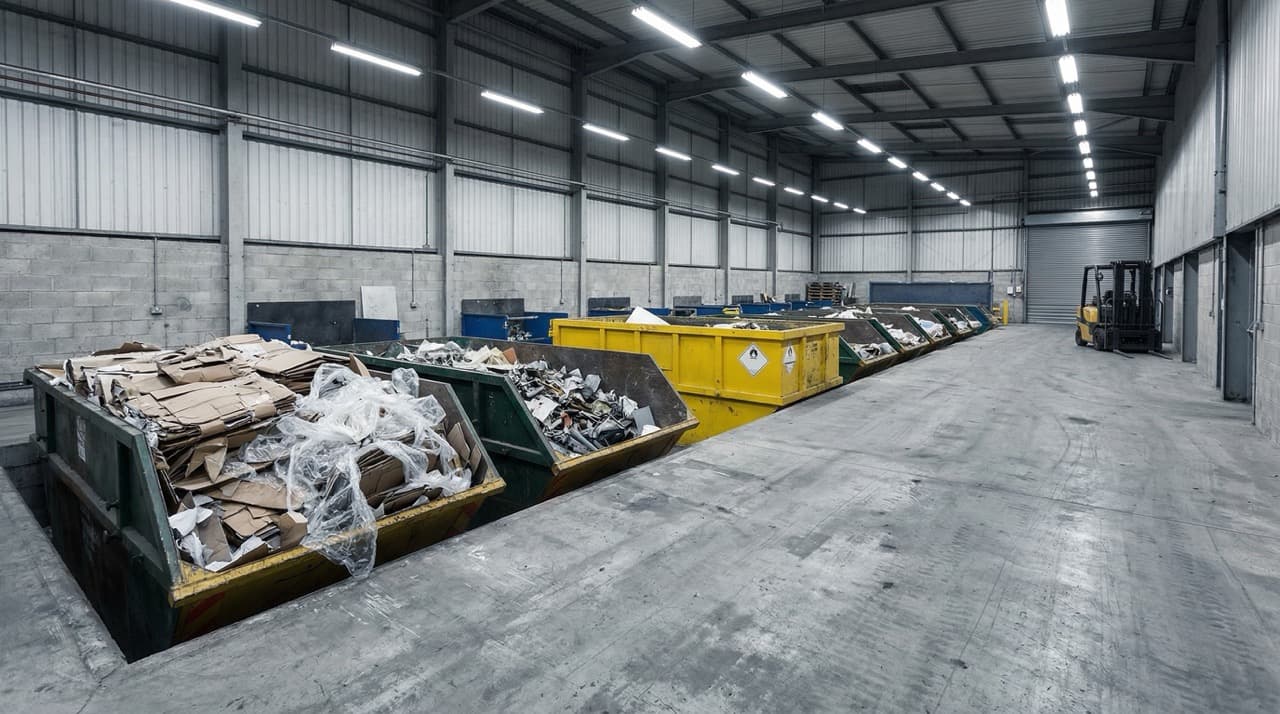
UK manufacturers generating mixed plastic, industrial organic, oil sludge, and hazardous waste are now paying landfill tax at £126.15/tonne (~$160/tonne), EPR compliance fees, PRN costs, and emerging CBAM exposure — simultaneously, on the same waste streams, with no verified data to challenge any of it. The problem is not the size of any individual fee. It is that they compound.
UK manufacturers generating mixed plastic, industrial organic, oil sludge, and hazardous waste are now paying landfill tax at £126.15 per tonne, EPR compliance fees, PRN costs, and emerging CBAM exposure — simultaneously, on the same waste streams, with no verified data to challenge any of it. The starting point for resolving all of them in a single capital decision is understanding PHANTOM industrial waste treatment machine — and what on-site subcritical water hydrolysis does to every line in your waste disposal budget.
This article is part of the Zero-Emission Industrial Waste Treatment series — covering non-combustion waste treatment across industrial, manufacturing, and regulatory contexts.
Before reading further: Use the calculator below to estimate your current Scope 3 waste carbon baseline and total annual non-compliance exposure — including landfill tax, EPR fees, and projected CBAM liability.
Manufacturing Waste Carbon Cost Calculator
Estimate your Scope 3 Category 5 baseline and total annual compliance exposure — including landfill tax, EPR fees, and projected CBAM liability.
What Is the Real Annual Cost of Manufacturing Waste Disposal in the UK Right Now?

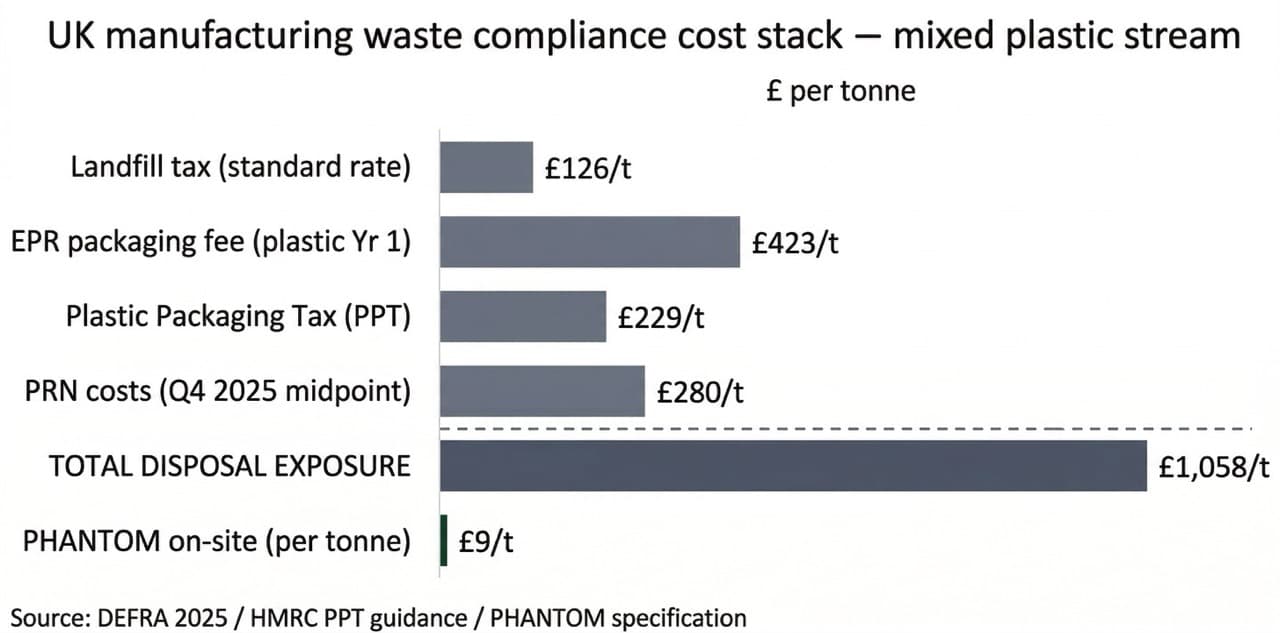
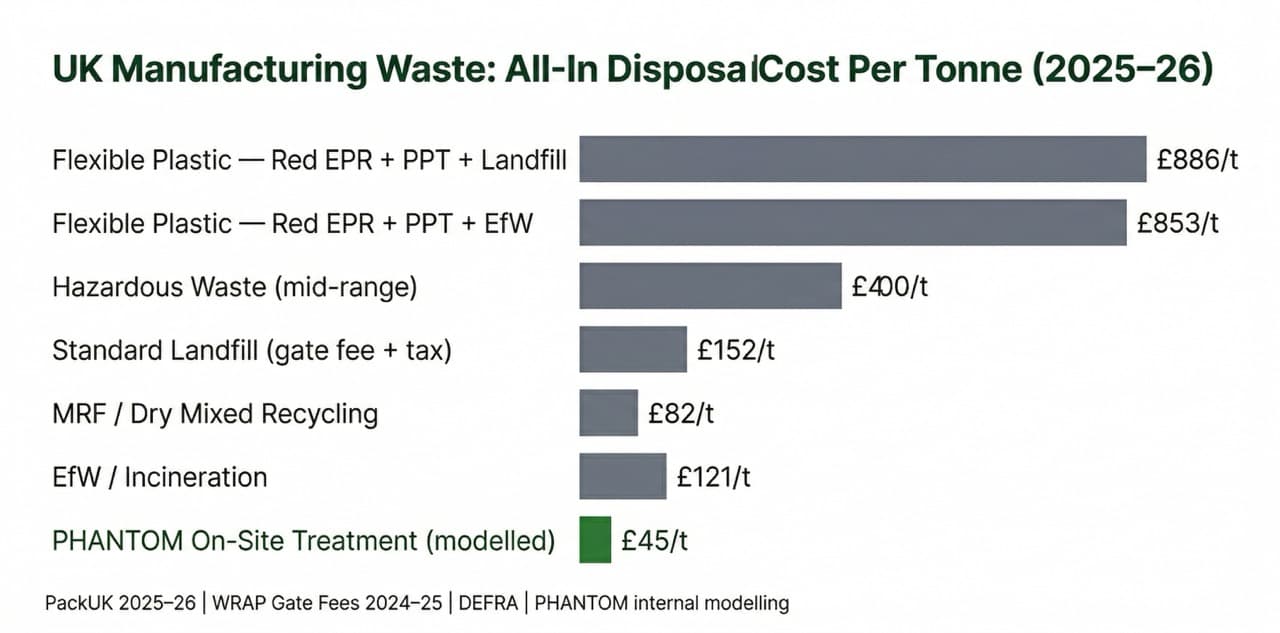
The combined cost of waste disposal for a UK manufacturer generating mixed plastic, organic, and hazardous streams now runs between £150 and £1,134/tonne (~$190–$1,440/tonne) depending on stream classification — and the upper figure is confirmed policy, not a projection.
- Landfill (standard rate): £126.15/tonne (~$160/tonne) tax + ~£26/tonne gate fee = approximately £152–£175/tonne (~$193–$222/tonne) total
- EPR packaging fee (plastic, Year 1): £423/tonne (~$537/tonne) confirmed; rising to £415–£545/tonne in Year 2 depending on recyclability rating
- Plastic Packaging Tax (PPT): £228.82/tonne (~$291/tonne) (2026/27) — applies to packaging with less than 30% recycled content
- PRN costs (plastic): £62–£440/tonne (~$79–$559/tonne) (market-driven; averaged £200–£360 in Q4 2025)
- Hazardous waste specialist disposal: £40–£600/tonne (~$51–$762/tonne) depending on classification
- Energy-from-waste gate fee: £103–£110/tonne (~$131–$140/tonne) median
This applies when a manufacturer places plastic packaging on the market and disposes of non-recyclable waste to landfill or energy recovery — the standard operational reality for most mixed-stream manufacturing sites. It does not apply if all output packaging contains ≥30% certified recycled content, all waste streams are fully recycled, and no residual fractions require disposal.
Scenario: A mid-scale FMCG manufacturer in the Midlands generating 400 tonnes of mixed plastic packaging waste annually and 200 tonnes of organic process sludge sent to landfill. Estimated annual disposal cost at current rates: plastic packaging obligations alone exceed £253,800 (~$322,326) (EPR + PPT + PRN at midpoint); organic sludge to landfill adds £30,430 (~$38,646) in tax plus gate fees. Total regulatory disposal burden: approximately £300,000 (~$381,000) per year before collection, haulage, or compliance administration.

How Is the UK EPR Fee Escalation Structured — and When Does It Become a CapEx-Level Decision?
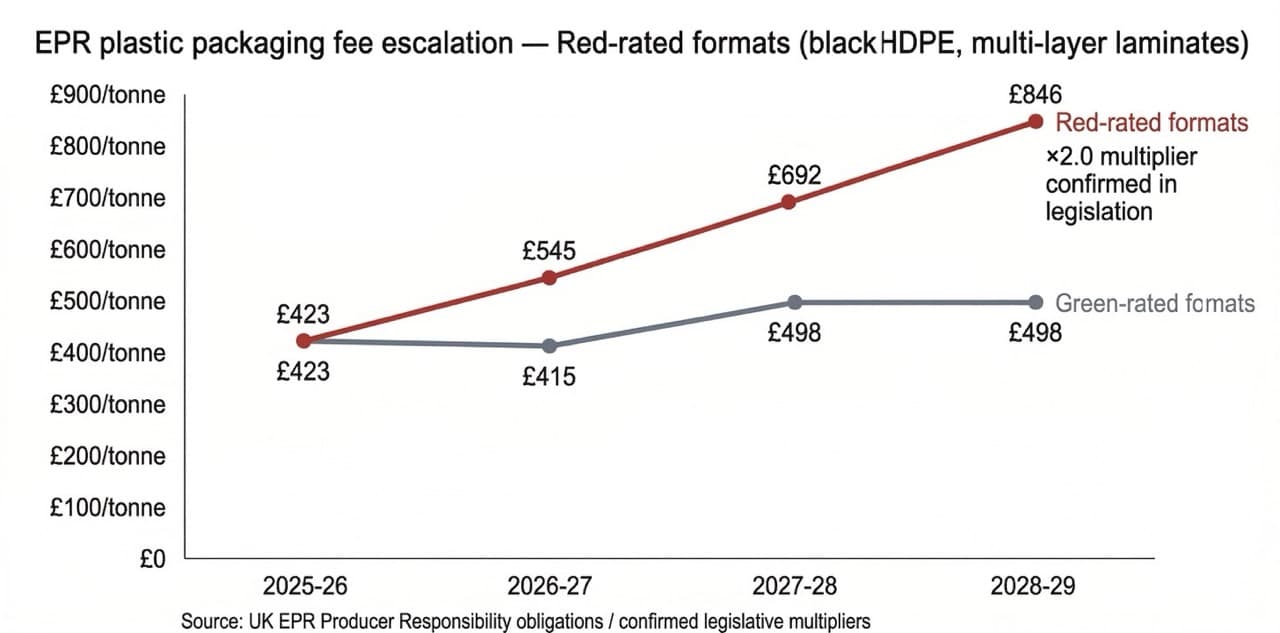
EPR fees for plastic packaging will double for non-compliant formats by 2028–29 under a confirmed legislative multiplier — making waste treatment investment a CapEx decision, not an ongoing operational cost management problem.
- Year 1 (2025–26): Flat rate £423/tonne (~$537/tonne) for all plastic — no recyclability modulation
- Year 2 (2026–27): Modulated rates introduced — Green (£415/t), Amber, Red (£545/t) based on OPRL recyclability assessment
- Year 3 (2027–28): Red-fee multiplier reaches ×1.6 on the base rate
- Year 4 (2028–29): Red-fee multiplier reaches ×2.0 — effectively doubling the disposal obligation for non-compliant packaging formats
- PPT change from April 2027: Pre-consumer (post-industrial) waste no longer counts toward the 30% recycled-content threshold — increasing tax exposure for manufacturers relying on factory offcuts

This applies when a manufacturer produces or handles packaging that fails the OPRL recyclability assessment — which includes most black plastics, multi-layer laminates, and composite formats. It does not apply if the manufacturer has already redesigned packaging to Green-rated formats or has shifted to on-site treatment that removes the material from the EPR disposal reporting chain entirely.
Scenario: A food manufacturer using black HDPE trays classified Red under OPRL. Current EPR cost: £423/tonne (~$537/tonne). By 2028–29: £846/tonne (~$1,074/tonne) (×2.0 multiplier). On 500 tonnes of plastic packaging waste annually, this represents a shift from £211,500/year (~$268,605/year) to £423,000/year (~$537,210/year) — a £211,500 (~$268,605) annual increase confirmed in primary legislation. At that run rate, the CapEx threshold for on-site treatment investment justifies itself within 18–24 months on EPR alone.
The full breakdown of how EPR, PPT, and PRN stack for a typical UK plastic packaging producer — and why mechanical recycling cannot resolve it — is covered in UK EPR 2025: Mixed Plastic Waste Compliance Costs Explained. For the legal foundation that governs every waste disposal decision — duty of care under Section 34 EPA 1990, carrier authorisation, consignment notes, and penalty exposure — see UK waste generator duty of care obligations.
How Does the UK CBAM Create Financial Exposure for Manufacturing Waste Specifically?
The UK CBAM takes full financial effect from 1 January 2027 for aluminium, cement, fertilisers, hydrogen, and iron and steel — and creates indirect waste-related financial exposure through Scope 3 Category 5 gaps that CBAM-adjacent auditors will scrutinise. For a detailed breakdown of what CBAM verified data requires and how to build a defensible Category 5 baseline, see our Scope 3 waste emissions reporting guide for UK manufacturers.
- Launch date: 1 January 2027 — full financial liability from Day 1, no transitional period
- First return and payment due: 31 May 2028 (covers full calendar year 2027)
- Sectors in scope: aluminium, cement, fertilisers, hydrogen, iron and steel (glass and ceramics excluded at launch)
- Default values: Available when verified supplier data cannot be obtained — no penalty surcharge for using them, but manufacturers with lower-carbon supply chains overpay under defaults
- De minimis threshold: £50,000 import value annually — estimated to exempt 80% of otherwise-affected importers
The indirect exposure: CBAM verification for aluminium and steel inputs will prompt auditors to examine the full carbon accounting of a manufacturer's operations — including how waste streams are treated and whether Scope 3 Category 5 emissions are measured at stream level. A manufacturer using DEFRA's generic C&I average factor (467 kg CO₂e/tonne for landfill) across all waste types, rather than stream-specific measurement, will face credibility challenges during the supply chain due diligence process CBAM creates.
What Does Scope 3 Category 5 Reporting Actually Require From a UK Manufacturer Today?
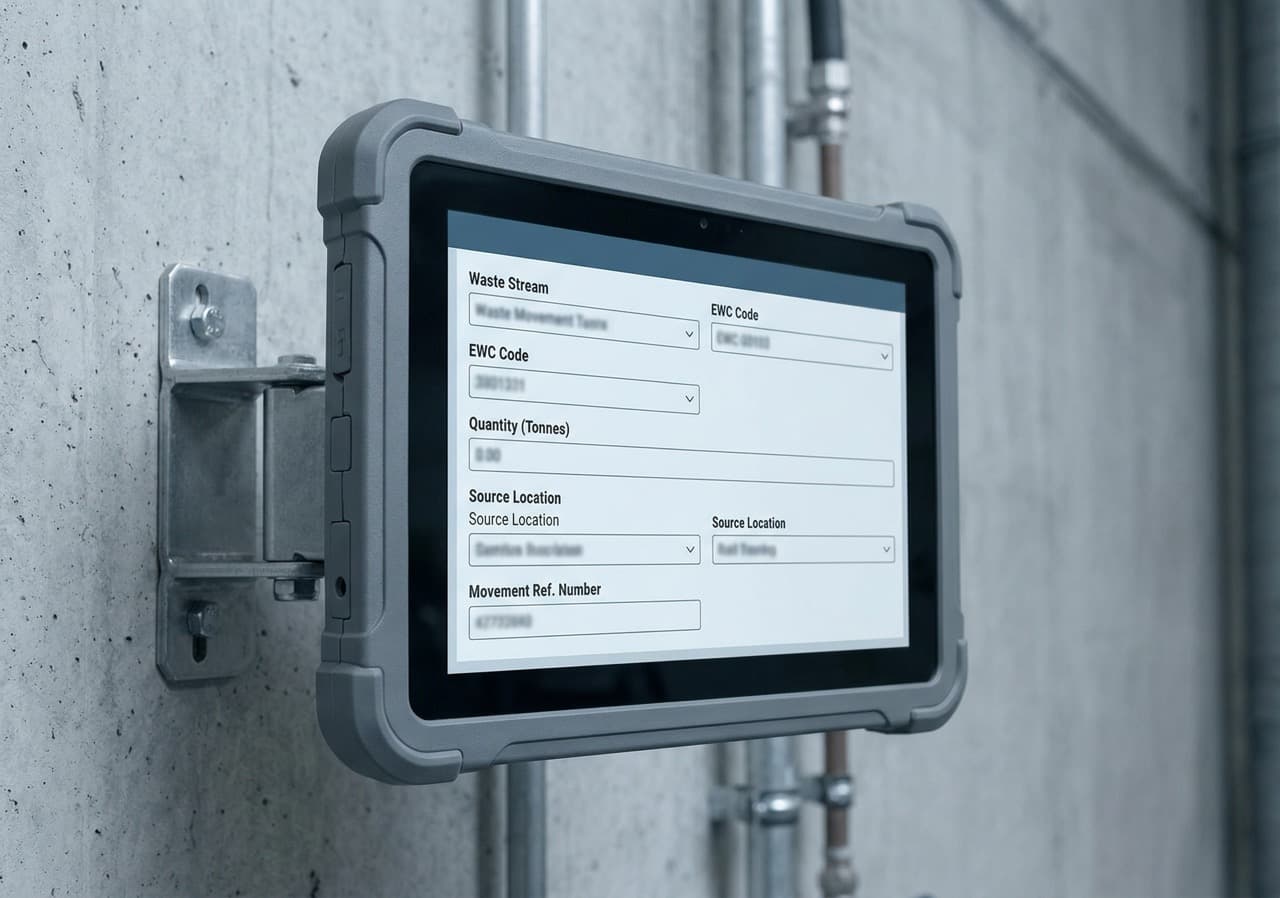
As of 2026, full Scope 3 reporting is not yet legally mandated for most UK manufacturers — but it is effectively required for government contractors, is scheduled as comply-or-explain for listed companies from 2028, and is already scrutinised in TCFD disclosures.
- SECR (mandatory): Scope 1 and 2 only, plus business travel. Applies to large unquoted companies meeting two of three thresholds: ≥250 employees, ≥£36m turnover, ≥£18m balance sheet
- TCFD (mandatory for qualifying entities): Meaningful climate risk assessment effectively requires value-chain data including Category 5. Applies to entities >500 employees that are publicly traded or large UK-registered with >£500m turnover
- UK SRS (voluntary from February 2026, comply-or-explain mandatory from 2028 for listed companies): ISSB-aligned S2 standard covers Scope 3 on comply-or-explain basis
- Government procurement (mandatory now): Companies bidding for contracts >£5m/year must publish a Carbon Reduction Plan covering five Scope 3 categories including waste, under PPN 06/21
This applies when a manufacturer is either subject to TCFD disclosure requirements, bidding for qualifying government contracts, or preparing for UK SRS voluntary adoption. It does not apply to small or medium-sized businesses below SECR thresholds with no government contract exposure.
Scenario: A Tier 1 automotive components manufacturer with 600 employees supplying to a listed OEM under TCFD disclosure. Their customer's TCFD submission requires upstream Scope 3 data including Category 5. The manufacturer's waste disposal records show four disposal routes, none measured by stream. The customer's procurement team flags this as an audit gap. The manufacturer is given 90 days to produce stream-level waste carbon data. They have none.
For the full GHG balance by disposal route — including how DEFRA factors apply per stream and where EfW attribution gaps distort corporate Scope 3 reports — see: Manufacturing Waste: Carbon Footprint Impact.
What Are the DEFRA Emission Factors for Industrial Waste — and Where Do They Leave Oil Sludge and Hazardous Streams?
DEFRA's 2025 GHG conversion factors provide stream-specific emission intensities for most industrial waste types — but oil sludge and hazardous waste have no specific factors, forcing manufacturers onto a generic proxy that overstates landfill emissions and cannot satisfy a CBAM auditor.
| Waste type | Landfill (kg CO₂e/tonne) | Combustion/EfW (kg CO₂e/tonne) |
|---|---|---|
| Mixed plastics | ~8.88 | ~21 (transport only — see note) |
| Industrial organic/food | ~580–630 | ~21 (transport only — see note) |
| Commercial & industrial (general) | ~467 | ~21 (transport only — see note) |
| Oil sludge | No specific factor | No specific factor |
| Hazardous waste (generic) | No specific factor | No specific factor |
Critical note on incineration/EfW factors: DEFRA's ~21 kg CO₂e combustion figure covers only transport to the facility. Real-world energy-from-waste combustion emits approximately 477 kg fossil CO₂e per tonne at plant level — but under GHG Protocol methodology, those emissions are attributed to the energy producer, not the waste generator. This makes incineration appear far cleaner than landfill in corporate Scope 3 reports, which can distort treatment route decisions.
This applies to any manufacturer completing SECR, TCFD, or voluntary GHG reporting using the GHG Protocol methodology. It does not apply if using a bespoke life-cycle assessment from an accredited third party — though even bespoke assessments reference DEFRA factors as the UK benchmark.
Scenario: A chemical manufacturer generating 80 tonnes of oil sludge per quarter. Their sustainability team attempts to calculate Category 5 emissions for their annual TCFD disclosure. DEFRA has no oil sludge factor. They fall back to the generic C&I average of 467 kg CO₂e/tonne. Their reported Category 5 figure is unverifiable. An investor ESG analyst queries it. The company has no defensible methodology on record.
In My Experience: The Budget Conversation Nobody Wants to Have Until It's Too Late
I've sat in enough sustainability reviews to know the moment when waste stops being an operational line item and becomes a board-level problem. It's usually not a regulatory announcement. It's a procurement renewal.
A facilities and sustainability director I work with — a 900-employee precision engineering manufacturer near Sheffield — came to me after their largest customer (a listed Tier 1 automotive group) requested a full Scope 3 breakdown as part of a supplier re-qualification exercise. The manufacturer had four waste disposal contractors across three sites. None of them reported by stream. The total waste carbon figure their team submitted was a single estimated number based on total weight and the generic C&I DEFRA factor. The customer's sustainability audit rejected it within 48 hours. It wasn't wrong by much. But it couldn't be verified. And unverifiable is the same as wrong in an ESG audit.
The conversation that followed wasn't about emission factors. It was about what it would take to get the data. The answer — across four contractors, three sites, and six waste types — was expensive, slow, and still wouldn't produce verified stream-level figures because third-party disposal tracking stops at the gate.
The manufacturer is now in the evaluation phase for on-site treatment. Not because of the carbon data. Because of what the carbon data conversation revealed: they were paying £164/tonne (~$208/tonne) to dispose of organic process waste that they had never measured, could not optimise, and could not justify to any external verifier.
For a full ROI analysis of on-site waste treatment investment — including CapEx payback, disposal cost avoidance, output revenue, and Scope 3 reduction documentation value — see: ROI of an Industrial Waste Processing Machine: A CFO's Complete Guide.
What Does On-Site Subcritical Water Hydrolysis Actually Change About the Cost Stack?

On-site subcritical water hydrolysis eliminates landfill tax, EPR disposal cost, incineration gate fees, and third-party collection charges simultaneously — replacing all of them with a single documented on-site treatment cycle that generates verified Scope 3 reduction data as a byproduct.
- Landfill tax at £126.15/tonne (~$160/tonne): eliminated — no waste leaves site to landfill
- EPR disposal fees (waste fraction): eliminated — treated on-site, removed from EPR reporting obligation
- Incineration/EfW gate fees (£103–£110/tonne): eliminated
- PRN costs on residual plastic: reduced — depending on output classification
- Scope 3 Category 5: documented — each treatment cycle generates mass-in/mass-out data per stream, producing the verified Category 5 baseline that CBAM auditors and TCFD reviewers require
Operating costs: kerosene boiler fuel per cycle. PHANTOM's published specification shows approximately £26–£28 (~$33–$36) per 3-tonne cycle. No stack emissions from the processing vessel. For the chemistry of how subcritical water breaks down organic and plastic waste streams, see: What Is Subcritical Water Hydrolysis?.
This applies to manufacturers generating mixed organic, soft tissue, plastic, oil sludge, food waste, and similar hydrolysable streams in sufficient volume to justify on-site unit economics. It does not apply to inert materials — glass, metal, stone — which pass through the system unchanged and must be separated prior to input.
Scenario: A meat processing facility in Yorkshire generating 2.5 tonnes of organic process waste per operating day (~900 tonnes annually). Current disposal: organic waste contractor + landfill tax = ~£152/tonne (~$193/tonne) × 900 = £136,800 (~$173,736)/year. Post-PHANTOM installation: operating cost ~£26–£28/cycle. Output: liquid fertiliser and sterile compost. Landfill tax liability: £0. Third-party contractor cost: £0. Scope 3 Category 5 data: fully documented per cycle.
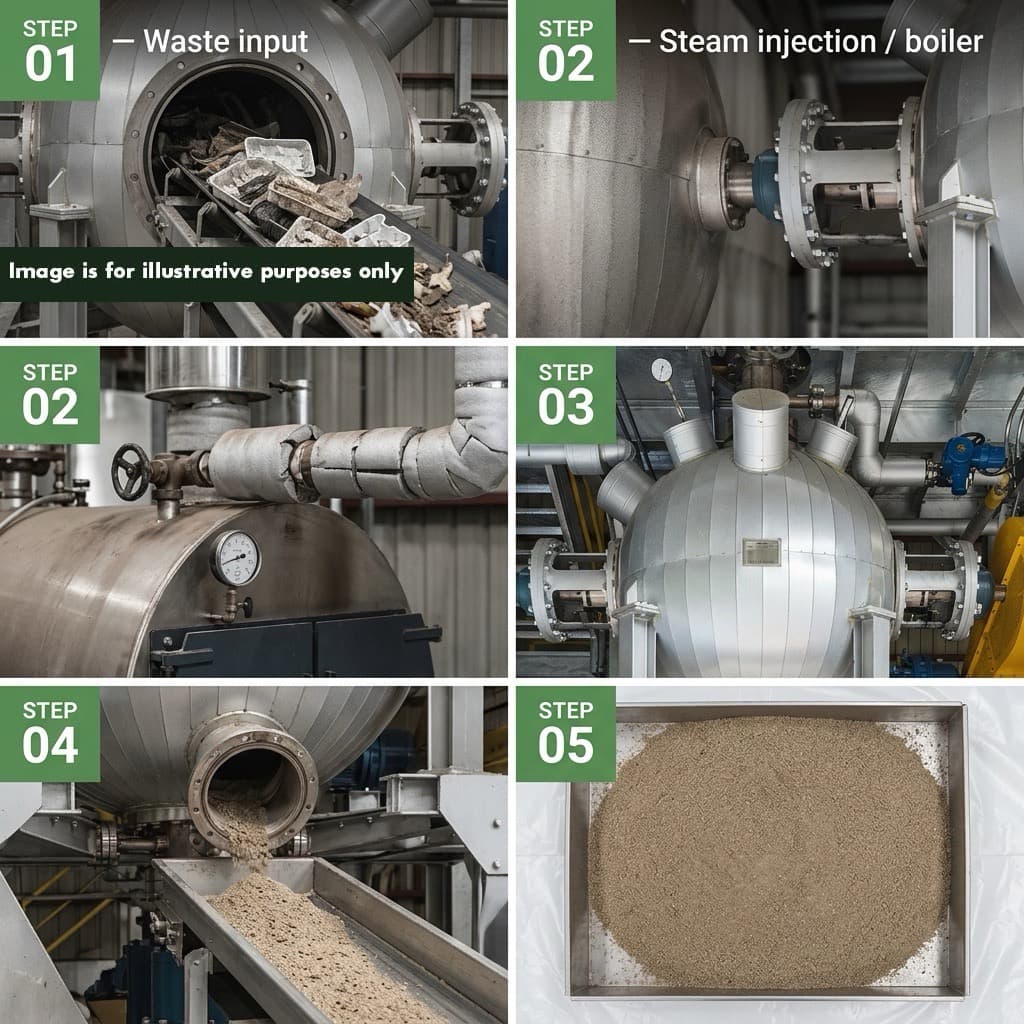
How on-site SWH eliminates the cost stack — 5-step physical sequence
Why Your Disposal Costs Keep Rising — No Matter What You Change
You now understand the UK's waste regulatory stack — landfill tax, EPR fees, PRN costs, and approaching CBAM verification requirements — creating a compounding cost burden that no single contract renegotiation or disposal route switch can resolve.
Here is why it keeps happening. Operators who switch disposal contractors, renegotiate gate fees, or improve segregation at source reduce costs temporarily — but remain exposed to the next regulatory rate change because the root cause is untouched. The root cause is this: UK manufacturers are paying all four obligations simultaneously not because on-site treatment is unavailable, but because waste has never been measured at stream level. Without stream-level mass data, no disposal route can be optimised, no DEFRA emission factor accurately applied, and no CBAM auditor will accept the Category 5 figure.
That is the problem PHANTOM's subcritical water hydrolysis process is designed to eliminate at the root. By replacing third-party disposal with pressurised hot water chemistry on-site, each processing cycle converts the waste stream from an unmanaged multi-fee liability into a single documented treatment event — producing stream-level mass data as a byproduct. The result: landfill tax eliminated, EPR disposal cost removed, Scope 3 Category 5 documented, and CBAM verification exposure resolved. Not incrementally improved. Structurally eliminated.
Conclusion
UK manufacturing waste compliance is no longer a back-of-house cost management question. It is a board-level liability with confirmed escalation curves, a CBAM audit exposure timeline starting January 2027, and a Scope 3 disclosure mandate approaching from 2028. The manufacturers who resolve it as a capital investment decision — rather than renegotiating disposal contracts year by year — are the ones who will arrive at those deadlines with verified data, zero landfill exposure, and a documented carbon reduction trail.
Every compliance decision framework described here, and every article in this cluster, points toward the same conclusion: the subcritical water hydrolysis machine is not a waste treatment purchase. It is the infrastructure that makes every other compliance decision simpler, cheaper, and auditable. Facilities that eliminate landfill entirely can formalise that achievement through CIWM or Valpak — see Zero Waste to Landfill certification UK for the certification pathway and CSRD reporting implications.
Manufacturing Waste Reduction UK — Full Resource Hub
All guides, compliance tools, and cost analyses for UK manufacturers
Frequently Asked Questions
The standard rate rose to £126.15/tonne (~$160/tonne) from April 2025, up 28% from £98.60/tonne in 2022. Combined with gate fees, total landfill cost runs £130–£152/tonne (~$165–$193/tonne). From 2028, waste incinerators enter the UK ETS, projected to add £20–£100/tonne to energy-from-waste gate fees on top of current rates.
The UK Carbon Border Adjustment Mechanism takes full financial effect from 1 January 2027, covering aluminium, cement, fertilisers, hydrogen, and iron and steel. The first return and payment is due 31 May 2028. There is no transitional period — financial liability applies from Day 1, with default values available for unverified supply chain data.
Year 1 (2025–26) charges a flat rate of £423/tonne (~$537/tonne) for all plastic packaging. Year 2 (2026–27) introduces modulated rates based on OPRL recyclability. By Year 4 (2028–29), Red-rated formats (black plastics, multi-layer laminates) reach a ×2.0 multiplier, doubling the disposal obligation to £846/tonne (~$1,074/tonne). Combined with PPT at £228.82/tonne and PRN costs of £200–£360/tonne, total plastic compliance exposure exceeds £1,000/tonne for non-compliant formats.
Scope 3 Category 5 covers waste generated in operations. SECR mandates Scope 1 and 2 only, but TCFD disclosure, UK SRS (comply-or-explain from 2028 for listed companies), and government procurement rules (PPN 06/21 — contracts over £5m/year) all effectively require stream-level Category 5 data. Manufacturers without stream-level waste carbon measurement face credibility challenges in supply chain audits and CBAM verification reviews.
On-site treatment removes waste from the EPR disposal reporting chain. Under DEFRA's EPR framework, disposal fees apply to material sent to third-party disposal routes — not material treated and recovered on-site. PHANTOM processes organic, plastic, and mixed streams in a sealed vessel with no stack emissions, generating sterile compost, liquid fertiliser, and fuel fraction as on-site outputs, classified as recovered material rather than disposed waste.
Figures in this article are provided for informational purposes based on DEFRA 2025 GHG conversion factors, confirmed UK landfill tax rates, published EPR base fees, and HMRC Plastic Packaging Tax guidance. They do not constitute legal, financial, tax, or procurement advice. Regulatory fee structures, EPR modulated rates, CBAM timelines, and Scope 3 reporting obligations are subject to amendment; verify current requirements with your sustainability adviser, legal counsel, or the relevant regulatory authority. USD conversion at approximately 1.27 USD/GBP at time of publication.