PHANTOM vs Autoclave: The Medical Waste Comparison That Changes the Conversation
Both sterilise. Only one converts clinical waste into sterile output and eliminates the downstream disposal contract. For NHS trusts paying \u00a3300\u2013617/tonne for clinical waste disposal, the difference is measured in hundreds of thousands of pounds per year.
Before the detail
When an Autoclave Is the Right Choice
- Small homogeneous low-plastic clinical stream
- GP surgery, dental practice, small clinic
- Primary concern is infection control not disposal cost
- Capital budget below \u00a3150,000
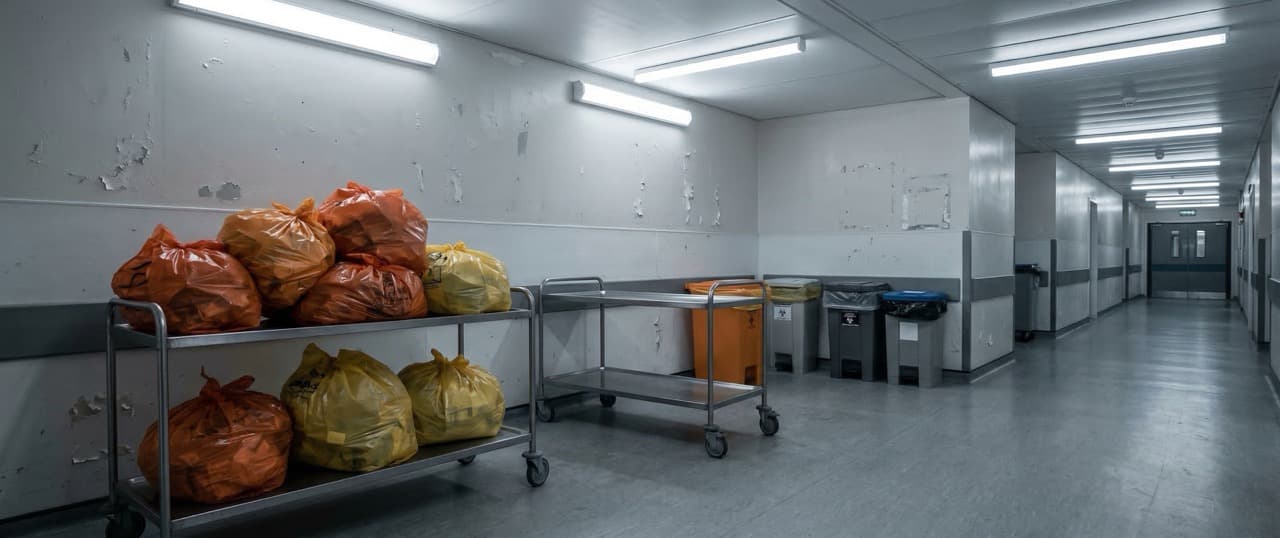
For NHS trusts, hospitals, nursing homes, and care groups generating 1+ tonnes daily, the comparison below shows why autoclave-only treatment is the most expensive long-term approach.
Full Comparison
PHANTOM vs Autoclave
Sterilisation is where the similarity ends. Everything downstream diverges.
| Criterion | PHANTOM | Autoclave |
|---|---|---|
| Sterilisation standard | >99.9999% (6-log, IStAATT Level III) | 99.9999% (6-log, EN 13060/EN 285) |
| Sterilisation temperature | 200–250°C | 121–134°C |
| Volume reduction | ~60% by weight | 0–10% (compression only) |
| Waste decomposed | Yes — molecular breakdown | No — physical form preserved |
| Output classification | Sterile inert residue — downstream pathway depends on input | Still classified clinical waste in most jurisdictions |
| Downstream disposal required | No — output not classified as waste (for clean organic inputs) | Yes — licensed disposal still required |
| Haulage cost eliminated | Yes — fully on-site | No — waste still transported post-autoclave |
| PVC / plastics treated | Yes — breaks polymers; chloride migrates to liquid phase | Sterilised only — plastics intact, still require disposal |
| Operating cost | ~£33/cycle (3 tonnes) | Low (electricity + water only) |
| Full treatment cost/tonne | ~£11–33 on-site | Autoclave cost + £300–617/t disposal contract |
| Odour | Zero — sealed pressure vessel | Minimal during cycle; odour risk on opening |
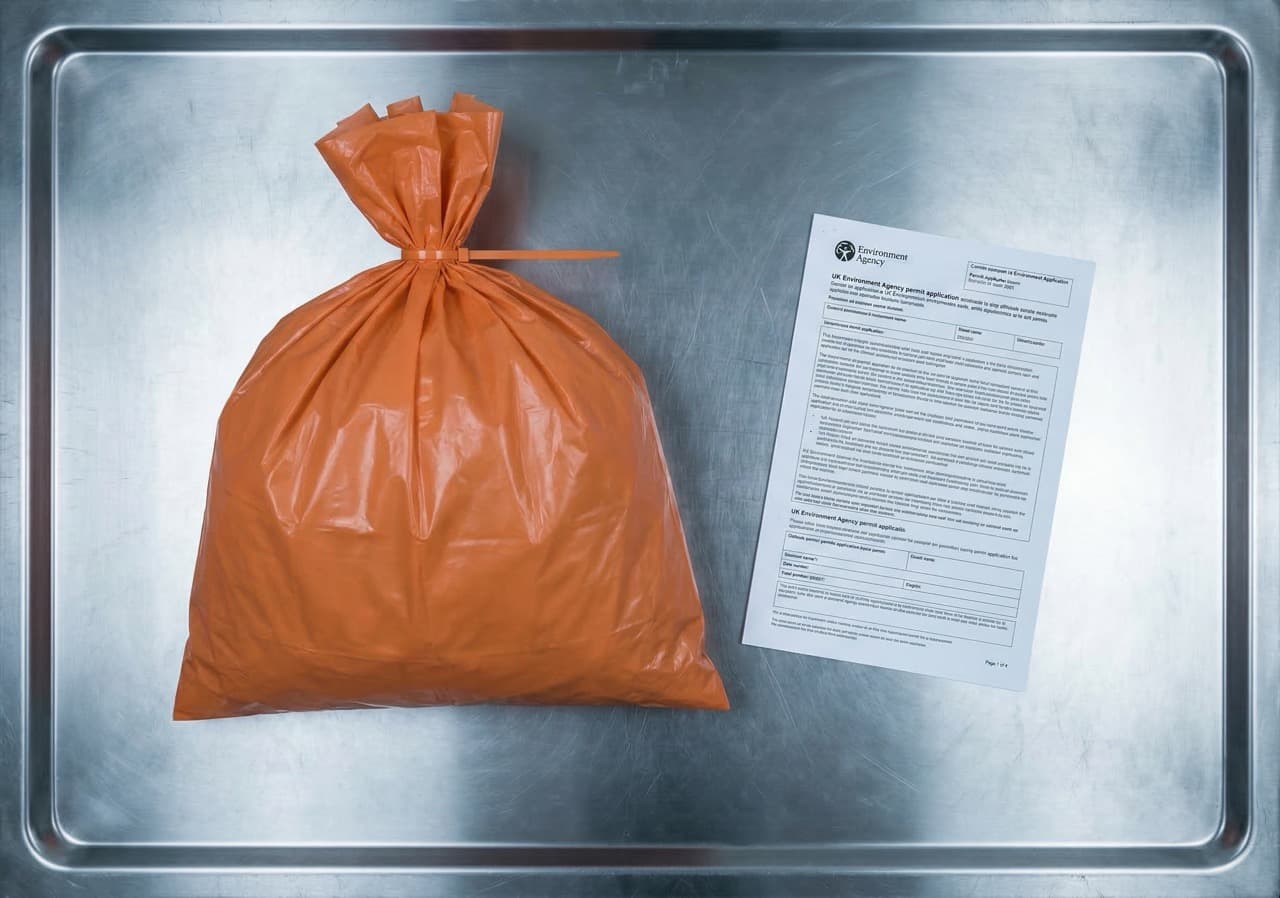
| UK regulatory pathway | IStAATT Level III + EA environmental permit | HTM 07-01 validation |
| Footprint | ~5m × 7m for 3t unit | Compact — bench-top to room-size |
| Capital cost | ~£1.37M (~$1.75M) | £15,000–£150,000 |
Full Treatment Cost
What Most Procurement Analyses Miss
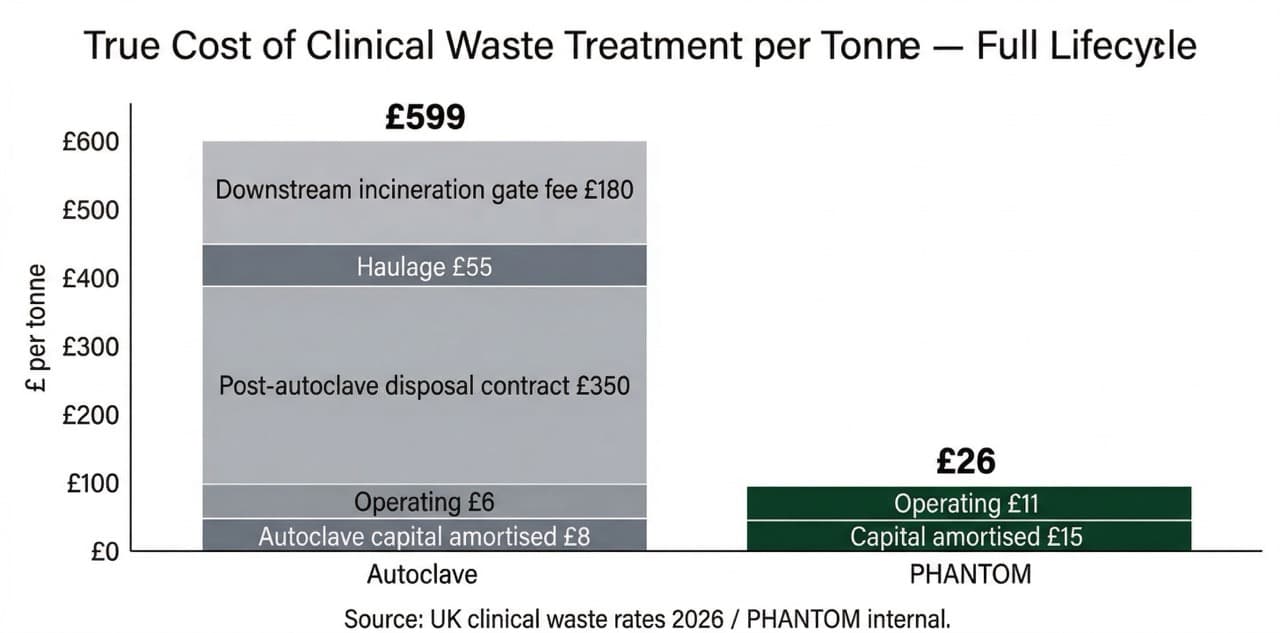
Standard Autoclave Analysis
- Capital: \u00a350k\u2013150k
- Operating: \u00a35\u201310/cycle
Conclusion: cheap
Full Treatment Cost Analysis
- Capital + operating
- + Post-autoclave disposal \u00a3300\u2013617/t (still clinical waste)
- + Haulage \u00a340\u201380/t
- + Downstream incineration \u00a3130\u2013617/t
Total: \u00a3470\u20131,300 per tonne over full lifecycle
PHANTOM Full Treatment
- Capital: ~\u00a31.37M
- Operating: ~\u00a333/cycle
- Downstream disposal: \u00a30
Total: ~\u00a311\u201333/t on-site
For a 100-bed hospital generating 5\u201310 tonnes of clinical waste per week at NHS disposal rates of \u00a3419\u2013617/t, avoided disposal costs alone exceed \u00a3160,000/year. Against PHANTOM capital of ~\u00a31.37M, payback from disposal savings alone is under 9 years \u2014 before any output revenue potential from clean organic fractions.
Stream Compatibility
What PHANTOM Treats That Autoclave Cannot
| Waste type | PHANTOM | Autoclave |
|---|---|---|
| Infectious soft waste (orange/yellow bags) | ✅ Full treatment | ✅ Sterilises; doesn’t decompose |
| Single-use PPE (gowns, gloves, masks) | ✅ Decomposes polymers | ⚠️ Sterilises only — plastics remain |
| PVC IV bags and tubing | ✅ Hydrolysis breaks PVC — chloride to liquid phase | ❌ Not suitable for standard autoclave |
| Anatomical waste | ✅ Full decomposition | ❌ Not suitable |
| Paper diapers / incontinence waste | ✅ Volume reduction + sterilisation | ⚠️ Sterilises; bulk remains |
| Sharps containers (plastic) | ✅ Polymer breakdown | ⚠️ Container intact, sterilised |
| Food/organic waste from clinical setting | ✅ Full treatment | ❌ Not designed for this |
| Microbiological cultures | ✅ Full treatment | ✅ Full treatment |
Common Questions
What is the total cost of clinical waste treatment with an autoclave vs PHANTOM?▾
The autoclave’s capital cost (£50k–150k) appears low, but the full treatment lifecycle includes post-autoclave disposal (still classified clinical waste at £300–617/t), haulage (£40–80/t), and downstream incineration gate fee (£130–617/t) — totalling £470–1,300 per tonne over the full treatment lifecycle. PHANTOM’s full treatment cost is approximately £11–33 per tonne on-site, with no downstream disposal contract required.
Does PHANTOM meet the same validation standards as an autoclave?▾
PHANTOM undergoes IStAATT (Independent Subcritical Thermal Treatment Testing) Level III validation — the highest non-incineration validation standard for clinical waste in the UK, confirming >99.9999% pathogen reduction. Autoclaves are validated under EN 13060/EN 285 porous load tests. Both pathways satisfy HTM 07-01 requirements.
Can PHANTOM treat PVC and plastic clinical waste that autoclaves cannot?▾
Yes. Subcritical water hydrolysis breaks down PVC and plastic polymers — IV bags, tubing, gloves, gowns. Chlorine from PVC migrates to the liquid phase as inorganic chloride (not as dioxins — that is PHANTOM’s key advantage over incineration). Autoclaves sterilise plastic but cannot decompose it, leaving the physical waste requiring downstream disposal.
Which healthcare facilities should choose PHANTOM over autoclave?▾
PHANTOM suits NHS trusts, hospitals, and care groups generating 1+ tonnes of clinical waste daily, with disposal contracts exceeding £150,000/year. For GP surgeries, dental practices, or small clinics with homogeneous low-volume streams and capital budgets below £150,000, a standard autoclave may be appropriate.
Related Comparisons
Compare PHANTOM to Other Technologies
Incineration creates dioxins, fly ash, and growing EU ETS carbon costs. PHANTOM treats in 30 minutes without combustion.
AD requires 30–60 day retention and planning consent for digestate. PHANTOM treats in 30 minutes on-site.
Composting takes 6–12 weeks and produces only compost. PHANTOM can treat contaminated and mixed organic waste.
Landfill tax is rising to £130.75/t in 2026 and bans are expanding. PHANTOM eliminates the gate fee entirely.
Ready to Calculate Your Clinical Waste Savings?
Our team will assess your current disposal contract, waste volumes, and facility requirements — and provide a detailed comparison within 5 business days.
UK disposal rates based on 2026 NHS and industry averages. HTM 07-01 requirements may vary by jurisdiction. Figures for informational purposes only and do not constitute financial, legal, or procurement advice. ~1.27 USD/GBP.