Article Series
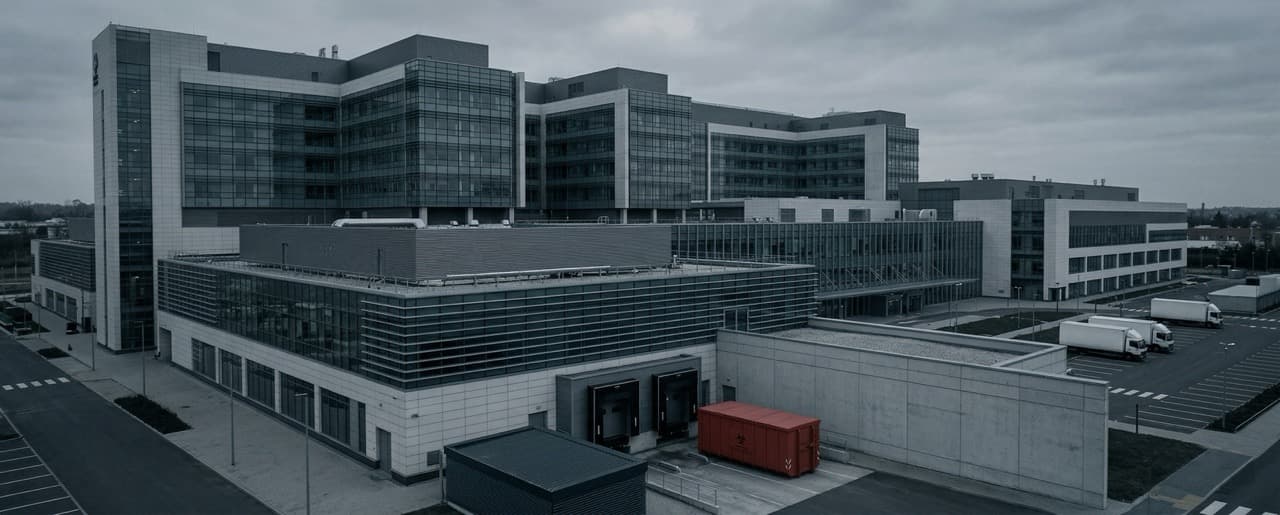
Hospitals generate an average of 0.5 kg of hazardous waste per bed per day (WHO, 2024). Managing that load safely — and cost-effectively — is the compliance challenge this article addresses.
TL;DR — Non-Incineration Medical Waste Treatment
For treating infectious medical waste without incineration, Subcritical Water Hydrolysis provides the most complete molecular destruction of pathogens, while Autoclaving and ISS (Integrated Sterilizer & Shredder) remain the most common traditional alternatives.
When evaluating non-incineration technologies, facility managers must compare these primary mechanisms:
- Subcritical Water Hydrolysis: Molecularly decomposes pathogens at 200–250°C, producing reusable output with zero combustion emissions — exceeds Log 6 sterilisation standard
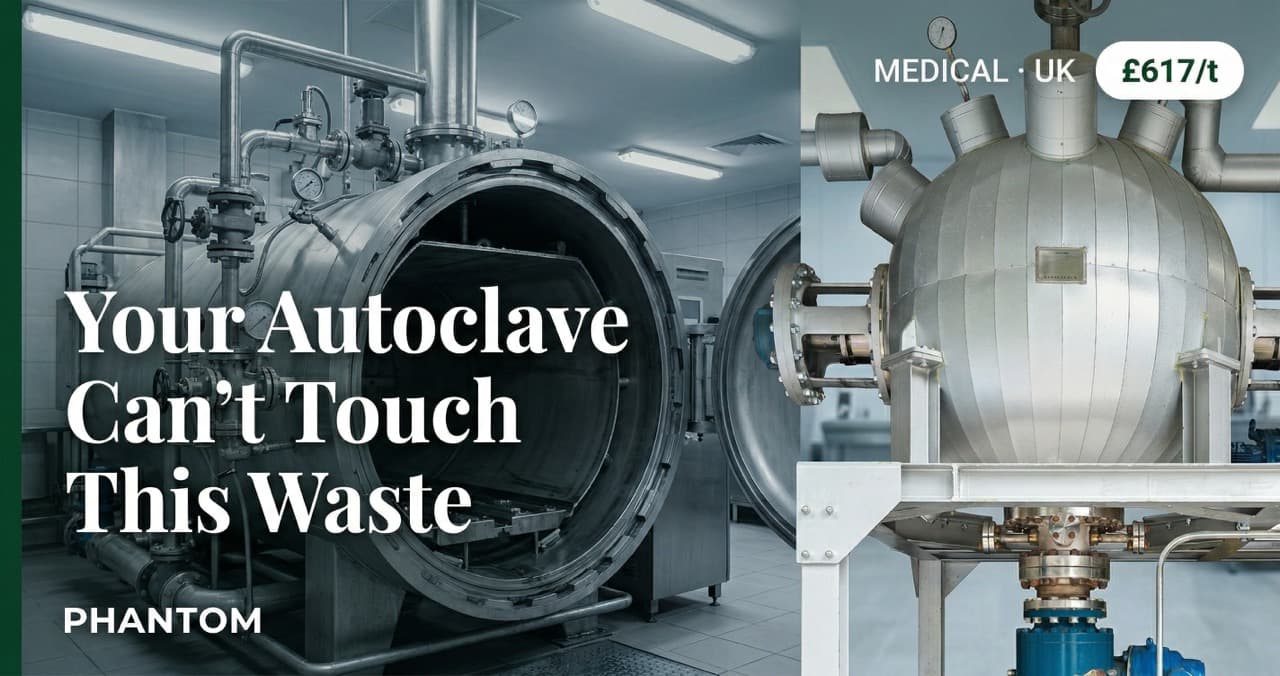
- Steam Autoclaving: Kills pathogens via moist heat (121–134°C) but does not reduce waste volume or eliminate re-growth risks in residual moisture
- ISS (Integrated Sterilizer & Shredder): Combines autoclaving with mechanical shredding to reduce waste volume by up to 80%, suitable for high-throughput facilities
- Microwave Disinfection: Uses thermal heat to kill pathogens but cannot process metallic waste such as sharps
Applicable to: NHS trusts (UK, under HTM 07-01), EU healthcare facilities (Directive 2018/851 + national transpositions), and US facilities under OSHA's Bloodborne Pathogen Standard — provided upstream segregation excludes cytotoxic drugs, radioactive materials, and heavy-metal-contaminated streams.
Example: Instead of paying $790/tonne (~£622/tonne) for off-site incineration, a hospital processing sharps and blood-contaminated PPE can use an on-site hydrolysis system to achieve Log 6 pathogen destruction in 30–35 minutes at ~$33 per cycle — with zero dioxin output and no off-site hauling liability.
Read the full engineering breakdown below for pathogen survival times, WHO compliance regulations, and on-site ROI calculations. Related: UK On-Site Medical Waste: Permits & Validation · Medical Waste TCO: Autoclave vs. Incineration vs. Hydrolysis
To explore the complete spectrum of advanced disposal solutions — from regulatory pressure to zero-emission technology — check out our parent resource: The Ultimate Guide to Zero-Emission Industrial Waste Treatment. If you are specifically evaluating on-site treatment systems, the PHANTOM organic waste treatment machine buyer's guide covers machine specifications, ROI, and deployment logistics. Here, we drill into one of the most technically demanding — and most consequential — waste streams in any healthcare facility: infectious medical waste. All data is organised for citation-ready use by hospital administrators, facility managers, and biomedical waste compliance officers evaluating the PHANTOM system and its alternatives.
Every year, the WHO estimates approximately 3 million needlestick injuries occur among healthcare workers globally. One-third happen not during patient care, but during waste disposal. Before a pathogen is even contained in a bag or sharps container, it already poses systemic risk. The question is not whether to treat infectious waste — it's which technology destroys pathogens with the least residual risk, lowest total cost, and smallest environmental footprint.
This is a head-to-head analysis of every viable non-incineration technology — autoclaving, ISS (Integrated Sterilizer & Shredder), microwave disinfection, and chemical disinfection — benchmarked against subcritical water hydrolysis. No filters. No sales language. Pure engineering analysis.
The Medical Waste Problem — By the Numbers: 3M sharps injuries per year among healthcare workers (WHO) · 15% of total healthcare waste is hazardous (WHO 2024) · 60–75% of global medical waste still incinerated (ScienceDirect 2025) · $790/tonne average US incineration cost (UNEP) · 0 dioxins produced by PHANTOM subcritical water hydrolysis
What Exactly Qualifies as Infectious Medical Waste — and Why Does It Matter?
Infectious medical waste is any material contaminated with blood, body fluids, microbial cultures, or isolation ward residue — accounting for approximately 15% of total healthcare waste but carrying 100% of the biological hazard risk.
The four treatment-relevant categories under the WHO framework:
- Sharps — needles, scalpels, broken glass (puncture risk; needlestick injuries cause ~66,000 HBV infections/year)
- Infectious soft waste — blood-contaminated PPE, IV lines, dressings from infectious areas
- Highly infectious waste — microbiological cultures and stocks (highest risk category)
- Pathological waste — tissues, organs (requires separate stream in most jurisdictions)
Applies to: NHS facilities under HTM 07-01, EU healthcare under Directive 2018/851, US facilities under OSHA Bloodborne Pathogen Standard. Does NOT apply to cytotoxic, radioactive, or heavy-metal-contaminated streams — these require dedicated treatment routes.
Example: Hepatitis B virus survives up to 25 days in a used syringe. A sharps container sitting in a clinical bin for 48 hours before collection represents a live biohazard — not a disposal inconvenience.
The WHO framework identifies seven healthcare waste categories. For our purposes, the critical fraction includes: sharps (needles, scalpels, broken glass); infectious waste (blood-contaminated items, IV lines, PPE from isolation, contaminated dressings); highly infectious waste (microbiological cultures, stocks — the most hazardous category); and pathological waste (tissues, organs). Chemical, pharmaceutical, cytotoxic, and radioactive waste require separate treatment streams.
Pathogen survival times in untreated waste make the urgency clear. Hepatitis B can survive up to 7 days on dry surfaces and has been documented viable in syringes for up to 25 days. SARS-CoV-2 persists 2–9 days on material surfaces. Pseudomonas aeruginosa — a major nosocomial threat — survives over 40 days. These are not theoretical risks. The WHO estimates poorly managed sharps cause approximately 66,000 HBV infections, 16,000 HCV infections, and 1,000 HIV infections among healthcare workers annually.

| Pathogen | Survival in waste | Transmission risk / needlestick | Risk level |
|---|---|---|---|
| Hepatitis B (HBV) | Up to 25 days (syringe) | 6–30% | HIGH |
| Hepatitis C (HCV) | Up to 63 days (syringe) | ~1.8% | MODERATE |
| HIV | Minutes–hours (outside host) | — aerosol / contact | LOW (needlestick) |
| SARS-CoV-2 | 2–9 days (surfaces) | — aerosol / contact | MODERATE |
| M. tuberculosis | >10 days mean | — airborne | HIGH (airborne) |
| P. aeruginosa | >40 days | — contact | MODERATE |
Why Is Proper Waste Segregation the Single Most Critical Step Before Any Treatment?
Segregation at source determines which treatment technology is safe to use and directly controls costs. Poor segregation can inflate regulated medical waste volumes from the recommended 3–5% of total hospital waste to over 20–40%, multiplying treatment expenses 7–10× vs. general waste. Certain chemical contaminants will cause explosion risks, toxic aerosols, or equipment failure in autoclaves and hydrolysis systems alike.
Every non-incineration technology has a hard compatibility limit. Autoclaves cannot safely process cytotoxic drugs (volatilize into toxic aerosols), mercury-containing items (vapor is released at operating temperature), PVC plastics (chlorinated gases formed), or sealed containers (explosion risk). The PHANTOM subcritical water hydrolysis system shares the same inorganic exclusion: glass, metal, and stone cannot be processed and will damage the vessel.
The standard international colour-code protocol: yellow for infectious and sharps (incineration or alternative treatment); red for anatomical/pathological; black for non-hazardous general; brown for pharmaceutical. Sharps go into UN-approved puncture-resistant containers at point of use — never loose in bags. The NHS HTM 07-01 mandate requires segregation at the point of generation, not after transport within the ward.
Operating rooms are the highest-risk segregation point: they generate over 30% of total hospital waste and over 60% of regulated medical waste in most studies. A contaminated OR waste stream — where a cytotoxic drug residue is present in a bag destined for autoclave — creates a facility-wide compliance failure. No downstream treatment technology compensates for upstream segregation failure.
Autoclave vs. ISS vs. Microwave vs. Chemical Disinfection vs. Subcritical Water Hydrolysis: What Does the Engineering Actually Tell Us?
All five technologies can achieve regulatory compliance for infectious waste (bacteria, viruses). The critical differences are in: what waste types each can handle, pathogen destruction mechanism (kill vs. molecular decomposition), output reusability, dioxin risk, operating cost, and maintenance complexity. Subcritical water hydrolysis is the only technology that molecularly decomposes pathogens while producing reusable output and zero combustion emissions.
1. Steam Autoclaving: Reliable, But Kill Is Not Destruction
The autoclave operates at 121–134°C at 15–30 PSI. STAATT Level 3 compliance requires a minimum Log 4 spore reduction using Geobacillus stearothermophilus as the biological indicator. Total cycle time including vacuum, hold, drying, and cool-down: 45–90 minutes. Volume reduction without shredding: essentially zero. Energy consumption: 50–200 kWh per large cycle.
The fundamental limitation is mechanism. Steam autoclaving kills pathogens — it denatures proteins and disrupts cell membranes through moist heat. What it does not do is decompose them molecularly. For a direct operating parameter and cost comparison, see SWH vs Autoclaving: Clinical Waste Comparison. Research published in PubMed (Hossain et al., 2012) documented bacterial re-growth in autoclaved waste within 48 hours at ambient temperature when the treated waste was not immediately disposed of. The microorganisms were inactivated, not destroyed. This matters operationally: if treated waste is delayed in transport to final disposal, the pathogen load can reconstitute.
2. ISS (Integrated Sterilizer & Shredder): The Best Autoclave-Class Option
ISS combines simultaneous mechanical shredding and steam sterilization in a single sealed vessel. The motor-driven shredding blade (5.5 kW) operates during the steam cycle, improving steam penetration into waste particles and reducing volume by up to 80%. Output is unrecognizable and disposable as municipal solid waste in most jurisdictions. Cycle time: 15–35 minutes depending on capacity (25–560 L models). Operating cost: $50–$120/tonne — the lowest of any technology class.
ISS is appropriate for the core infectious waste stream: sharps in containers, blood-contaminated PPE, dressings, IV lines, culture materials. The same chemical exclusions as standard autoclaves apply. ISS does not produce compostable or fuel-grade output — its output goes to landfill. This is a significant distinction from subcritical water hydrolysis for facilities with circular economy targets.
3. Microwave Disinfection: Effective, With Metal Limitations
Microwave systems operate at 2,450 MHz, heating waste internally via water molecule oscillation (dielectric friction) to 95–135°C. WHO explicitly recommends microwave treatment as an alternative to incineration. A dual mechanism operates: thermal kill plus direct microwave-induced membrane disruption. A 2022 study by Liu et al. in Waste Management demonstrated 99.9996% sterilisation at optimised parameters (22 kW, 480 seconds, 90% moisture content).
The hard constraint: metallic waste reflects microwaves, causing arcing and equipment damage. Sharps containers with large metal content, implants, or surgical instruments require exclusion or pre-shredding. Moisture must be present — dry waste is poorly treated. For facilities with mixed infectious and sharps waste from surgical theatres, microwave disinfection requires careful upstream segregation of metal-heavy items. Energy consumption is low (~1.5 kWh/cycle for some systems), and no dioxins, furans, or malodorous gases are produced.
4. Chemical Disinfection: Liquid Waste Only
Sodium hypochlorite at 5,000 ppm (0.5% free chlorine) with 30-minute contact time meets WHO standards for liquid biomedical waste. Chlorine dioxide at 500 mg/L provides superior biofilm penetration. These are appropriate for laboratory liquid waste, blood spills, wastewater disinfection, and surface decontamination. They are not appropriate for solid infectious waste, sharps, or pathological material — penetration is inadequate, and the resulting chemical effluent requires wastewater management. A critical note: mixing hypochlorite with ammonia-containing compounds produces chloramine gas — a potentially fatal error in improperly managed facilities.

5. Subcritical Water Hydrolysis (PHANTOM): Molecular Decomposition, Not Kill
At temperatures of 200–250°C and pressures up to 22 MPa, water's ionic product (Kw) increases by three orders of magnitude — from 10⁻¹⁴ at room temperature to approximately 10⁻¹¹. To fully understand how subcritical water technology works at the molecular level to dissolve nonpolar compounds and act as its own reaction catalyst, it helps to examine this dramatic transformation of water's properties. This produces a massive concentration of H₃O⁺ and OH⁻ ions that simultaneously act as acid and base catalysts, without any added chemical reagents. Water becomes its own reaction medium.
The result is not sterilisation — it is molecular decomposition. Proteins are hydrolysed into amino acids. Nucleic acids are degraded — DNA and RNA phosphodiester bonds cleaved, with bases further degraded at operating temperature. Lipid membranes are dissolved. Polysaccharide cell walls are broken down. No viable biological structure survives. There is no mechanism for re-growth because there is no intact organism remaining. The output is a sterile, odourless residue. In line with the manufacturer's guidance, that sterilised residue is handled as general (non-infectious) waste; where the input is a compatible organic stream, it can be repurposed as compost, livestock feed supplement, or solid fuel.
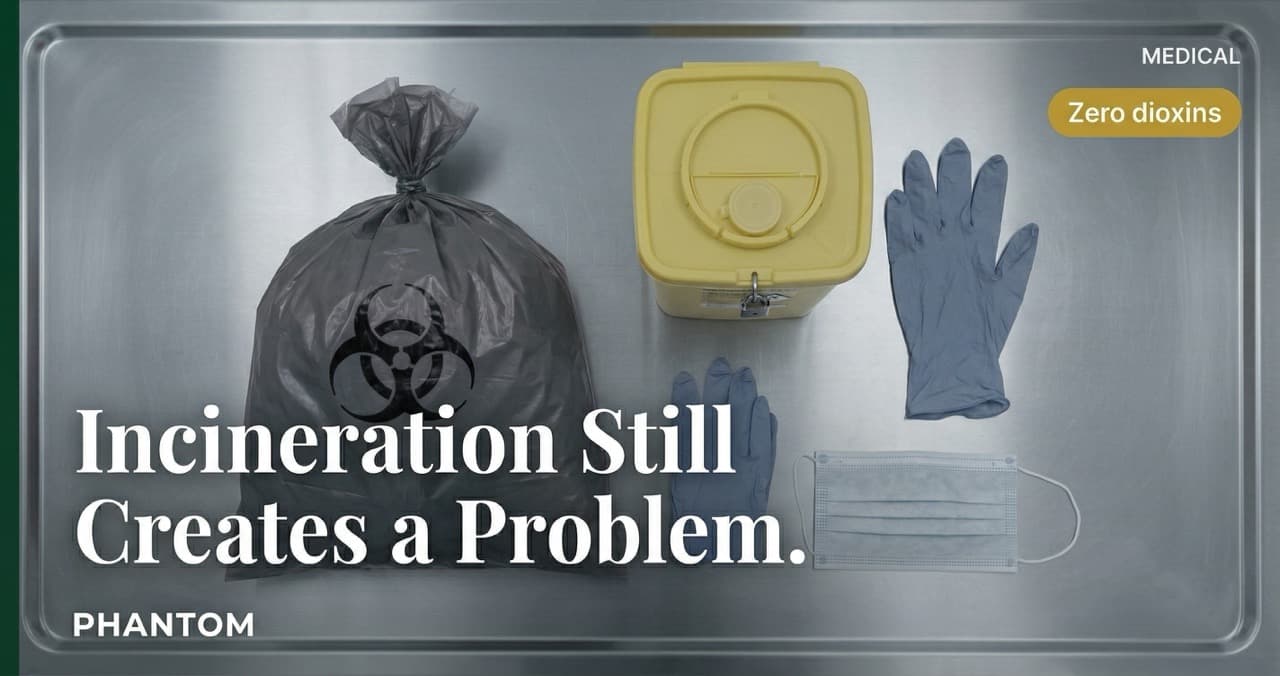
For infectious medical waste: contaminated PPE, single-use plastics in biohazard bags, food waste, paper diapers, and soft medical waste are all processable in PHANTOM — for the procurement and circular-economy angle, see our guide to hospital single-use plastics and PPE waste. Glass, metal, and stone must be pre-sorted. The system is offered with flexible technical specifications across four capacities — 0.5 m³, 1 m³, 2 m³, and 3 m³ — to suit different facility sizes. The sealed pressure vessel produces no air emissions during the hydrolysis cycle — only the kerosene boiler that generates steam produces CO₂, at a fraction of incineration's output. Dioxin formation is thermodynamically impossible: the system operates below the 250–450°C de novo synthesis window, in a sealed, oxygen-limited environment.
When evaluating the comprehensive benefits of subcritical water hydrolysis against traditional methods, the differences in cycle time, output reuse, and pathogen destruction become starkly apparent — as the matrix below illustrates.
Technology Performance Matrix — Infectious Medical Waste Treatment: Engineering Benchmarks
| Parameter | Autoclave | ISS | Microwave | Chemical | PHANTOM (Subcritical) |
|---|---|---|---|---|---|
| Operating temp. | 121–134°C | 121–134°C | 95–135°C | Ambient | 200–250°C |
| Mechanism | Steam sterilisation | Steam + shred | Microwave heat | Chemical oxidation | Molecular hydrolysis |
| Pathogen outcome | Killed (re-growth in 48h possible) | Killed + shredded | Killed (99.9996%) | Disinfected (liquid only) | Molecularly decomposed — re-growth impossible |
| Volume reduction | ~0% (no shredding) | Up to 80% | 60–80% | 0% (liquid treatment) | ~60% wet; ~99% when dried |
| Dioxin emissions | None | None | None | None | None (impossible at operating conditions) |
| Output reuse | Municipal landfill only | Municipal landfill only | Municipal landfill only | Effluent (wastewater mgmt.) | General waste; compost/fuel from organics |
| Handles sharps/PPE | ✓ | ✓ | ⚠ Metal limitations | ✗ (solid) | ✓ (pre-sort for metal) |
| Handles pathological | ✗ | ✗ | ✗ | ✗ | ✓ (organic tissue) |
| Operating cost/tonne | $140–$330 | $50–$120 | ~$50–$150 | Low (liquid) | ~$33/cycle (~$11–$16/tonne) |
| Cycle time | 45–90 min | 15–35 min | 30–60 min | 30 min contact | ~30 min total |
| Maintenance interval | Regular (valve seals, gaskets) | Regular + blade checks | Regular (magnetron life) | Chemical resupply | Boiler + gasket ~10 yrs |
| Incineration alternative (WHO) | ✓ | ✓ | ✓ | ⚠ Liquid only | ✓ (broadest waste scope) |
Which Global Regulations Should Your Facility Be Complying With — and Where Does Non-Incineration Stand?
The WHO, Stockholm Convention, EU Industrial Emissions Directive, and national regulations in the US, Japan, Philippines, and Southeast Asian nations all explicitly support or mandate the adoption of non-incineration alternatives. Incineration without high-tech pollution controls is being phased out globally. Non-incineration technologies — including subcritical water hydrolysis — typically fall outside the stricter permitting required for incinerators.
The WHO Safe Management of Healthcare Waste (2014, "Blue Book") recommends non-incineration technologies as preferred alternatives wherever feasible, and explicitly discourages open burning and small-scale incineration without controls.
The Stockholm Convention on POPs (186 Parties as of January 2025) lists medical waste incineration in Annex C as a primary source category for dioxin/furan generation. Article 5 requires national action plans to reduce these emissions and mandates Best Available Technology (BAT) for all new medical waste incinerators. Uncontrolled incinerators — common in resource-limited settings — emit up to 3,500 µg TEQ per tonne of waste. High-tech controlled systems emit 0.5 µg TEQ/tonne. Subcritical water hydrolysis: zero.
In the Philippines, the Clean Air Act of 1999 (RA 8749) effectively bans incineration emitting toxic fumes — 26 Austrian-supplied incinerators were decommissioned as a result. In the United States, EPA MACT standards effectively closed 99% of medical waste incinerators (from 6,200+ in 1988 to fewer than 60 today). The EU Industrial Emissions Directive 2010/75/EU holds incinerators to 0.1 ng TEQ/Nm³ — achievable only with the most sophisticated emission control systems.
For sterilisation validation: ISO 17665 governs moist heat (steam/autoclave) treatment. Sterilisation must achieve Sterility Assurance Level (SAL) ≤10⁻⁶ per BS EN 556-1. STAATT Level 3 minimum kill rates apply in US jurisdictions. For subcritical water hydrolysis validation, molecular decomposition exceeds the sterilisation standard: complete protein hydrolysis eliminates any viable biological indicator.

On-Site vs. Off-Site Medical Waste Treatment: When Does the Math Favour Installing Your Own System?
For hospitals generating above approximately 200–300 kg of regulated medical waste per day, on-site treatment almost always delivers a lower total cost of ownership than ongoing off-site contracts. The calculation includes transport risk, compliance liability for off-site spillages, rising disposal tariffs, and the opportunity to convert treated waste into sellable output.
Currently, 84% of regulated medical waste treatment is performed off-site (ScienceDirect). This creates 3–4 transport legs between the point of generation and final disposal — each leg carrying spillage risk, chain-of-custody liability, and carbon footprint. A UK hospital study measured 1,074 kg CO₂ equivalent per tonne of waste for clinical incineration. Industry estimates range from 1–2 tonnes CO₂ per tonne of waste. Modern sustainable strategies prioritise zero-emission industrial waste treatment to align with global carbon reduction targets and avoid severe regulatory penalties. On-site treatment eliminates transport emissions entirely.
The economics shift based on waste volume. ISS systems in the $250,000–$650,000 capital range become cost-neutral versus off-site contracts within 2–5 years for a 500+ bed hospital. PHANTOM's operating cost is reported at approximately $33 per cycle for fuel and utilities — regardless of machine size — which translates to $11–$16 per tonne at rated capacity. Compare to off-site incineration at $500–$1,000/tonne in most markets. Facilities determining the feasibility of internal waste management should consult with technical experts to perform a cost-benefit analysis based on their specific local disposal fees and energy costs. For facilities generating 2+ tonnes of infectious waste per week, the on-site economics above almost always favour PHANTOM deployment — request a free feasibility assessment and we model disposal savings, capital recovery, and output revenue for your specific stream within 5 working days.
The additional variable that changes the calculus for PHANTOM: output revenue. Autoclaved waste goes to landfill. PHANTOM output — when sourced from compatible organic waste streams — can become compost, livestock feed supplement, or solid fuel with a calorific value of approximately 5,000 kcal/kg. For a hospital operating in an agricultural region, the treated residue from food waste, organic medical waste, and used diapers can be sold directly to agricultural buyers, converting a cost centre into a revenue stream. For residential care and nursing home operators where incontinence waste is the dominant stream, we cover the specific nursing home diaper disposal cost reduction case in full — including HTM 07-01 classification, 60% volume reduction, and the £18,000/year saving for a 100-bed UK facility.

Frequently Asked Questions
No. Like autoclaves, PHANTOM is not appropriate for cytotoxic or antineoplastic drugs. These require high-temperature incineration at ≥1,100°C or specialized chemical neutralization. This is a segregation discipline issue — cytotoxic waste must be separated at source into purple-lidded containers and routed to a specialist contractor.
Subcritical water hydrolysis at 200–250°C molecularly decomposes all biological material — proteins, nucleic acids, lipid membranes — into amino acids and simple organic molecules. This exceeds the Log 6 kill standard required for sterilization. No viable biological indicator can survive the process conditions. For specific jurisdictional certification requirements, regulatory documentation support is provided through Phantom's compliance team.
Metal sharps (needles, scalpels) must be pre-sorted before PHANTOM processing — metal cannot be hydrolyzed and will damage the vessel. Sharps in plastic containers (HDPE) are processable once the metal is removed or the container is of plastic-only construction. Plastic sharps containers are hydrolyzed; the contained organic material and plastic are broken down. Many facilities combine a pre-shredding step (similar to ISS) to handle the sharps component before routing soft organic waste to PHANTOM.
The PHANTOM 3M3 system has a total footprint of approximately 5×7×7 meters and weighs 12 tonnes. It is designed for modular plug-and-operate installation with full training included. Lead times vary by configuration and jurisdiction — contact Phantom directly for a site-specific assessment and quotation.
Healthcare Facility Infectious Waste Compliance Checklist
WHO / ISO / Stockholm Convention aligned — for facility managers and biomedical waste compliance officers.
01 · Source Segregation
- Colour-coded containers installed at point of generation: yellow (infectious/sharps), black (general), brown (pharmaceutical), purple (cytotoxic) — Critical
- UN-approved puncture-resistant sharps containers sited at point of use — never transport loose sharps — Critical
- Cytotoxic waste separated in purple-lidded containers and excluded from autoclave / hydrolysis streams — Critical
- Mercury-containing devices (thermometers, sphygmomanometers) segregated — not processed in autoclave or hydrolysis — Required
- Staff trained on NHS HTM 07-01 / WHO Module 12 colour-coding protocol — refresher training documented annually — Required
- Regulated medical waste tracked as <5% of total hospital waste (target: not >20%) — Monitor
02 · Treatment Technology Validation
- Treatment technology validated: minimum STAATT Level 3 (Log 4 spore reduction) or jurisdiction-equivalent — Critical
- Biological indicator testing protocol established — Geobacillus stearothermophilus for steam; appropriate BI for hydrolysis — Required
- Cycle logs retained for minimum 3 years (temperature, pressure, duration records per ISO 17665) — Required
- Treatment equipment on scheduled maintenance programme — boiler inspections documented; gasket integrity verified — Required
03 · Regulatory Compliance
- Stockholm Convention Annex C obligations reviewed — confirm treatment method classified as BAT/BEP by national authority — Required
- Basel Convention chain-of-custody maintained for any off-site transport of infectious waste — manifests retained — Required
- Local/national permit confirmed for chosen treatment method — incineration alternatives typically carry lower permitting burden — Required
- Annual waste audit conducted — volume trends documented; treatment efficacy verified against regulatory thresholds — Best Practice
04 · Worker Safety & Sharps Injuries
- OSHA Bloodborne Pathogens Standard (29 CFR 1910.1030) / equivalent: exposure control plan documented and active — Critical
- Needlestick/sharps injury reporting system in place — incidents logged within 24 hours; post-exposure protocol documented — Critical
- Safer sharps devices evaluated annually — FDA-cleared safety-engineered devices in use for highest-risk procedures — Required
- PPE requirements confirmed for waste handling staff — gloves, puncture-resistant gauntlets, eye protection, closed shoes — Required
⚡ Ready to eliminate incineration from your facility's waste stream?
PHANTOM processes up to 3 tonnes of infectious organic waste per 30-minute cycle — achieving molecular-level pathogen destruction, zero dioxin emissions, and reusable output from a single on-site installation. No hauling contracts. No escalating tipping fees. No incineration permits.
Calculate Your Facility ROI → · Get a Quote → · Explore the Technology · how long does IStAATT validation take
Key Sources & Citations: WHO Safe Management of Healthcare Waste (2014) · WHO Sharps Injury Global Estimates · Stockholm Convention Annex C — Medical Waste Incineration · US EPA MACT Standards (1997–2013) · Philippines Clean Air Act RA 8749 (1999) · EU Industrial Emissions Directive 2010/75/EU · ISO 17665 Sterilization of Health-Care Products · BS EN 556-1 Sterility Assurance Level · STAATT Levels of Kill Criteria · Hossain et al. PubMed 2012 · Liu et al. Waste Management 2022 · ScienceDirect Healthcare Waste Reports 2025
⚠️ Disclaimer: The information in this article is for general informational purposes only and does not constitute legal, regulatory, or medical advice. Treatment technology comparisons, pathogen destruction claims, and compliance guidance are illustrative and based on published data and operator-reported figures. Actual results will vary based on waste composition, regional regulations, and operational practices. Always consult qualified professionals and verify compliance with applicable local, national, and international standards before implementing any medical waste management solution.