Article Series
The fastest way to cut nursing home waste costs: correctly classify incontinence waste as offensive/hygiene waste (not clinical) — saves approximately £8,000 (~$10,160) per year immediately. Then install on-site subcritical water hydrolysis to reduce volume by 60%, cut per-tonne cost from £1,500 (~$1,905) to under £60 (~$76), and return investment in 18–24 months. A 100-bed UK facility saves approximately £18,000–£20,000 (~$22,860–$25,400) per year across four compounding cost categories.
Introduction: The Budget Line Nobody Talks About
The single biggest controllable waste cost in a nursing home is the daily collection of soiled incontinence products — buried under a single "clinical waste" line, billed by a contractor, and never interrogated. Seventy-five per cent of residents are incontinent, the waste generated is up to 80% water, and most facilities are paying clinical-waste rates to haul every gram of absorbed fluid.
This article is part of our broader guide on safe, non-incineration disposal of infectious medical waste. It focuses specifically on the operational and financial pain of incontinence waste in residential care. If your facility also handles PPE and single-use plastics, our companion guide on hospital single-use plastics and PPE waste management covers the same regulatory frameworks and disposal economics in that context.
Here is the problem in three numbers:
- 75% of long-term nursing home residents are incontinent (CDC)
- A 100-bed facility generates roughly 66 tonnes of soiled incontinence waste per year
- Up to 80% of that weight is water — and you are paying clinical-waste rates to haul it away
The scale of this problem across the UK is significant. As of March 2025, the CQC registers 4,186 nursing care homes and 10,301 residential care homes in England alone — over 14,400 facilities generating this waste stream every day, the majority still on the wrong bag colour.
That is not a waste management problem. It is a procurement problem that has never been interrogated. This article breaks it open section by section — from why your contractor bills are structurally inflated, to how on-site subcritical water hydrolysis eliminates the root cause, to the precise ROI calculation.
Why Do Absorbent Hygiene Products Cost So Much to Haul Away?
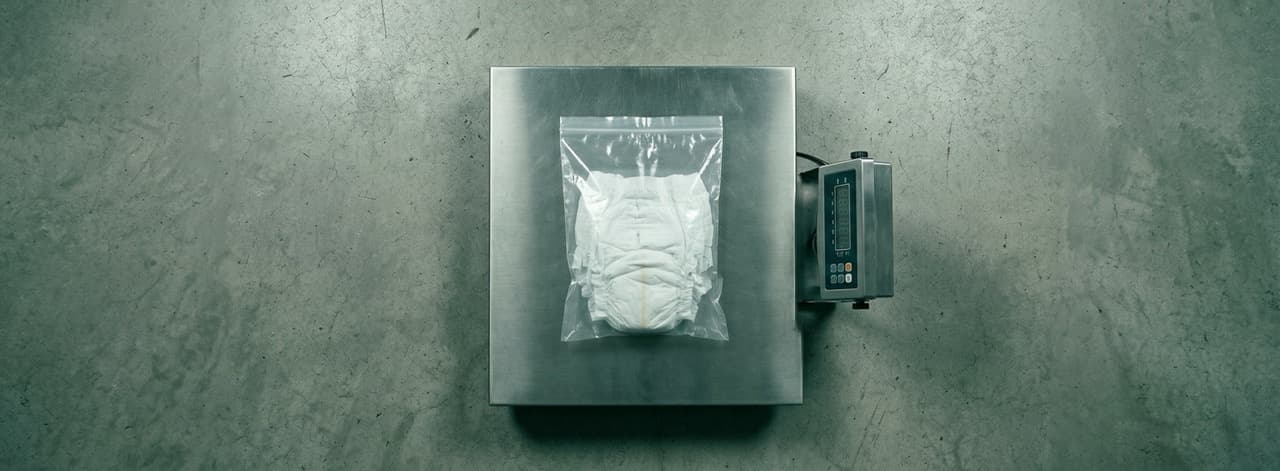
Waste contractors charge by weight, and most of that weight is water. A used adult diaper that weighed 100 g dry arrives at the truck weighing 400–500 g. You pay clinical-waste tipping fees on every gram of absorbed urine — and 70% of UK care homes are in the wrong waste stream, costing approximately £8,000 (~$10,160) per year in avoidable premium charges.
The structural economics at the bag level:
- Dry weight of a standard adult brief: 80–120 g
- Wet weight at a 2–3 hour change interval: 350–500 g
- The superabsorbent polymer (SAP) core absorbs 30–50× its own weight in urine
- Moisture cannot be compressed or bagged away — it travels to the facility at full weight
- UK clinical waste rates run £500–£1,500/tonne (~$635–$1,905/tonne); offensive waste rates run £200–£430/tonne (~$254–$546/tonne)
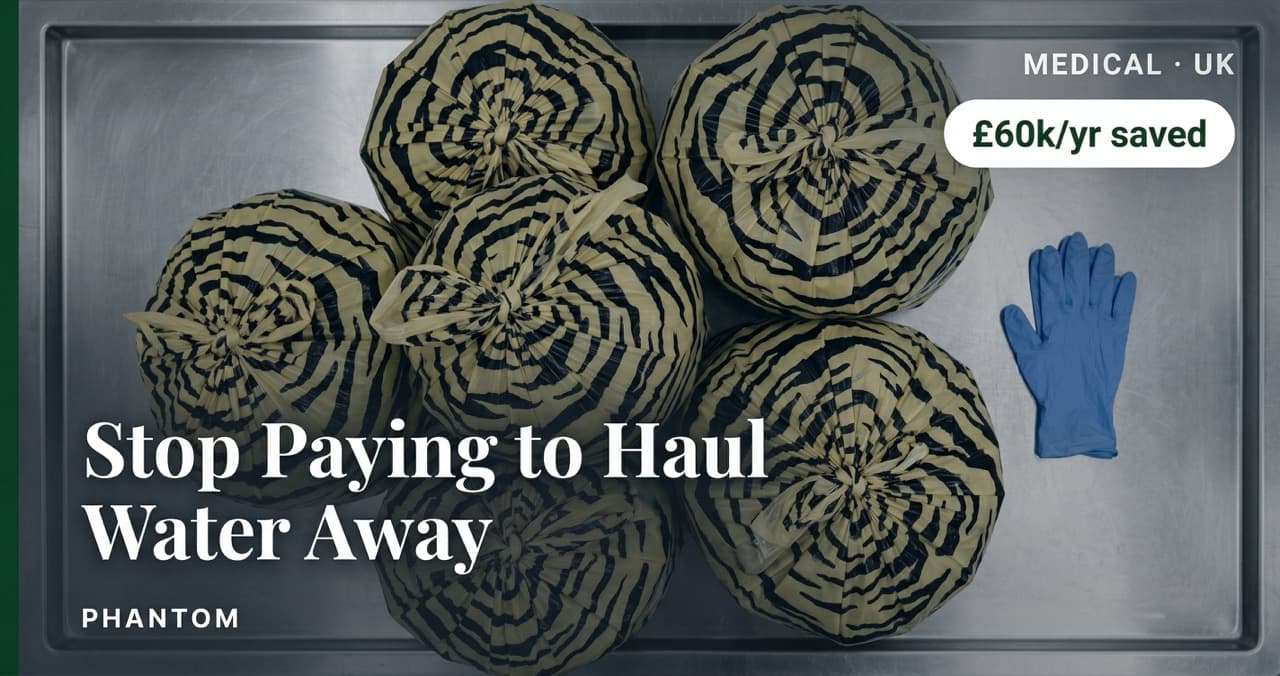
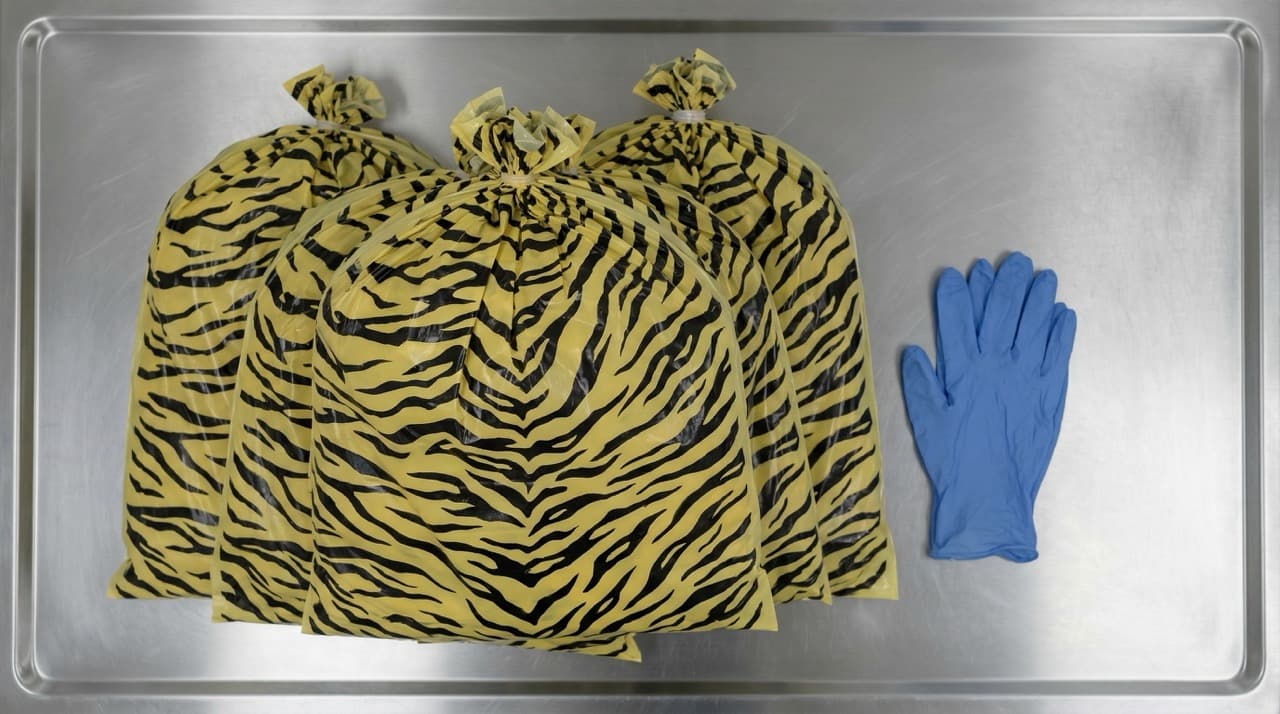
The classification decision is where you lose or recover thousands of pounds per year. Under HTM 07-01, incontinence products from residents with no known or suspected infection are offensive/hygiene waste — yellow/black tiger-stripe bags, EWC 18 01 04, at £200–£430/tonne (~$254–$546/tonne). Only products from residents with confirmed or suspected C. difficile, MRSA, or norovirus escalate to infectious clinical waste (orange bags, EWC 18 01 03*, up to £1,500/tonne, ~$1,905/tonne). Industry audits consistently find 70% of care home waste is in the wrong stream, costing an average facility approximately £8,000 (~$10,160) per year in avoidable premium charges.
Scenario: A 100-bed nursing home currently places all incontinence pads in orange clinical waste bags at £650/tonne (~$825/tonne). Correctly reclassifying non-infectious residents to tiger-stripe (£315/tonne, ~$400/tonne) on 70% of volume reduces that cost by £12,500 (~$15,875) per year before any change in treatment technology.
Applies to: UK nursing homes with a general mixed-dependency resident population. Does not apply to: Dedicated infectious disease or isolation units where blanket clinical classification is clinically directed.
Can You Safely Reduce the Volume of Adult Diapers On-Site?
Yes — by approximately 60%, without incineration, added chemicals, or pre-sorting. On-site subcritical water hydrolysis processes incontinence waste in a sealed, pressurised vessel at 200–250°C, achieving complete pathogen destruction and dramatic volume reduction in a single 30-minute cycle. Output routes to general waste at £80–£130/tonne (~$102–$165/tonne) instead of clinical-waste rates.
What the system delivers:
- 60% volume reduction — output requiring external disposal drops from 66 tonnes to ~26 tonnes per year for a 100-bed facility
- Complete sterilisation at temperatures far exceeding the 121°C autoclave standard — destroying C. diff spores, MRSA, norovirus, and all known pathogens at the molecular level
- No combustion, no dioxins, no emissions — the only environmental output is CO₂ from the kerosene boiler
- No pre-sorting required — incontinence pads, food waste, and organic clinical waste can be co-processed
- ~30-minute cycle time (≈15–20 min active hydrolysis) on a 3-tonne capacity vessel
The core principle is elegant: water at temperatures around 250°C and under 2–2.7 MPa (approximately 20–27 atmospheres) of pressure becomes subcritical — it remains liquid but its molecular behaviour changes dramatically. To understand the precise thermodynamics behind this phase change, read our deep dive on what subcritical water hydrolysis actually is and how it works. Its ionic dissociation increases by three orders of magnitude, generating concentrations of H⁺ and OH⁻ ions sufficient to break down long-chain organic molecules — the cellulose, protein, and polymer compounds that make up incontinence waste — at the chemical level.
Scenario: A 100-bed nursing home (75 incontinent residents, 6 changes/day) currently pays £19,800/year (~$25,146/year) to collect 66 tonnes of incontinence waste. After installing the Phantom system: output volume drops to ~26 tonnes of treated residual, routed to general waste at £120/tonne (~$152/tonne). External disposal cost falls to £3,120/year (~$3,962/year) — an £16,680 (~$21,183) direct saving on disposal alone, before accounting for reduced collection frequency or eliminated misclassification risk.
Applies to: Incontinence pads, absorbent briefs, bed pads, and mixed organic hygiene waste. Also suitable for food waste and organic clinical waste from the same facility, improving per-cycle cost economics. Does not apply to: Sharps, glass, metal, or stone — these must be pre-segregated before loading.
→ For temperature curves, MPa operating ranges, and pathogen log-reduction data specific to clinical settings, see our zero-emission industrial waste treatment pillar.
How Does a Sealed Hydrolysis System Solve Your Facility's Odour Problem?
A sealed subcritical water hydrolysis vessel eliminates odour completely — not by masking it, but by chemically destroying the volatile organic compounds responsible for it before they can reach the air. The chamber does not open until treatment is complete, meaning zero off-gassing during the cycle.
The mechanism, in plain terms:
- Ammonia, hydrogen sulphide, skatole, indole, and other faecal VOCs are organic molecules — they hydrolyse under subcritical conditions at 200–250°C
- The sealed vessel means zero off-gassing during the cycle — no odour escapes into the facility
- Output material is deodorised, sterilised residue — not a source of further off-gassing
- The entire process from load to output takes approximately 30–35 minutes including handling
Applies to: All incontinence waste processed through the Phantom sealed system. Does not apply to: Waste stored awaiting processing — proper interim storage protocol (sealed bags, ventilated dedicated rooms, minimal dwell time) is still required between resident care and loading.
Scenario: A 60-bed facility receiving repeated odour complaints from families and a CQC improvement notice under Regulation 12 (safe care and treatment) installs the Phantom system. Collections are consolidated to twice weekly. Staff loading and cycle time: under 20 minutes per session. Within 30 days, no further odour complaints are logged, and waste storage room ambient VOC levels return to background.
The infection control case is equally concrete. C. difficile spores — which survive on surfaces for months, resist alcohol-based hand gel, and cost the US healthcare system over $1 billion per year — are destroyed inside the sealed vessel before staff ever handle the output. This cuts a critical link in the faecal-oral transmission chain without changing a single resident care protocol. For a facilities manager preparing for a CQC inspection, that is a documentable, auditable improvement under both Regulation 12 (infection prevention) and Regulation 15 (premises and equipment).
What Is the Real ROI of Eliminating Daily Clinical Waste Pickups?
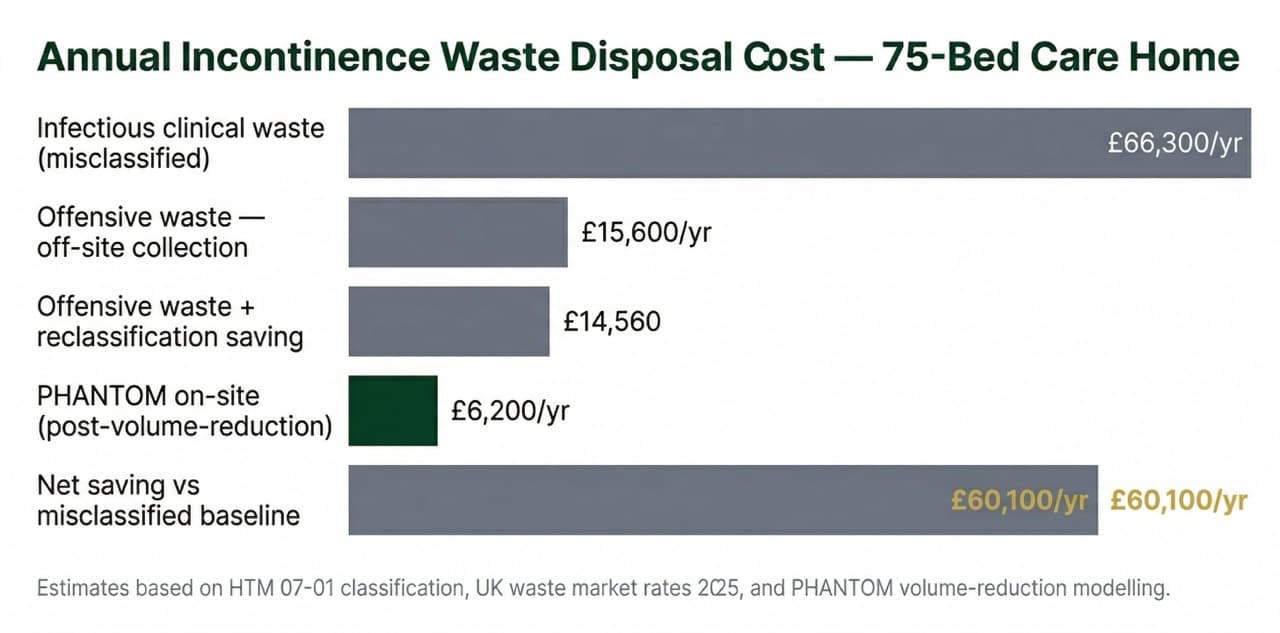
On-site waste treatment systems in healthcare settings return their investment within 18–24 months, reducing cost-per-tonne from £200–£1,500 (~$254–$1,905) external collection to approximately £35–£60 (~$44–$76) on-site treatment plus residual disposal. The saving compounds across four cost categories simultaneously. A 100-bed UK nursing home saves an estimated £18,000–£20,000 (~$22,860–$25,400) per year.
The four compounding saving categories:
- Disposal rate arbitrage — residual post-treatment waste routes to general waste (£80–£130/tonne, ~$102–$165/tonne) instead of offensive or clinical streams (£200–£1,500/tonne, ~$254–$1,905/tonne)
- Misclassification elimination — on-site treatment renders output non-clinical, removing the legal and financial risk of incorrect bag-colour decisions
- Collection frequency reduction — treated facilities typically move from 4–5 lifts per week to 1–2, with each standing charge (typically £35–£60, ~$44–$76) eliminated
- Tax ratchet insulation — UK landfill tax rose 22% in 2025 alone (£103.70 to £126.15/tonne, ~$132 to ~$160/tonne) and rises again to £130.75/tonne (~$166/tonne) from 1 April 2026; incineration is joining the UK ETS; on-site treatment insulates volume from this escalator
- NHS 20:20:60 compliance — NHS England's Clinical Waste Strategy requires all NHS providers to reach 60% offensive waste, 20% alternative treatment, and 20% HTI segregation by March 2026; on-site SWH satisfies the 20% AT target while simultaneously eliminating the majority of offensive waste volume — a single system ticks two compliance boxes simultaneously
Annual Saving Calculator: On-Site Incontinence Waste Treatment
Adjust bed count to estimate your facility's annual net saving at current UK disposal rates. Based on offensive waste stream at £315/tonne (~$400/tonne).
Estimates based on UK 2025–26 disposal rates. Actual savings depend on waste composition, collection frequency, and local market conditions.
Scenario — 100-bed UK nursing home, currently using tiger-stripe offensive waste at £315/tonne (~$400/tonne), 4 collections per week:
| Cost Line | Current Annual Cost | With Phantom | Annual Saving |
|---|---|---|---|
| External disposal (66t → 26t residual at £120/t, ~$152/t) | £20,790 (~$26,403) | £3,120 (~$3,962) | £17,670 (~$22,441) |
| Collection standing charges (4 lifts/wk → 1–2) | £7,280 (~$9,246) | £2,184 (~$2,774) | £5,096 (~$6,472) |
| Phantom fuel operating cost (~1 cycle/day) | — | −£9,855 (~−$12,516) | — |
| Misclassification risk eliminated (est.) | £4,200 (~$5,334) exposure | £0 | £4,200 (~$5,334) |
| Rising disposal tax exposure (est.) | £1,800 (~$2,286) | £300 (~$381) | £1,500 (~$1,905) |
| Net annual saving | ~£18,611 (~$23,636) |
Applies to: 100-bed UK nursing home running one Phantom cycle per day on incontinence waste only. Savings increase materially if food waste and other organic streams are co-processed through the same cycle, spreading fuel cost across greater input volume. Does not apply to: Facilities generating less than 1 tonne of incontinence waste per day, where a smaller-capacity system configuration should be assessed.
→ For a full financial comparison against autoclave and incineration across a 15-year asset lifecycle, see our Total Cost of Ownership: Autoclave vs. Incineration vs. Hydrolysis breakdown.
Is This a Medical Device or an Industrial System? What Do You Need for a CQC Inspection?
The Phantom system is an industrial waste treatment system — not a medical device. Procurement, planning permission, and CQC documentation all follow environmental and health-and-safety frameworks, not MHRA regulation. The four required documents are: environmental permit or exemption, waste transfer notes, staff training records, and an updated infection control policy.
The four documents that satisfy a CQC inspection under Regulations 12 and 15:
- Environmental permit or exemption registration — for the on-site treatment activity (Environment Agency; many facilities qualify for registered exemptions below specified tonnage thresholds)
- Waste transfer documentation — showing reclassification of output from offensive/clinical waste to treated residual general waste
- Staff training records — covering safe loading, cycle operation, and output handling procedures
- Updated infection control policy — explicitly referencing the on-site treatment step as part of the waste management protocol
Applies to: England. Scotland, Wales, and Northern Ireland have equivalent but separately administered environmental permitting regimes. Does not apply to: Facilities that process hazardous clinical waste streams (sharps, pharmaceutical, cytotoxic) through the same system — these require separate permitting assessment.
Scenario: A care home group preparing for a scheduled CQC inspection in 90 days installs the Phantom system and commissions Phantom Ecotech's implementation team to handle permit registration and staff training. All four documentation requirements are met within 6 weeks of installation.
→ For the full permitting pathway — including registered exemption thresholds and Environment Agency registration steps — see our guide to obtaining UK medical waste treatment permits and validation.
Frequently Asked Questions
Five key compliance and operational questions answered — covering UK waste classification law, odour control, co-processing food waste, environmental permitting, and treated output disposal routes.
The default classification for most nursing home incontinence waste is offensive/hygiene waste — tiger-stripe bags, not orange clinical waste bags. Under HTM 07-01, the classification turns on a single question: is the resident known, suspected, or at heightened risk of infection?
- No infection status → Offensive/hygiene waste (EWC 18 01 04, tiger-stripe bag, £200–£430/tonne, ~$254–$546/tonne)
- Known or suspected C. diff, MRSA, norovirus → Infectious clinical waste (EWC 18 01 03*, orange bag, up to £850/tonne, ~$1,079/tonne)
- Medicinally contaminated → HTI clinical waste (yellow bag, up to £1,500/tonne, ~$1,905/tonne)
Applies to: UK nursing homes operating under HTM 07-01 and Environmental Protection Act 1990 Duty of Care obligations. Does not apply to: Scotland, where SHTM 04-01 applies and some classification thresholds differ.
Scenario: A resident develops a confirmed C. diff diagnosis on Tuesday. From that point, their personal incontinence waste moves to orange bags immediately. When they are discharged or cleared of infection, classification reverts to tiger-stripe. Staff training must cover this escalation-and-reversion workflow explicitly.
The only method that eliminates odour at source is destroying the organic matter before it off-gases — which is what on-site treatment achieves. All other methods manage the symptom, not the cause.
For facilities not yet on a treatment system, the four best interim measures in order of effectiveness:
- Sealed continuous-roll bag systems — prevent direct contact with bin interior and contain odour between changes
- Ventilated dedicated waste rooms — mechanical extract ventilation, kept at low ambient temperature, with no resident or visitor access
- Enzyme-based deodorising sprays — applied to bin interior surfaces, not waste — breaks down odour compounds rather than masking them
- Minimum dwell time — the single biggest driver of odour is time; increasing collection frequency is costly but directly effective
Applies to: Facilities with standard storage holding times of 24–72 hours at ambient temperature. Does not apply to: Cold-chain waste storage rooms (below 5°C), where biological decomposition is substantially slowed and 7-day storage is permissible under clinical waste regulations.
Yes — and co-processing is the recommended configuration for maximising ROI. The Phantom system accepts mixed organic waste inputs. Processing food waste and incontinence waste in combined or sequenced cycles allows the facility to amortise the fixed fuel cost (approximately £27, ~$34, per cycle) across a larger total input volume. At 3 tonnes per cycle, a facility generating 1 tonne of incontinence waste and 1 tonne of food waste per day requires one cycle daily — the same fuel spend, double the throughput value.
Applies to: Facilities with on-site kitchen operations generating significant food waste volumes (more than 200 kg/day). Does not apply to: Facilities receiving meals from external catering suppliers where food waste does not arise on-site.
Most care home-scale installations will qualify for a registered exemption rather than a full environmental permit, significantly reducing administrative burden and timeline. The specific exemption categories depend on treatment method, input waste type, and annual throughput. Phantom Ecotech's implementation team handles the Environment Agency registration process as part of installation. Full permitting pathway detail is in our guide to obtaining UK medical waste treatment permits and validation.
Applies to: England. Separate registration processes apply in Scotland (SEPA), Wales (NRW), and Northern Ireland (NIEA).
The output is a sterilised, deodorised solid residue at approximately 40% of input volume — no longer classified as clinical or offensive waste. It can be routed to general residual waste (typically £80–£130/tonne, ~$102–$165/tonne), composted where locally approved, or used as an agricultural soil conditioner where nutrient composition supports this. The reclassification from offensive to general waste is documented via waste transfer notes and forms part of the facility's environmental compliance record.
Applies to: Incontinence waste and mixed organic inputs with no inorganic contamination. Does not apply to: Any input stream containing glass, metals, or stone — these must be pre-segregated as they pass through the system unchanged.
Stop Calculating Losses. Install the Solution.
Every month a 100-bed nursing home defers this decision, it spends an estimated £1,550 (~$1,969) in avoidable external collection costs — paying premium rates to transport 5.5 tonnes of waste that is 80% water onto diesel trucks, through incineration, and into rising-cost disposal tax regimes.
The financial model is not complex:
- One Phantom system handles the full incontinence waste volume of a 100-bed facility
- One cycle per day at approximately £27 (~$34) in fuel replaces £1,550 (~$1,969) in monthly contractor invoices
- The output is sterile, deodorised, reclassified as general waste, and documentable for CQC
- Net estimated annual saving: £18,000–£20,000 (~$22,860–$25,400) at current UK disposal rates — rates that will only rise
The only open question is how long you wait.
Calculate your care home's ROI on the PHANTOM machine page → · Speak to Phantom Ecotech about a site assessment →
Citation & Regulatory Reference Index
- UK Health Technical Memorandum 07-01: Safe management of healthcare waste (Department of Health)
- Environmental Protection Act 1990, Section 34: Duty of Care — unlimited fine for non-compliance
- CQC Regulation 12: Safe care and treatment (infection prevention and control)
- CQC Regulation 15: Premises and equipment (waste management as infrastructure)
- European Waste Catalogue (2000/532/EC): EWC 18 01 04 (non-hazardous) and 18 01 03* (hazardous clinical)
- McKnight's Long-Term Care News: 75% nursing home incontinence prevalence (citing CDC)
- UK Landfill Tax Rates: HMRC — standard rate £126.15/tonne (~$160/tonne) from April 2025; rising to £130.75/tonne (~$166/tonne) from 1 April 2026
- CLA 40th SNF Cost Comparison Report (2024): median nursing home operating margin 1.8%
- Tu et al. (2016), BioResources: subcritical water hydrolysis nutrient recovery at 82.6% efficiency
- ScienceDirect LCA Study (2023): life cycle assessment of absorbent hygiene product end-of-life scenarios
The figures, cost estimates, and regulatory references in this article are provided for informational and educational purposes only. They do not constitute legal, financial, procurement, or compliance advice. Waste classification obligations, disposal rates, environmental permitting requirements, and CQC inspection standards vary by facility type, jurisdiction, and individual circumstance. Always consult qualified legal, environmental, and regulatory advisers before making procurement or operational decisions. Currency conversions use an approximate rate of 1 GBP = 1.27 USD at the time of publication and are indicative only.