Article Series
TL;DR — Medical Waste Treatment: Cost and Carbon
Hydrolysis has the lowest fuel cost per tonne of the routes compared here, on manufacturer figures, and needs no flue-gas treatment. Whether it gives the lowest 10-year total cost depends on the quoted price for your configuration, your waste volume and your local disposal costs. Ask us for a facility-specific model.
For a mid-sized facility generating ~730 tonnes/year, the 10-year cost differences between the off-site and combustion routes are stark:
- Autoclave / ISS ($1.37M–$2.23M TCO): Cheaper than incineration, but requires expensive electricity and secondary shredding to render waste unrecognisable.
- Outsourcing ($3.1M–$7.65M TCO): The most expensive long-term option due to escalating third-party hauling and tipping fees.
- Incineration ($3.4M–$6.83M TCO): Prohibitively expensive due to $300K+ pollution-control stacks, $80K–$150K annual fuel costs, and rising emissions-compliance burden.
Applicable to: Hospitals, clinics, and waste management facilities handling 1–3 tonnes of daily waste.
Example: Against the cost of running a compliant incinerator for ten years, on-site treatment that avoids the pollution-control stack, the continuous emissions monitoring and the hazardous-ash premium changes the operating-cost picture markedly. PHANTOM treats 3 tonnes per batch using up to about ¥5,000 of kerosene (manufacturer estimate).
Read the full analysis below for the CapEx vs. OpEx breakdown, maintenance cycle comparisons, and a region-by-region view. Related: UK On-Site Medical Waste: Permits & Validation · Infectious Medical Waste: Non-Incineration Guide · SWH vs Autoclaving: Technical Comparison
How much does high-temperature incineration cost per tonne in the UK?
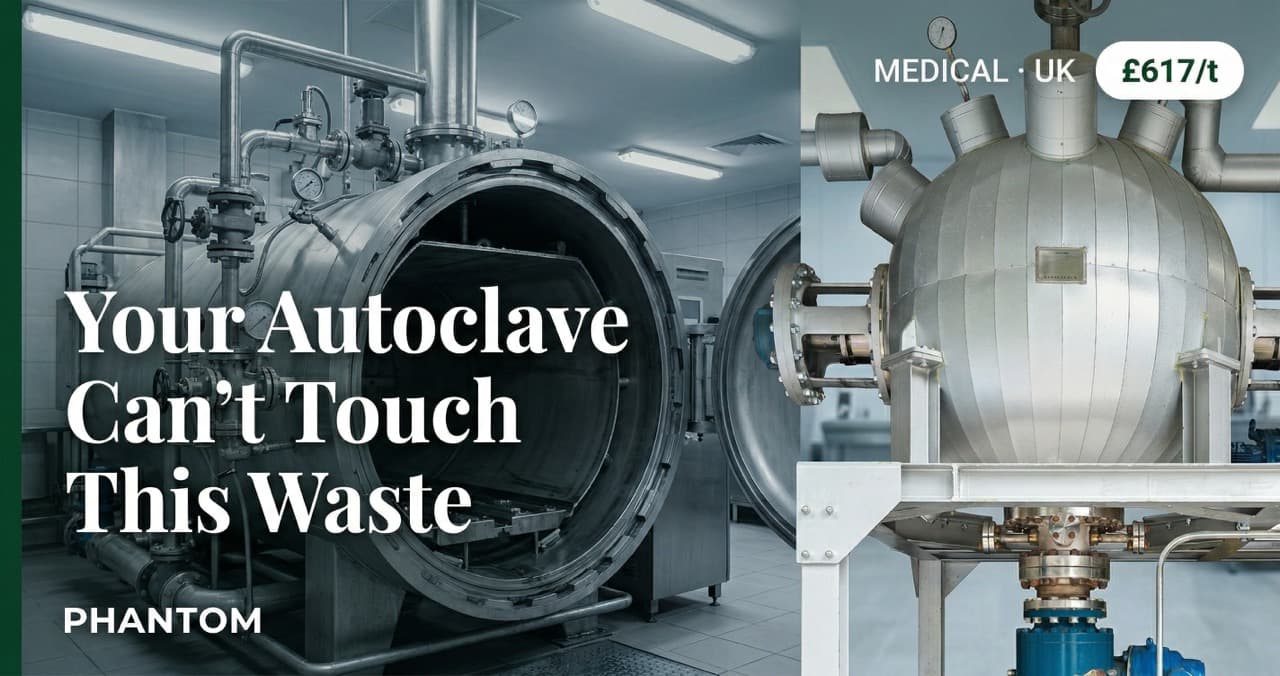
NHS England's benchmarking data puts the average cost of high-temperature incineration (HTI) of clinical waste at about GBP 617 per tonne, against GBP 419/t for alternative treatment such as autoclaving and GBP 298/t for offensive waste (ERIC 2019/20). These are pre-2021 averages and NHS England notes ERIC data contains reporting errors, so check your own contract. During the 2020-21 NHS Scotland contingency service, HTI cost about GBP 3,056/t including logistics, almost three times the GBP 1,075/t for alternative treatment.
| Route | Average cost (NHS England, ERIC 2019/20) | Carbon footprint (Rizan et al. 2021) |
|---|---|---|
| High-temperature incineration | GBP 617/t | 1,074 kg CO2e/t |
| Alternative treatment (autoclave + low-temp incineration) | GBP 419/t | 569 kg CO2e/t |
| Offensive waste (low-temp incineration with energy recovery) | GBP 298/t | 172–249 kg CO2e/t |
| Recycling | n/a | 21–65 kg CO2e/t |
NHS GGC reported clinical waste at GBP 503/t vs GBP 160/t for non-clinical waste (2024). Landfill tax does not apply to incinerated waste. Sources: NHS clinical waste strategy appendices · NHS Scotland contingency tonnages and cost (FOI) · NHS GGC — watch your waste · Rizan et al. 2021.
To see how an on-site route compares against these benchmarks for your own volumes, model it with the PHANTOM organic waste treatment machine buyer's guide, or request a tailored cost model.
Introduction
Every hospital, clinic, and waste management facility buying a treatment system today faces the same dilemma: the technology that was the easiest to justify a decade ago is the most expensive to operate now. This guide builds on our deep-dives on infectious medical waste non-incineration strategies and hospital single-use plastics and PPE waste management, and answers the question facility directors and ESG officers are increasingly asking: what does each technology actually cost over ten years, all-in?
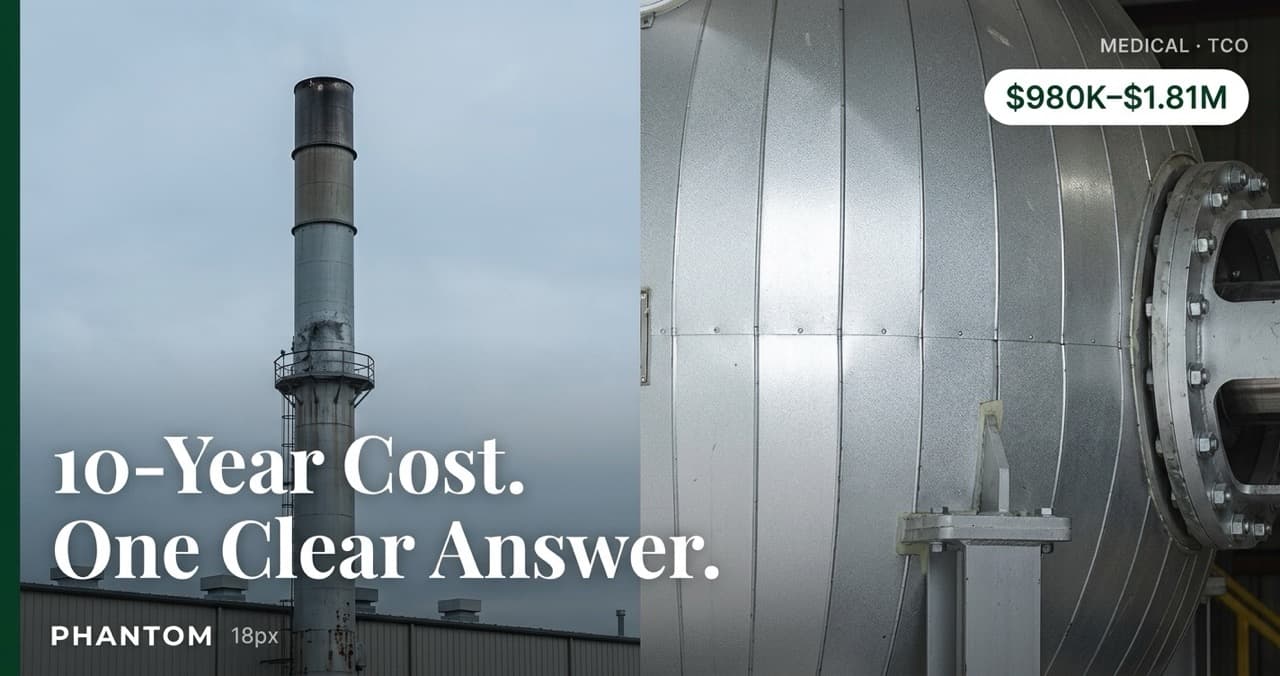
For the off-site and combustion routes, the ten-year ranges are well established: $1.37M–$2.23M for autoclave/ISS, $3.4M–$6.83M for compliant incineration, and $3.1M–$7.65M for third-party outsourcing, for a mid-size hospital generating ~730 tonnes of medical waste per year. On-site subcritical water hydrolysis (the Phantom 3M3) has the lowest fuel cost per tonne of the routes here and needs no flue-gas treatment; whether it gives the lowest ten-year total depends on the quoted price for your configuration, your waste volume and your local disposal costs.
The cost environment has shifted on three fronts. First, carbon pricing: the UK planned to bring waste incineration into the UK ETS from 2028, but on 26 August 2026 the government dropped that date and said a new timeline will follow; a monitoring and reporting phase began on 1 January 2026. Second, regulatory enforcement: the revised EU Industrial Emissions Directive (2024) now requires emissions monitoring during all operating periods including start-up and shutdown, adding six-figure compliance costs. Third, disposal economics: US landfill tipping fees average $62/tonne (EREF 2024), while fly ash from incinerators can trigger RCRA hazardous classification. Against this backdrop, the question is no longer which technology burns waste most efficiently. It is which technology converts waste into the lowest ongoing liability.
1. The Three Technologies: What They Actually Do
Three technologies dominate compliant medical waste treatment. Autoclaves sterilise but do not destroy volume. Incinerators destroy mass but create a mounting regulatory and carbon liability. Subcritical water hydrolysis treats waste, reduces volume by about 60%, and runs without combustion in the reactor.
Sterilises. Reduces. Zero emissions.
1.1 Autoclave / Integrated Sterilizer-Shredder (ISS)
Steam autoclave systems operate at 121–160°C and 0.15–0.3 MPa, holding pressurised steam in contact with waste for a defined exposure time (typically 30–60 minutes at temperature). The ISS variant integrates a mechanical shredder, which both confirms sterilisation by exposing all surfaces to steam and renders the waste unrecognisable, enabling disposal as municipal solid waste (MSW) in most jurisdictions. Volume reduction is 80–90%. Mass reduction is minimal: 5–20% (organic matter is not destroyed, merely sterilised).
1.2 Incineration (Dual-Chamber, With Air Pollution Control)
Dual-chamber medical waste incinerators combust waste at 850–1,200°C, achieving 90–95% mass reduction. However, this thermal destruction generates a complex regulatory burden: dioxins, furans, particulate matter, heavy metals, and greenhouse gases require mandatory continuous emissions monitoring (CEMS), scrubbers, activated carbon injection, and baghouse filters. In contrast, modern facility managers are increasingly pivoting toward non-combustion industrial waste treatment to bypass these heavy filtration costs entirely. In the EU and UK, incineration is subject to the strictest industrial emissions standards; in the US, the number of hospital/medical/infectious waste incinerators fell from about 2,400 in 1997 to 57 by 2009 (US EPA). Residual ash — bottom ash and fly ash — may be classified as hazardous, carrying a disposal premium over MSW.
1.3 Subcritical Water Hydrolysis — The Phantom 3M3
Subcritical water operates at conditions below the critical point of water (374°C, 22.1 MPa) where liquid water properties change dramatically: the hydrogen-bond network weakens, dielectric constant drops, and the H⁺ and OH⁻ ion product increases by several orders of magnitude. For a visual breakdown of how this phase change eliminates the need for combustion, explore our subcritical water technology overview. In this state, water acts as both a powerful acid-base catalyst and a solvent for organic polymers.
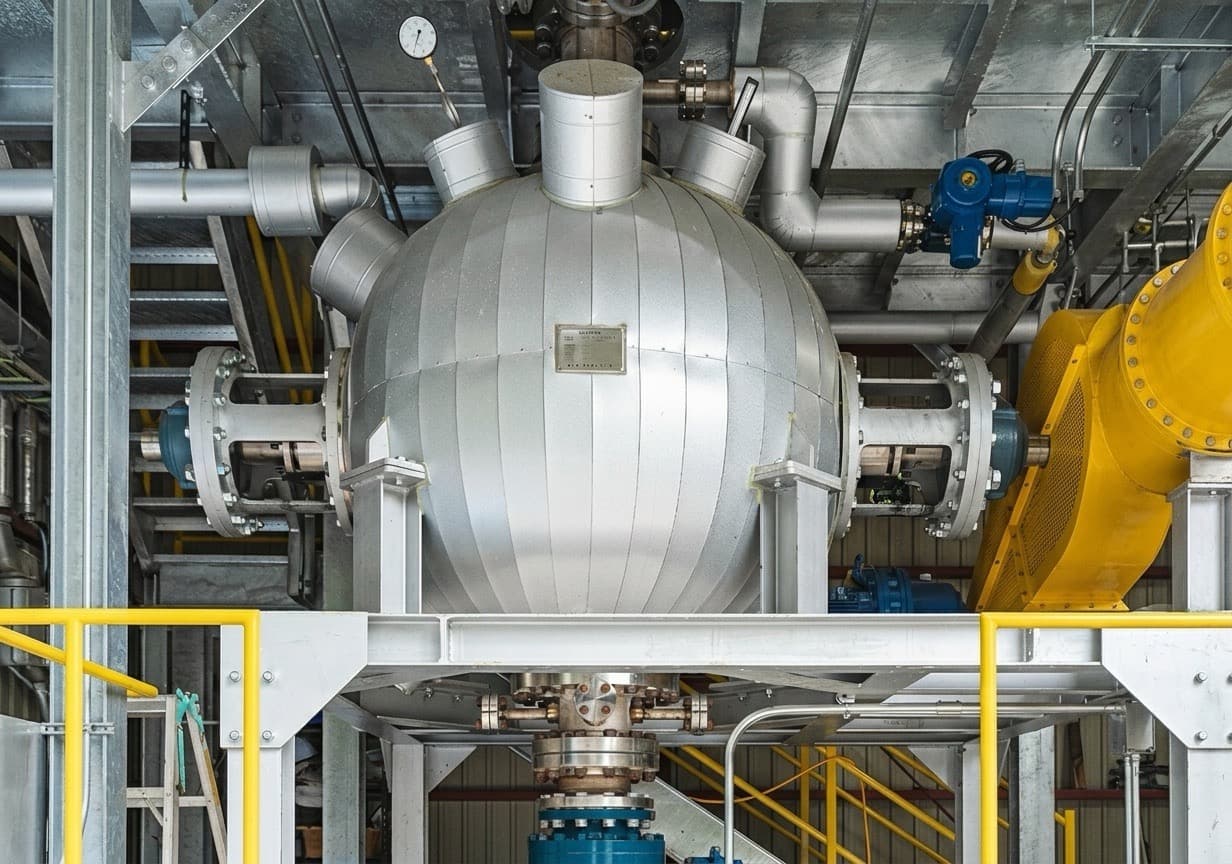
PHANTOM treats waste with steam at about 220–230 °C and about 2.5 MPa (25 bar), below the critical point of water (374 °C, 22.1 MPa). The Phantom 3M3 uses a sealed, round SUS304 stainless-steel pressure vessel (190 cm diameter) fed by a kerosene boiler. Each batch spends 15–20 minutes at treatment temperature; allowing for heating, loading and unloading, a batch takes about 30–50 minutes (manufacturer figures). Polymeric compounds, including plastics and biological tissue, are hydrolysed into low-molecular-weight fragments. No combustion takes place inside the reactor, so there is no incinerator flue gas and none of the conditions that form dioxins in incineration; the steam comes from a kerosene boiler, which emits CO₂ like any small boiler. From a 3-tonne batch, about 1.8 tonnes of wet, granulated solids come out: roughly 60–65% of the input mass and about 60% less volume.
In the UK, any alternative treatment used for infectious clinical waste must be validated to IStAATT Level III under HTM 07-01. That means at least a 6-log reduction of vegetative bacteria, fungi, viruses and mycobacteria, and at least a 4-log reduction of bacterial spores. It must also be authorised by the Environment Agency. Validation is specific to each site and waste stream. Ask us about validation for your application.
⚠️ Compliance Note — The "Recognisable Waste" Requirement
In the US (many state regulations) and the UK (Environment Agency guidance), treated medical waste cannot be classified as MSW if it remains visually recognisable — intact syringes, tubing, or sharps can still trigger regulated waste classification. The Phantom system's hydrolysis process breaks down soft organic tissue and flexible plastics; however, facilities handling hard sharps or rigid polycarbonate should confirm with Phantom Ecotech whether the configuration for their waste stream includes an integrated crusher/shredder stage. Address this during the design consultation.
2. Capital Expenditure (CapEx): What You Pay to Walk Through the Door
Initial capital expenditure for medical waste treatment ranges from about $130K for autoclave systems to $2.45M+ for a compliant incinerator at scale. On-site hydrolysis avoids the pollution-control stack, CEMS and flue that incineration requires; PHANTOM is quoted per project.
CapEx comparison at mid-size facility (~730 t/yr) level:
- Phantom 3M3 hydrolysis unit: quoted per project — no scrubbers, no CEMS, no stack required
- Autoclave / ISS: $130K–$825K installed — no air-emissions permit required
- Incineration (EPA/IED-compliant): $650K–$2.45M installed; pollution-control stack alone adds $300K–$1.3M
- Off-site outsourcing: $0 CapEx — but $427–$1,048/tonne all-in cost over 10 years
Applies to: Facilities with 1–3 tonnes/day waste generation seeking a capital purchase. Does NOT apply to large regional NHS trusts evaluating shared-service infrastructure — at that scale, economics and permitting pathway differ.
Example: A 200-bed private hospital choosing between an incinerator ($650K+ installed plus $300K+ pollution control) and an on-site PHANTOM unit avoids the pollution-control infrastructure incineration mandates. PHANTOM is quoted per project; configuration, waste stream, ancillary equipment and delivery terms all affect the price. Contact us for a quotation.
The installed CapEx comparison for mid-scale systems (1–3 tonnes/day):
- Autoclave / ISS: $130K–$825K installed. No air-emissions permit required. Building modifications are minimal.
- Incineration (EPA/IED-compliant): $650K–$2.45M installed; up to $4M+ for full HMIWI-compliant US systems. The pollution-control stack alone adds $300K–$1.3M. Environmental Impact Assessments run a further $25K–$100K+.
- Phantom 3M3: PHANTOM is quoted per project; configuration, waste stream, ancillary equipment and delivery terms all affect the price. Contact us for a quotation. Structurally, it needs no scrubbers, no CEMS and no stack — removing the flue-gas infrastructure that incineration mandates.
The permit gap is structurally important. An incinerator in the UK requires a bespoke Environment Agency permit at £8,000–£25,000+ (~$10,000–$32,000) with annual subsistence fees. In the US, a new HMIWI permit triggers MACT compliance, public notification, and state-level review — EPA does not expect any new HMIWI to be built. Non-incineration alternatives operate under simpler waste-treatment permits. For a stage-by-stage breakdown of the EA authorisation process — including the IStAATT lab testing costs and the pre-consultation requirement that terminates most first applications — see the IStAATT validation cost and timeline for on-site treatment.
3. Operating Expenditure (OpEx): The Numbers That Define Long-Term ROI
3.1 Energy: The Phantom's Most Disruptive Advantage
Fuel cost is up to about ¥5,000 of kerosene per 3-tonne batch, plus electricity and water (manufacturer estimate). Local fuel prices will change this. By comparison, compliant incineration runs $80,000–$150,000 annually in fuel and APC electricity costs for a facility at this throughput.
At a kerosene baseline of up to about ¥5,000 per batch, plus electricity and water, and with each batch processing up to 3 tonnes, the Phantom system's running cost is dominated by local fuel price. Incineration at the same throughput runs $80,000–$150,000 annually in fuel and APC electricity costs.
💡 Fuel Sensitivity Note: Kerosene price is the main variable in the Phantom's running cost. Local fuel prices will change the per-batch figure, so model your own fuel cost. EU industrial electricity at €0.19/kWh (Eurostat H1 2025) also inflates costs for electric-intensive autoclave systems.
3.2 Maintenance: The 10-Year Major Maintenance Advantage
Incinerators require refractory lining replacement every 2–5 years — a major recurring cost. The Phantom 3M3's major maintenance event is roughly every 10 years: boiler inspection and gasket/packing replacement (manufacturer). No refractory bricks. No scrubber chemicals. No CEMS calibration.
| Technology | Annual maintenance | Major maintenance event | Practical lifespan |
|---|---|---|---|
| Autoclave / ISS | $15,000–$25,000 | Overhaul every 5–10 yrs | 10–20 years |
| Incineration | $40,000–$80,000 | Refractory relining every 2–5 years | 5–10 years |
| Phantom 3M3 | Site-specific | Boiler inspection + gasket replacement every ~10 years (manufacturer) | 20+ years (SUS304 vessel) |
Over a 10-year horizon, an incinerator processing 730 tonnes/year will likely require two to four refractory relining events, multiple CEMS overhauls, and potentially a scrubber media replacement — adding $200,000–$400,000 to the maintenance total on top of annual OpEx.
3.3 Labor and Operator Requirements
Incinerators impose the highest labor certification burden. In the US, HMIWI operators must complete 24–40 hours of initial training and 8 hours of annual recertification under 40 CFR Part 60. Two to four operators are typically required per shift: $80,000–$120,000/year in loaded labor cost. Autoclave/ISS systems require 1–2 operators with basic training. Phantom operation — managing a kerosene boiler, loading, and monitoring the batch — is comparable in complexity at single-operator deployment.
3.4 Post-Treatment Disposal: The Hidden Cost Multiplier
Incinerator fly ash is frequently classified as hazardous waste, carrying a disposal premium over MSW. Autoclaved-and-shredded waste disposes as MSW at $35–$100/tonne. The differential is routinely absent from TCO calculations. It shouldn't be.
- Autoclave/ISS output: 80% volume reduction → 146 tonnes from 730 t input. Disposed as MSW at $35–$100/tonne (US average $62/tonne, EREF 2024). Annual disposal: $7,300–$14,600. (MSW classification requires the waste to be unrecognisable — the ISS shredder achieves this; a stand-alone autoclave without shredding may not.)
- Incineration output: 73 tonnes ash from 730 t input. Fly ash frequently classified as RCRA hazardous (concentrated heavy metals, potential dioxin residues). Disposal cost depends on classification and jurisdiction.
- Phantom 3M3 output: about 1.8 tonnes of wet, granulated solids per 3-tonne batch (roughly 60–65% of input mass; about 60% less volume). Manufacturer describes output as non-toxic solid, suitable for compost, fertiliser, or fuel feedstock by selective input. Disposal is site-specific — higher absolute tonnage than incineration, but no hazardous classification, and potential value recovery.
⚠️ Wastewater / Effluent Note: Subcritical water hydrolysis liquefies significant organic matter. While the Phantom 3M3's primary output is solid, process condensate and washwater from unloading carry elevated BOD and COD. Municipal sewer authorities typically set industrial surcharge thresholds at 250–500 mg/L BOD and 500–1,000 mg/L COD; discharge above these triggers trade-effluent consent fees or mandatory pretreatment. Facilities should: (a) confirm local trade-effluent thresholds, (b) request effluent characterisation data from Phantom Ecotech for their specific waste stream, and (c) budget for a settling/pre-screening stage if effluent volumes are significant.
4. Regulatory and Compliance Costs: The Escalating Tax on Incineration
Incineration faces a compound regulatory burden — dioxin testing ($15–50K per event) and continuous emissions monitoring ($10–30K/yr). Carbon pricing for clinical-waste incineration is not currently in force in the UK: the planned 2028 UK ETS start date was dropped in August 2026. A PHANTOM boiler is far below ETS thresholds, so it carries no ETS cost.
4.1 United Kingdom
- UK ETS carbon price: £41.84/tonne CO₂ (~$53/tonne) — 2025 carbon price for use in civil penalties; £49.41/tonne (~$63/tonne) — 2026 (GOV.UK determination). The market price was around £60/t in autumn 2026 (£62 on 29 September 2026) (S&P Global).
- UK ETS and incineration: The UK planned to bring waste incineration into the UK ETS from 2028, but on 26 August 2026 the government dropped that date and said a new timeline will follow. A monitoring and reporting phase began on 1 January 2026 (S&P Global).
- UK-EU ETS linkage: EU member states approved a negotiating mandate in November 2025; both sides aim to conclude a deal at a UK-EU summit later in 2026.
- NHS Clinical Waste Strategy targets 29,540 tonnes CO₂e/year reduction, projecting £11 million/year (~$14 million/year) in savings from shifting away from high-temperature incineration, under a 20:20:60 segregation target (high-temperature incineration : alternative treatment : offensive waste). See the NHS Clinical Waste Strategy.
- Landfill tax: £130.75 per tonne (standard rate) and £8.65 per tonne (lower rate) from 1 April 2026 (up from £126.15 in 2025–26). Landfill tax does not apply to incinerated waste.
4.2 European Union
Hazardous-waste incinerators, which include clinical waste, are outside the EU ETS. Municipal waste incineration is under review, with Commission proposals pointing to 2031–34.
- Industrial Emissions Directive (IED): dioxin/furan limit 0.1 ng TEQ/Nm³. Revised IED (August 2024) requires monitoring during all operating periods including start-up/shutdown. Monthly long-term dioxin sampling now mandatory. Annual IED compliance monitoring for a medium incinerator: €100,000–€250,000/year.
4.3 United States
- EPA HMIWI rules (40 CFR Part 60): the number of US hospital/medical/infectious waste incinerators fell from about 2,400 in 1997 to 57 by 2009 (US EPA). EPA does not expect any new HMIWI to be built. Today, most US regulated medical waste is now treated by non-incineration methods such as autoclaving.
- Annual HMIWI compliance costs: $50,000–$150,000/facility. Dioxin/furan stack testing: $15,000–$30,000 per event; comprehensive 9-pollutant testing: $30,000–$50,000 per event.
- No federal carbon pricing — but California, Washington, and northeast states have cap-and-trade mechanisms creating regional cost asymmetry.
4.4 Middle East (GCC)
- No carbon pricing in UAE, Saudi Arabia, Qatar, or Kuwait as of 2025.
- Fuel costs significantly below EU/US: Saudi diesel $0.48/L; UAE $0.78/L — 40–60% below European levels. This narrows the fuel-cost gap in the region.
- Water costs are high and rising: Dubai $2.10–$3.05/m³; Abu Dhabi $2.13–$2.83/m³. Confirm water demand and effluent volume during the design consultation.
5. The 10-Year Cost Comparison
Hydrolysis has the lowest fuel cost per tonne of the routes compared here, on manufacturer figures, and needs no flue-gas treatment. Whether it gives the lowest 10-year total cost depends on the quoted price for your configuration, your waste volume and your local disposal costs. Ask us for a facility-specific model.
Model assumptions: 200–500-bed hospital; ~2 t/day infectious waste; 730 t/year; USD baseline; US outsourcing at $440–$1,100/tonne regulated medical waste.
| Cost Category | Autoclave / ISS | Incineration (Compliant) | Phantom 3M3 | Outsourcing |
|---|---|---|---|---|
| CapEx (amortised/yr) | $25–40K | $60–150K | Quoted per project | $0 |
| Energy (annual) | $35–55K | $80–150K | Up to ~¥5,000 kerosene per 3 t batch (manufacturer estimate) + electricity/water | Included |
| Maintenance (annual) | $15–25K | $40–80K | Major service ~every 10 years (manufacturer) | Included |
| Labor (annual) | $50–70K | $80–120K | Site-specific | $15–25K |
| Regulatory / compliance | $5–15K | $20–50K | Site-specific | $5–10K |
| Post-treatment disposal | $7–15K | $7–73K (ash risk) | Site-specific | $292–730K |
| Total annual cost | $137–223K | $342–683K | Quoted per project | $312–765K |
| 5-Year TCO | $687K–$1.1M | $1.7M–$3.4M | Quoted per project | $1.6M–$3.8M |
| 10-Year TCO | $1.37M–$2.23M | $3.4M–$6.83M | Quoted per project | $3.1M–$7.65M |
| All-in cost per tonne | $188–305 | $468–935 | Site-specific | $427–1,048 |
Phantom cost figures are quoted per project; the energy line is the manufacturer's kerosene estimate. Autoclave, incineration and outsourcing figures are illustrative market ranges, not quotations.
For a facility-specific cost calculation based on your waste volumes, jurisdiction, and current disposal contracts, the PHANTOM organic waste treatment machine buyer's guide includes a free ROI calculator — or request a tailored financial model from our commercial team.
Structurally, the hydrolysis route has the lowest fuel cost per tonne of the options here, a 10-year major maintenance cycle that avoids the $200,000–$400,000 in cumulative refractory relining an incinerator incurs, and no flue-gas treatment train.
6. Where Does Each Technology Win by Region?
| Region | Regulatory / Cost Pressure | Phantom Viability |
|---|---|---|
| 🇬🇧 United Kingdom | High. The planned 2028 UK ETS start for waste incineration was dropped in August 2026; a monitoring phase began January 2026. NHS Net Zero mandate. Landfill tax £130.75/t from April 2026 (does not apply to incinerated waste). | Strong case. For a full seven-variable ROI model, see ROI of an Industrial Waste Processing Machine: A CFO's Guide. |
| 🇪🇺 European Union | Very high on IED. EU IED continuous monitoring. Hazardous-waste (incl. clinical) incinerators sit outside the EU ETS; municipal incineration is under review (2031–34). | Strong case. €100–250K/yr IED compliance avoided. |
| 🇺🇸 United States | Moderate (no federal carbon price). US HMIWI fell from ~2,400 (1997) to 57 (2009). Most US medical waste now treated by non-incineration methods. | Competes vs. autoclave + outsourcing ($427–1,048/t outsourcing). |
| 🌍 Middle East (GCC) | Low carbon pressure (no ETS). Cheap fuel ($0.48–0.78/L diesel). Water scarce ($2–3/m³). | Confirm water demand and effluent volume in design. Strongest case for ESG-mandated facilities. |
7. Phantom 3M3 Technical Specification
Below is the summary configuration; for full dimensional drawings and pump ratings, view the complete Phantom 3M3 specifications.
| Parameter | Phantom 3M3 Specification |
|---|---|
| Total Weight | 12 tonnes |
| Footprint | 5 × 7 × 7 m |
| Pressure Vessel | 190 cm diameter — SUS304 stainless steel |
| Operating conditions | about 220–230 °C at about 2.5 MPa (25 bar) |
| Inlet Diameter | 30 cm |
| Max Input per Cycle | 3 tonnes |
| Output per batch | ~1.8 t (about 35–40% mass reduction; ~60% volume reduction) |
| Treatment time | 15–20 min at temperature |
| Batch time | ~30–50 min incl. heating, loading and unloading |
| Operating Cost per Batch | Up to ~¥5,000 kerosene (manufacturer estimate) + electricity/water |
| Major Maintenance Interval | Every ~10 years (boiler inspection + gasket/packing replacement) |
| Emissions | Reactor: no combustion gases (manufacturer). Boiler: CO₂ from kerosene. |
| Acceptable Waste Streams | Food waste, livestock manure, fish/shells, wood, plastics (in plastic containers), medical waste, oil sludge, used diapers |
| Cannot Process | Glass, metal, stone |
| Output Use Cases | Compost, liquid fertiliser, fuel feedstock (by selective input) |
Kerosene is the main variable in the running cost; regional fuel pricing should be confirmed during the design consultation.
8. Frequently Asked Questions
NHS England's benchmarking data (ERIC 2019/20) puts the average cost of high-temperature incineration (HTI) of clinical waste at about GBP 617 per tonne, against GBP 419/t for alternative treatment such as autoclaving and GBP 298/t for offensive waste. These are pre-2021 averages and NHS England notes ERIC data contains reporting errors, so check your own contract. During the 2020-21 NHS Scotland contingency service, HTI cost about GBP 3,056/t including logistics, almost three times the GBP 1,075/t for alternative treatment.
Autoclaves avoid several incinerator cost categories: no pollution-control infrastructure, no continuous emissions monitoring, and no hazardous ash disposal premium. Industry benchmarks put autoclave operating costs below those of incineration, typically a 2–5× OpEx differential.
This is a critical compliance question for US and UK operators. The Phantom's subcritical water hydrolysis process breaks down organic polymer chains and soft plastics at temperature and pressure. However, hard sharps (needles, rigid polycarbonate) may not fully deform without a secondary shredder stage. Facilities operating in jurisdictions with a "recognisable waste" standard should confirm with Phantom Ecotech whether an integrated crusher/shredder module is available for their configuration.
The Phantom system produces a solid output rather than a liquid effluent. However, boiler condensate and washwater from unloading carry elevated BOD and COD. Most municipal sewer authorities set industrial surcharge thresholds at 250–500 mg/L BOD and 500–1,000 mg/L COD. Facilities should plan for an effluent pre-screening step and confirm local sewer authority thresholds before commissioning. Request effluent characterisation data for your specific waste stream during the design consultation with Phantom Ecotech.
Not automatically — but the risk is significant. Fly ash from medical waste incineration concentrates heavy metals (Cd, Ni, Cu, Cr, Pb, Zn) and may contain dioxin residues, making RCRA hazardous classification in the US highly probable. UK Environment Agency guidance treats clinical waste incineration residues as requiring specialist disposal by default.
Payback depends on the quoted price for your configuration and your daily waste volume, set against your current disposal contract. Against US outsourcing at $440–$1,100/tonne, on-site treatment systems typically pay back within a few years, but the decisive variables are the quote and throughput. Ask us for a facility-specific model.
The Bottom Line
The regulatory trajectory is clear, and so is the operating-cost gap between combustion and non-combustion routes.
The EU's IED monitoring burden and the US outsourcing baseline of $427–$1,048/tonne point to the same conclusion: for facilities running incineration or outsourcing, the ongoing liability keeps climbing. What on-site hydrolysis costs in total depends on the quote for your configuration and your volume — so the right next step is a facility-specific model.
Use the PHANTOM ROI calculator for a facility-specific estimate, or contact our engineering team for a full cost calculation and system specification. For care home and nursing home operators where incontinence waste dominates the clinical stream, see our dedicated nursing home clinical waste disposal cost per bed analysis.
Cite this article: Phantom Ecotech Research Team. (2026, March). "Medical Waste TCO: Autoclave vs. Incineration vs. Hydrolysis." Phantom Ecotech. https://phantomecotech.com/blog/medical-waste-tco-autoclave-incineration-hydrolysis#non-incineration-treatment-comparison
Published: March 2026. Last updated: October 2026. Author: Phantom Ecotech Research Team.
Sources: NHS England Clinical Waste Strategy and appendices; NHS Scotland contingency tonnages and cost (FOI); US EPA HMIWI fact sheet (40 CFR Part 60); EU Industrial Emissions Directive (2010/75/EU, revised 2024); UK ETS GOV.UK civil-penalty carbon price; S&P Global — UK ETS waste incineration delay; S&P Global — UK carbon prices Sep 2026; EREF 2024 Landfill Cost Report; Rizan et al. (2021) "The carbon footprint of waste streams in a UK hospital," Journal of Cleaner Production. GBP/USD conversion based on prevailing exchange rate at time of publication (~1.27 USD/GBP); actual rates will vary.
⚠️ Disclaimer: The financial figures, regulatory citations, and cost comparisons in this article are compiled from publicly available industry reports, academic research, and manufacturer-reported data, and are provided for general informational and illustrative purposes only. They do not constitute legal, financial, regulatory, or procurement advice. All cost estimates — including capital expenditure, operating costs, regulatory fees, and carbon pricing projections — are subject to significant variation based on facility size, geographic location, waste stream composition, local regulatory requirements, currency fluctuations, and market conditions at the time of procurement. GBP/USD conversions are approximate and based on the exchange rate prevailing at the time of publication. Carbon price projections are third-party forecasts and may differ materially from actual future prices. Readers should independently verify all figures with qualified engineers, procurement specialists, legal advisors, and the relevant regulatory authorities before making any investment, procurement, or operational decisions. Phantom Ecotech makes no representation or warranty regarding the accuracy, completeness, or fitness for purpose of third-party data cited in this article.