Article Series
What Is Zero Waste to Landfill?
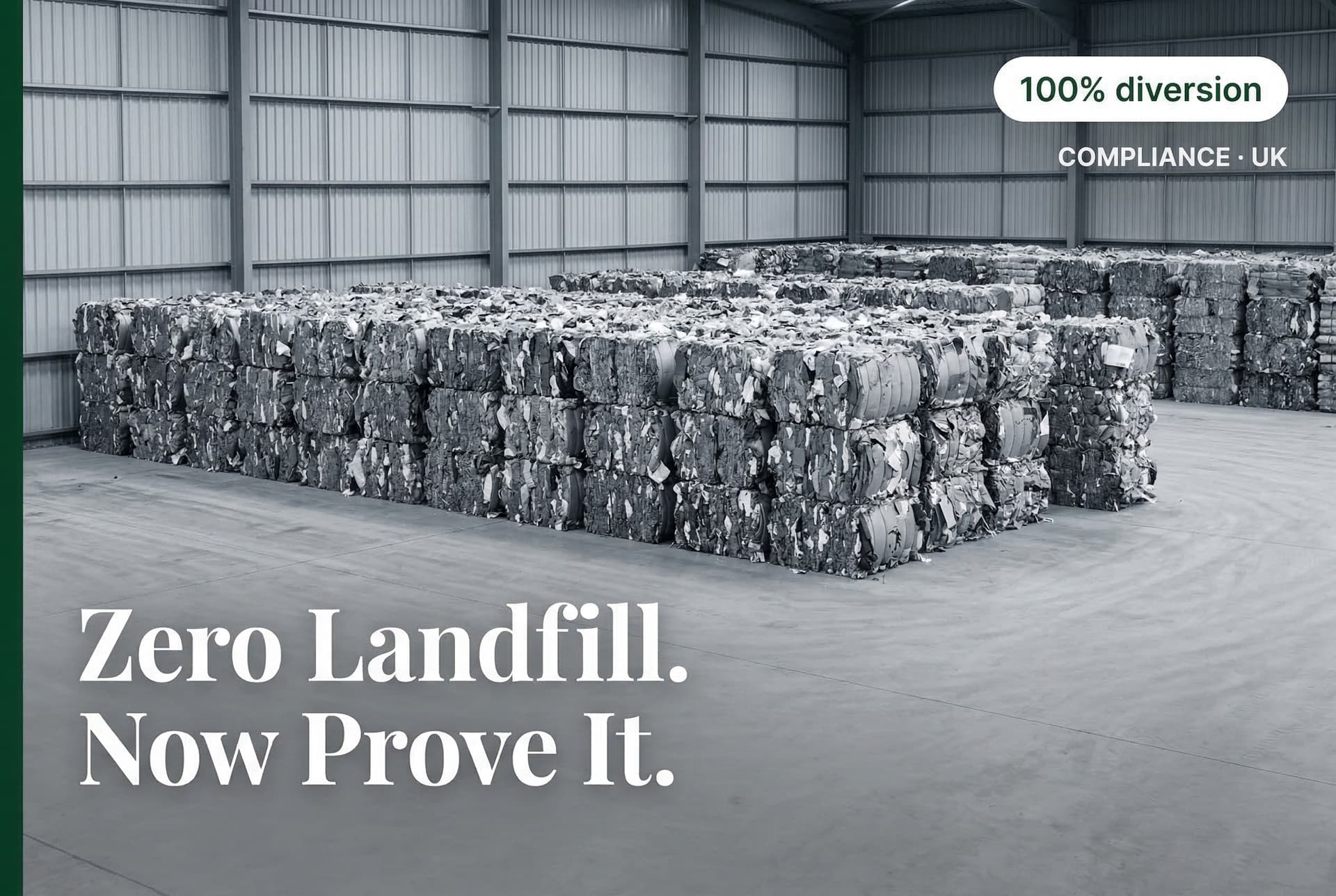
Zero Waste to Landfill (ZWFL) is the verified achievement of diverting 100% of a facility's waste output away from landfill disposal — including any overseas landfill — through reuse, recycling, recovery, or certified treatment processes.
Three elements that define a credible ZWFL claim:
- Scope: covers all waste streams generated at the facility — not just the easy-to-divert fractions
- Verification: third-party audit of waste transfer notes and disposal routes to confirm no material reaches landfill
- End routes: the diverted waste must go to genuine recovery (recycling, composting, energy from waste) — storage or export to markets with high landfill rates does not qualify under stricter standards
Applies to: any UK or EU facility aiming to eliminate landfill from its waste disposal mix — manufacturing, food processing, healthcare, hospitality, and retail.
Does NOT apply to: waste that is hazardous and has no available certified recovery route — these require specialist disposal and are typically treated separately from the ZWFL programme.
Example: A food manufacturer generating 500 tonnes/year of organic waste currently spending £205–285/t (~$260–362/t) all-in on landfill achieves ZWFL by installing on-site hydrothermal treatment — converting all 500 tonnes into sterile outputs. Annual avoided landfill cost: £102,500–142,500 (~$130,175–181,000). Scope 3 Category 5 reduction: ~99.7%.
Zero Waste to Landfill is not merely a sustainability aspiration — it is now a verifiable, auditable claim with recognised UK certification bodies and a growing mandatory reporting framework behind it. Understanding what ZWFL requires, which bodies certify it, and which technologies qualify is essential for any sustainability manager or procurement officer facing ESG disclosure deadlines in 2025 and beyond.
This article is part of the Zero-Emission Industrial Waste Treatment series — covering non-combustion waste treatment across industrial, manufacturing, and regulatory contexts.
UK ZWFL Certification Bodies and Standards
CIWM Verified Zero Waste to Landfill
The Chartered Institution of Wastes Management provides third-party audited ZWFL verification for UK facilities. Certification requires documentary evidence — waste transfer notes, consignment notes, contracts with licensed waste management facilities — demonstrating that no material from the facility's operations reached a landfill in the audit period. Annual re-certification maintains the claim and provides year-on-year trend data for CSRD reporting. CIWM-verified ZWFL status is accepted by UK retailers, supermarkets, and procurement officers requiring supplier ESG evidence as a condition of contract.
Valpak ZWFL Certification
Valpak is a commercial certification service used extensively by large UK manufacturers and retailers. It provides data analytics alongside ZWFL status reports, making it directly compatible with CSRD Scope 3 Category 5 reporting requirements. Valpak can audit multi-site operations and aggregate data across supply chains for group-level ZWFL claims.
TRUE Zero Waste (Green Business Certification Inc.)
TRUE is an international standard and the strictest available: it requires 90%+ genuine diversion from all disposal routes before certification is granted. Critically, TRUE counts incineration (Energy from Waste) as a disposal route — not as recovery — which is stricter than the default UK ZWFL norm where EfW typically counts as diversion. TRUE certification is used by multinationals operating cross-border ZWFL commitments where the lowest common denominator standard is insufficient for investor or customer scrutiny.
ISO 14001 Environmental Management
ISO 14001 is not a ZWFL standard directly, but provides the management system framework within which ZWFL programmes are designed, implemented, monitored, and improved. Auditable evidence of waste management objectives, measurable targets, and documented improvement trajectories are all required under ISO 14001 — making it the operational backbone on which formal ZWFL certification sits.
Why CSRD Has Made ZWFL a Board-Level Priority
From 2025, the EU Corporate Sustainability Reporting Directive (CSRD) mandatory Scope 3 reporting applies to large EU companies and EU-listed multinationals in Phase 1. Scope 3 Category 5 — waste generated in operations — requires:
- Quantification of methane emissions from landfilled organic waste. Methane has a global warming potential of 84× CO₂ over a 20-year horizon, making even modest organic waste landfill volumes a significant Scope 3 line item
- Full documentation of all waste management routes and their associated emissions
- A year-on-year improvement trajectory that can be independently audited
For companies with net-zero commitments, any material still going to landfill creates a documented Scope 3 liability that appears in mandatory ESG disclosures — visible to investors, customers, and regulators. The ESG audit trail now runs directly from the waste stream back to the board. See manufacturing waste carbon footprint for the full Scope 3 methodology and how waste disposal routes map to Category 5 emissions.
The UK Environment Act 2021 sets statutory targets for reducing residual waste going to landfill for local authorities, with equivalent industrial targets expected as the Environment Agency progressively tightens waste permit conditions. The direction of travel is clear: Germany, Austria, the Netherlands, Belgium, and Sweden have already effectively banned organic waste from landfill. The UK regulatory trajectory follows the same path, and facilities that achieve ZWFL ahead of mandatory requirements will avoid the regulatory and cost disruption of a forced transition.
The Waste Hierarchy and ZWFL Compliance
UK waste law is structured around a five-tier hierarchy, running from most preferred to least preferred:
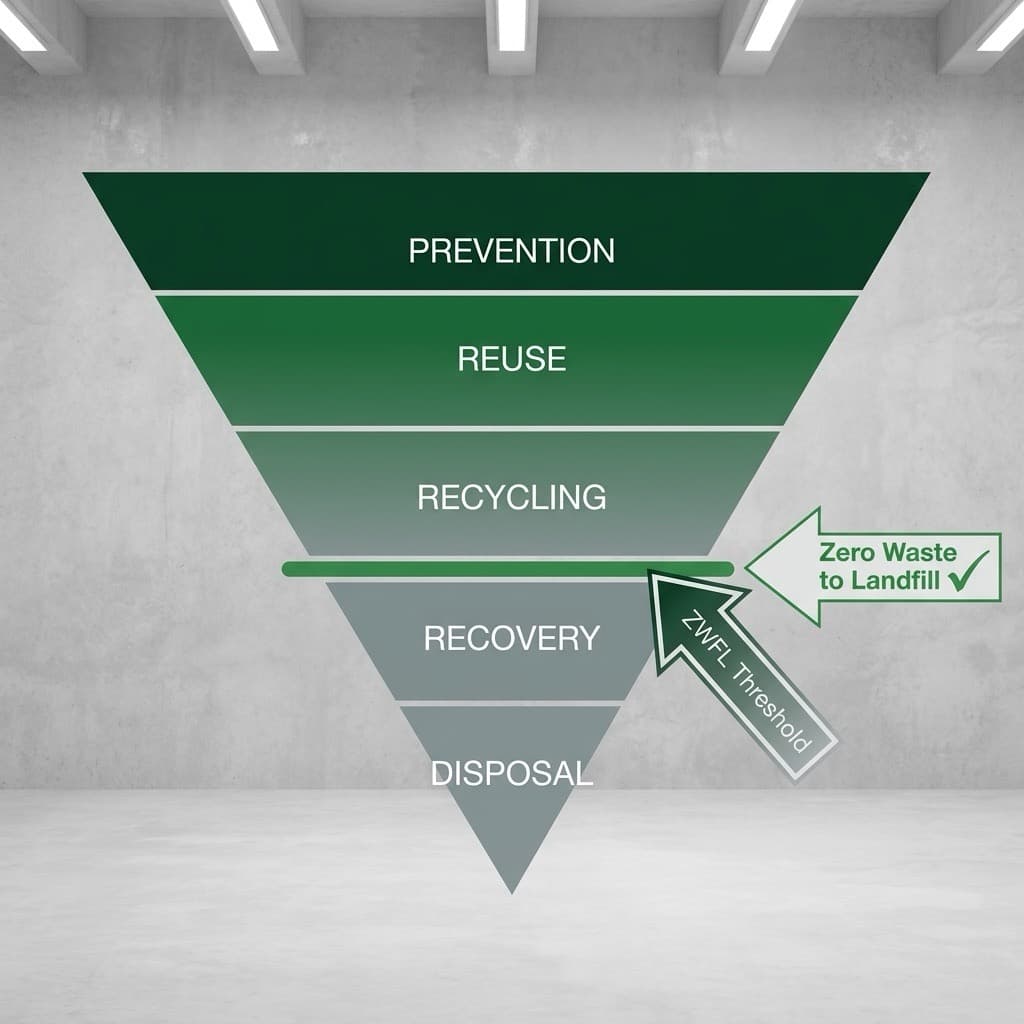
- Prevention — reduce waste generation at source before it arises
- Reuse — materials reused without treatment or reprocessing
- Recycling — materials recovered and reprocessed as secondary raw materials
- Recovery — composting, anaerobic digestion, energy from waste
- Disposal — landfill; the tier that a ZWFL programme eliminates entirely
Most UK ZWFL programmes operate primarily at tier 4 — sending residual non-recyclable waste to composting, AD, or EfW rather than landfill. The ongoing debate in stricter certification standards (particularly TRUE) concerns whether EfW counts as genuine recovery or whether it is effectively disposal-with-heat-recovery-credit — a distinction that matters for multinationals benchmarking against the most demanding global standards.
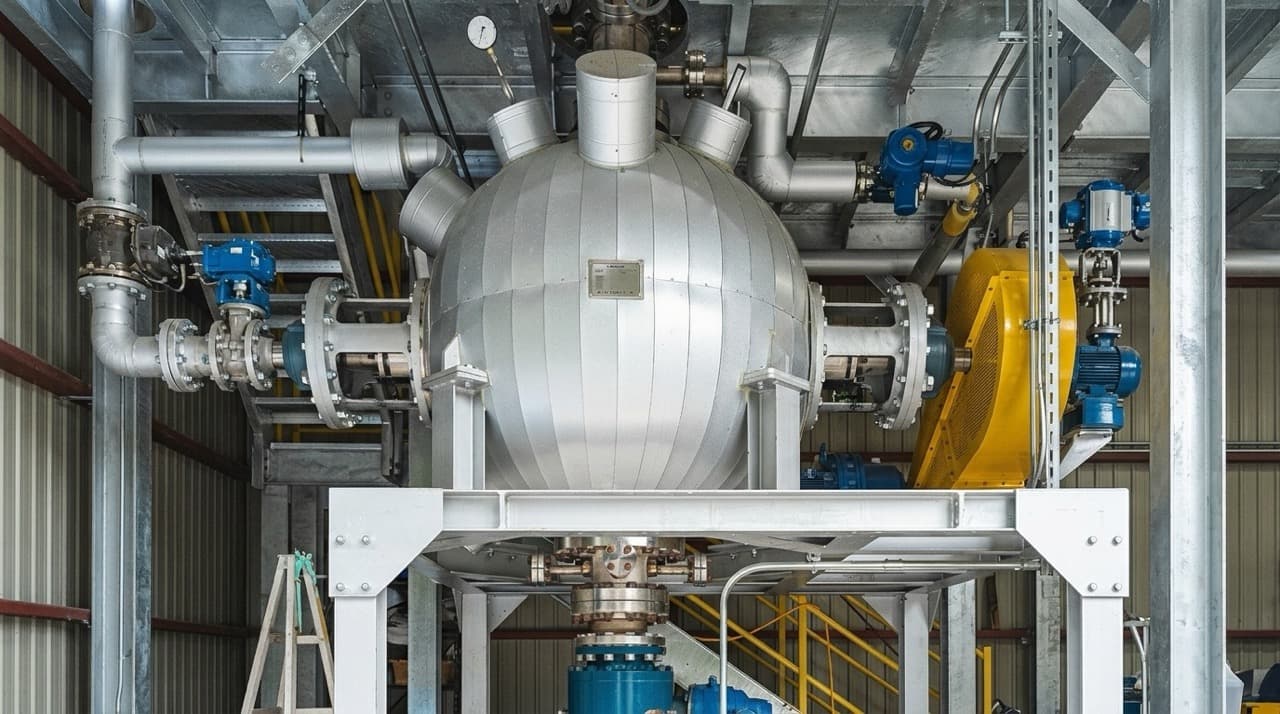
On-site treatment via subcritical water hydrolysis (PHANTOM) operates at tier 4, converting organic, medical, and mixed organic-plastic waste streams into sterile solid and liquid outputs. For clean organic inputs, these outputs can pursue compost or bio-coal end-of-waste classification under EA Quality Protocol or PAS 110 assessment — removing the material from the controlled waste stream entirely and advancing the facility to the boundary between tier 3 and tier 4. For full output specification and throughput data, see the PHANTOM organic waste treatment machine buyer's guide.
How to Achieve ZWFL — A Practical Roadmap
Step 1: Waste audit. Categorise all waste streams by type, weight, and current disposal route. Map precisely which streams currently reach landfill, in what volumes, and at what cost. This forms the baseline for certification and for CSRD Category 5 reporting.
Step 2: Identify diversion routes for each stream.
- Clean dry recyclables → licensed material recovery facility (MRF)
- Clean organics (food, green waste) → composting, AD, or on-site hydrothermal treatment
- Mixed organic and plastic streams → on-site subcritical water hydrolysis (PHANTOM converts both fractions simultaneously)
- Clinical and infectious medical waste → on-site subcritical hydrolysis to IStAATT Level III validation standard
- Contaminated or complex hazardous materials → specialist permitted treatment facility
Step 3: Contract and verify. Engage certified waste management facilities, verify EA carrier and permit registrations, and establish the transfer documentation trail required for third-party audit.
Step 4: Achieve and certify. Once 0% landfill diversion is verified across a full audit period, apply for CIWM or Valpak ZWFL certification. Maintain the programme annually.
Step 5: Report. Publish ZWFL status in CSRD Scope 3 Category 5 disclosures, annual reports, and supplier questionnaire responses.
For facilities with significant organic waste streams, on-site PHANTOM treatment is often the single intervention that eliminates the largest and most difficult-to-divert landfill fraction — and generates an auditable, independently defensible Scope 3 reduction for CSRD reporting. Request a free site assessment to model the ZWFL impact and payback period for your facility.
For the landfill cost context that underpins the financial case for ZWFL, see What Is the UK Landfill Tax and Who Pays It? and the PHANTOM vs Landfill cost comparison. For the full regulatory cost stack — landfill tax, EPR fees, Scope 3 obligations, and CBAM exposure — that makes ZWFL certification a commercial imperative, see UK Manufacturing Waste Compliance Costs: 2025 Guide.
Frequently Asked Questions
Figures are for informational purposes only and do not constitute legal, financial, or procurement advice. UK regulatory requirements and disposal rates based on 2026 industry data. ~1.27 USD/GBP.