Article Series
This guide covers the legal definition and classification framework. For the cost consequences of misclassification and how to reduce your disposal bill, see the HTM 07-01 Cost & Misclassification Guide →.
This article is part of the UK On-Site Medical Waste Treatment series — covering permits, validation, and treatment pathways for clinical and infectious waste in England, Wales, and Scotland.
The UK Legal Definition of Clinical Waste
Clinical waste in the UK is any waste arising from healthcare, veterinary, or research activities that poses a risk of infection, injury, or public health harm — requiring segregation, specialist packaging, and licensed disposal or treatment under HTM 07-01 and the Environmental Protection Act 1990.
Three characteristics define clinical waste classification:
- Origin: generated from healthcare (medical, dental, veterinary, laboratory, or research) settings
- Risk: may cause infection, injury, or public health harm to any person coming into contact with it
- Composition: includes human or animal tissue, blood, body fluids, sharps, pharmaceuticals, or contaminated dressings
Applies to: NHS trusts, private hospitals, care homes, dental practices, GP surgeries, veterinary practices, laboratories, and any facility generating waste meeting these criteria.
Does NOT apply to: administrative paper waste, catering waste, and general office waste from healthcare settings — these follow normal municipal disposal routes.
Example: A 100-bed hospital generates approximately 1–3 tonnes of clinical waste per week. At NHS incineration rates of £419–617/t (~$532–783/t), disposal costs run £21,000–96,000/year — before haulage charges.
The UK definition sits at the intersection of two legal instruments. The Environmental Protection Act 1990 (EPA 1990) provides the overarching statutory framework, imposing a duty of care on every person in the waste chain under Section 34. NHS England's Health Technical Memorandum 07-01 (HTM 07-01), updated in March 2023, provides the operational specification — defining which containers to use, which disposal routes are permissible, and which EWC codes to assign at the point of generation.
A key practical point: not everything generated inside a hospital is clinical waste. Over-classification — putting offensive/hygiene waste into infectious-stream containers — is one of the most common and costly errors in UK healthcare waste management. Understanding the precise boundary between HTM 07-01 categories is the first step in controlling disposal costs.
The Seven HTM 07-01 Categories
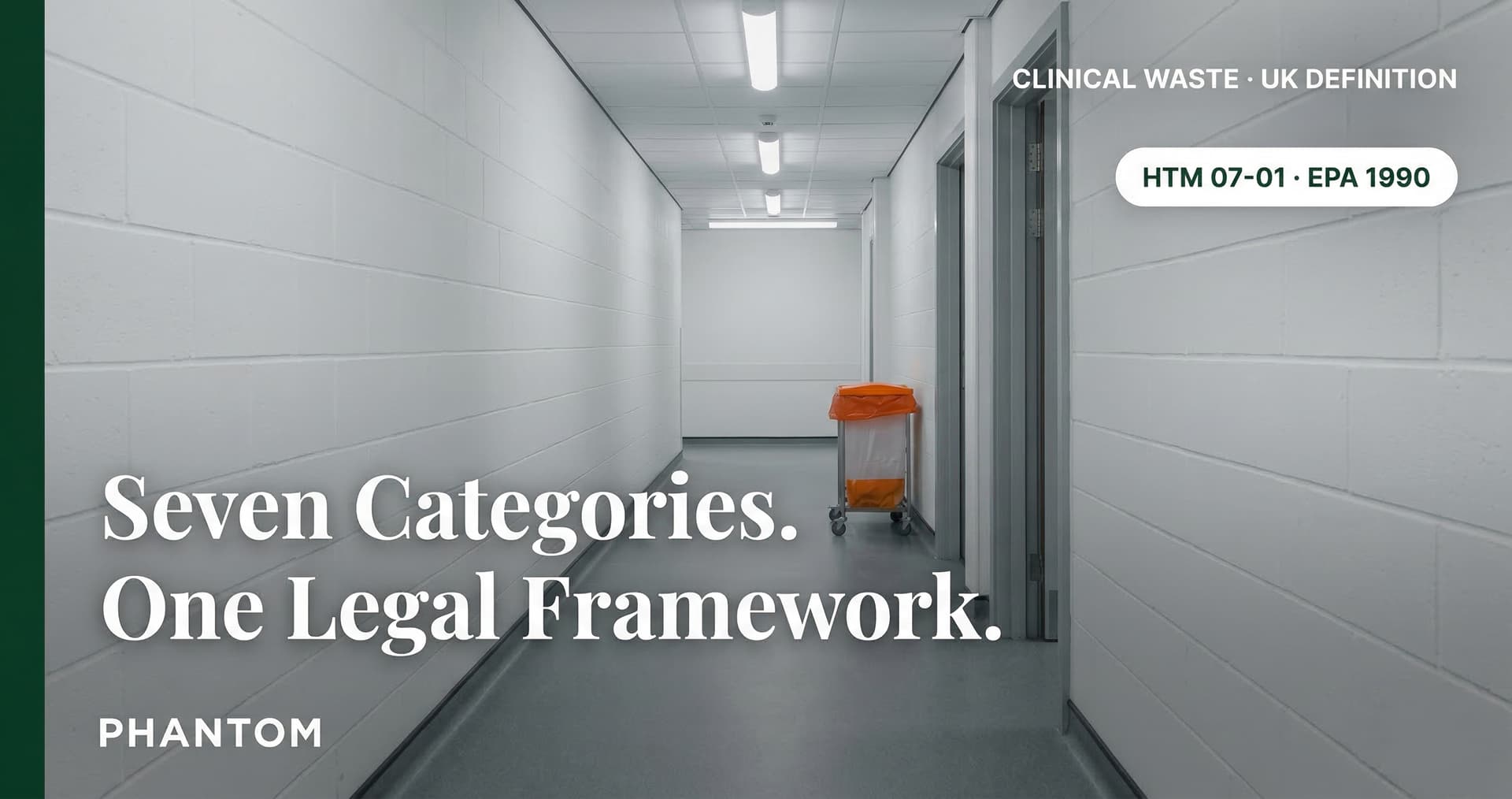
HTM 07-01 divides UK healthcare waste into seven categories — A through G — each assigned a specific container colour, EWC code, and lawful disposal route. Categories A and C (infectious streams) carry absolute hazardous classification and the highest disposal costs. Category G (offensive/hygiene waste) is non-hazardous and routinely over-classified into Category A — the single most common and costly error in UK healthcare waste management.
HTM 07-01 segments clinical and healthcare waste into seven distinct categories, each with a prescribed container, EWC code, and lawful disposal route.
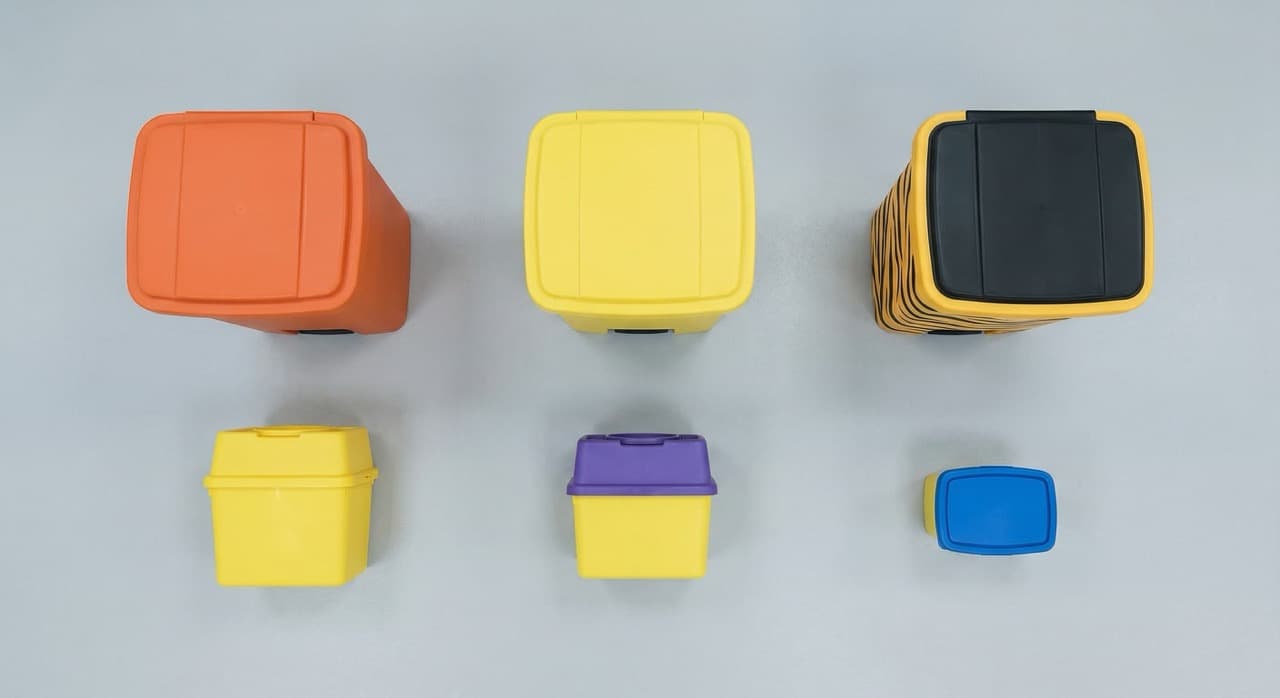
Category A — Infectious soft waste (orange bag): Contaminated dressings, swabs, gloves, and PPE from patients with confirmed or suspected infection. EWC 18 01 03* (hazardous). Route: alternative treatment (autoclave, hydrolysis) or incineration. This is the primary stream eligible for on-site subcritical water hydrolysis treatment.
Category B — Anatomical/recognisable tissue (yellow bag): Recognisable body parts, organs, and tissue arising from surgery or post-mortem. EWC 18 01 02. Route: high-temperature incineration or specific licensed disposal. Not eligible for alternative treatment.
Category C — Sharps (yellow-lidded sharps bin): Needles, scalpels, lancets, syringes with needles attached. EWC 18 01 01 (non-infected) or 18 01 03* (infected). Route: incineration or alternative treatment depending on contamination status. Metal sharps must be pre-sorted from soft organic waste before hydrolysis processing.
Category D — Pharmaceutical waste (white-lidded container): Expired medications, residual drugs, and pharmaceutical products. EWC 18 01 08* (cytotoxic medicines) or 18 01 09 (non-hazardous pharmaceutical waste). Route: high-temperature incineration for the majority; some non-hazardous pharmaceutical waste has alternative disposal routes.
Category E — Cytotoxic and cytostatic waste (purple-lidded container): Chemotherapy drugs, antineoplastic agents, and all waste contaminated with cytotoxic residues. EWC 18 01 06* or 18 01 08*. Route: mandatory high-temperature incineration at ≥1,100°C. No exceptions. No alternative treatment route exists in UK regulation.
Category F — Radioactive waste: Waste contaminated with radioactive isotopes from diagnostic imaging or radiotherapy. Handled under the Environmental Permitting (Radioactive Substances) framework — entirely separate from the clinical waste contractor system.
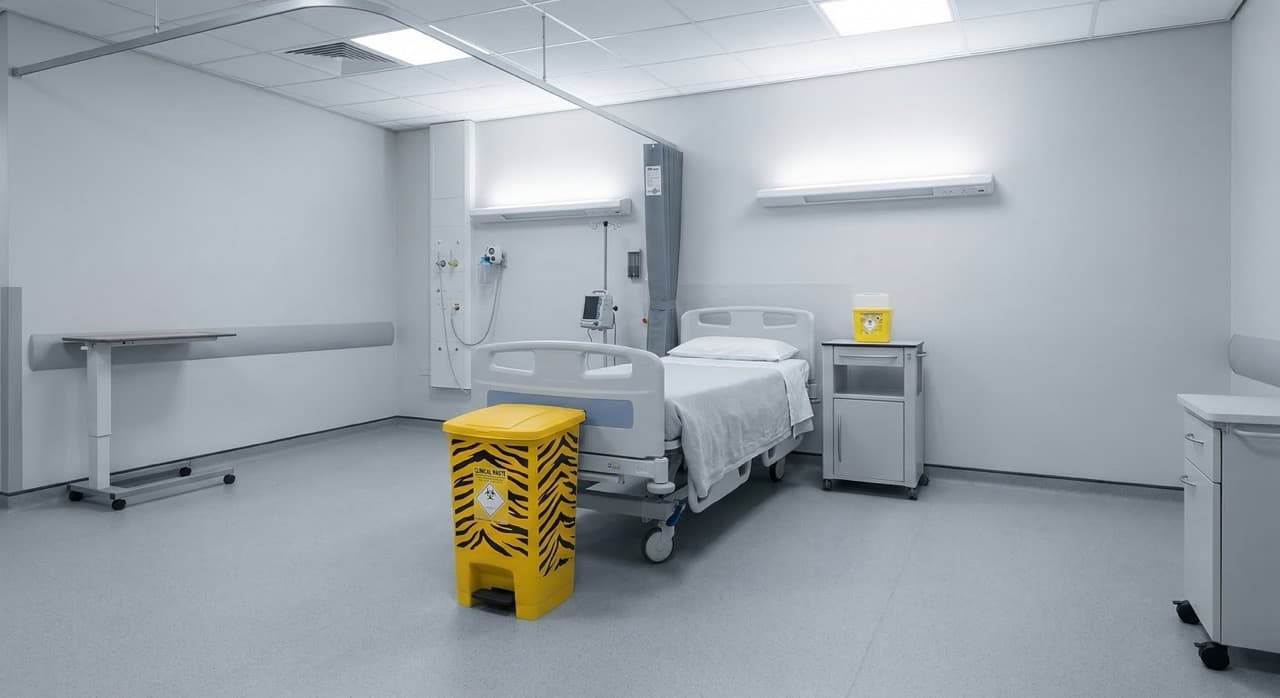
Category G — Offensive/hygiene waste (tiger-stripe or black bag): Incontinence products, nappies, colostomy bags, and PPE from non-infected patients. EWC 18 01 04 (non-hazardous). Route: municipal landfill, energy-from-waste, or deep burial — no clinical treatment required. This stream must not be misclassified as Category A. For facilities managing high volumes of this stream — particularly nursing homes — see the nursing home incontinence waste disposal cost guide.
Key EWC code reference:
| EWC Code | Description | Hazardous? |
|---|---|---|
| 18 01 01 | Sharps without infection risk | No |
| 18 01 02 | Anatomical waste | Yes |
| 18 01 03* | Infectious waste requiring special handling | Yes (absolute) |
| 18 01 04 | Non-infectious waste — not starred | No |
| 18 01 06* | Chemicals consisting of or containing hazardous substances | Yes (absolute) |
| 18 01 07 | Chemicals not in 18 01 06* | No |
| 18 01 08* | Cytotoxic and cytostatic medicines | Yes (absolute) |
| 18 01 09 | Medicines other than 18 01 08* | No |
Codes marked with an asterisk (*) carry an absolute hazardous classification under the List of Wastes (England) Regulations 2005 — they cannot be reclassified as non-hazardous by any dilution or mixing process.
Disposal Cost Ranges by Category
Disposal costs range from approximately £80–180/t for offensive/hygiene waste (tiger-stripe bags) to £419–617/t for NHS-contracted infectious streams — with cytotoxic waste reaching £600–1,200/t. For a full per-category cost breakdown, sharps misclassification penalties, and on-site treatment economics, see the HTM 07-01 Cost & Misclassification Guide →.
Segregation at Source — Why It Matters
Correct segregation is a statutory obligation under Section 34 EPA 1990 (Duty of Care) — not a best practice. Misclassification runs in both directions: genuinely infectious material placed in non-infectious containers creates CQC enforcement risk; non-infectious waste placed in orange bags routes to unnecessarily expensive disposal streams. Surveys consistently show 40–60% of orange-bag content could lawfully be tiger-stripe instead.
For the full financial analysis — including the £11m/year NHS misclassification cost, per-tonne saving calculations by correction type, and on-site treatment options — see the HTM 07-01 Cost & Misclassification Guide →.
For facilities managing large volumes of single-use plastics and PPE, see hospital single-use plastics and PPE waste management.
On-Site Treatment Options
HTM 07-01 permits on-site treatment of Category A (orange bag) infectious soft waste, subject to a bespoke Environmental Permit from the Environment Agency and on-site clinical waste treatment validation UK. The three available routes are autoclave sterilisation, off-site incineration, and subcritical water hydrolysis — each with distinct cost, compliance, and operational profiles.
Why on-site treatment changes the cost equation: NHS incineration contracts run £419–617/t (~$532–783/t). Autoclave sterilisation reduces that to approximately £20–60/t but leaves residual waste requiring further licensed disposal. Subcritical water hydrolysis via PHANTOM on-site clinical waste treatment system operates at approximately £11–33/t (~$14–42/t) — with no residual waste stream, no off-site haulage cost, and three sellable outputs (compost, liquid fertiliser, and solid fuel). For a medium-volume NHS trust generating 300 tonnes/year of Category A waste, the difference between incineration and on-site hydrolysis is approximately £120,000–175,000/year (~$152,000–222,000) in disposal costs alone.
Capital payback context: The PHANTOM unit typically reaches payback in 18–28 months for facilities treating 100+ tonnes/year of clinical waste, based on disposal cost elimination alone — before factoring in output revenue from the liquid fertiliser and bio-coal streams.
For operating costs by route, EA permit obligations, capital payback calculations, and the full IStAATT validation framework, see the HTM 07-01 Cost & Misclassification Guide →.
UK healthcare providers managing clinical waste streams can request a free feasibility assessment to evaluate on-site hydrolysis treatment costs against current contracted disposal rates.
Frequently Asked Questions
Under the Environmental Protection Act 1990 and HTM 07-01, clinical waste is any waste arising from healthcare activities that may cause infection, injury, or public health risk — including human tissue, blood, body fluids, pharmaceutical products, sharps, and dressings that have been in contact with patients.
Orange bags — infectious soft clinical waste for alternative treatment or incineration. Yellow/striped bags — infectious waste for incineration only. Purple-lidded containers — cytotoxic and cytostatic waste (mandatory incineration). White-lidded containers — pharmaceutical waste. Black bags — offensive/hygiene waste (non-infectious), suitable for municipal disposal. Tiger-stripe bags — offensive/hygiene waste for energy-from-waste or landfill.
Disposal costs by classification: offensive/hygiene (black bag) £80–180/t (~$102–229/t); infectious soft waste (orange bag) £200–400/t (~$254–508/t) for private healthcare; NHS incineration contracts £419–617/t (~$532–783/t). On-site subcritical water hydrolysis treatment via PHANTOM reduces operating cost to approximately £11–33/t (~$14–42/t), eliminating the off-site disposal contract entirely.
Yes. HTM 07-01 permits on-site treatment of Category A (orange bag) infectious soft waste subject to regulatory approval. The PHANTOM subcritical water hydrolysis system is validated to IStAATT Level III — the highest non-incineration standard in the UK — achieving >99.9999% (6-log) pathogen reduction. On-site treatment requires a bespoke EA Environmental Permit under the Environmental Permitting (England and Wales) Regulations 2016. The typical permitting timeline is 9–12 months. For a full stage-by-stage cost and timeline breakdown, see the guide to on-site clinical waste treatment validation UK.
Sources: Environmental Protection Act 1990; NHS England Health Technical Memorandum 07-01 (2023 edition); List of Wastes (England) Regulations 2005; Environmental Permitting (England and Wales) Regulations 2016; NHS Clinical Waste Strategy (March 2023). Disposal rates based on UK 2026 industry averages.
Figures are for informational purposes only and do not constitute legal, financial, or procurement advice. Disposal rates based on UK 2026 industry averages. ~1.27 USD/GBP.