Article Series
The fastest cost fix for UK clinical waste: immediately reclassify incontinence pads and non-infectious ward waste from orange bags to tiger-stripe bags (EWC 18 01 04) — saving £121/tonne on the next collection cycle, with zero additional regulatory complexity. For persistent, structural cost reduction, install on-site subcritical water hydrolysis to break the incineration contractor dependency entirely — cutting treatment cost from £419–£617/tonne to approximately £11/tonne, with capital payback in 18–30 months for facilities generating ≥2 tonnes per week.
UK hospitals and care homes are losing an estimated £11 million a year to a single, fixable error: clinical waste misclassification. This guide covers the cost diagnosis, bag colour reference, and how to eliminate the incineration contract dependency entirely. If you need the foundational definitions first — what legally constitutes clinical waste and the seven HTM 07-01 categories — start with the UK Clinical Waste Classification Guide →.
Clinical Waste Classification Checker
Select your waste source and type to get the correct bag or container colour, EWC code, and legal disposal route under HTM 07-01.
What Are the Correct Bag Colours, EWC Codes, and Disposal Routes Under HTM 07-01?
Correct segregation at source is not a best practice — it is a regulatory obligation. Getting it wrong is the single largest driver of avoidable disposal cost in the NHS.
Direct Conclusion: HTM 07-01 assigns a specific bag or container colour to each waste stream, tied to a corresponding European Waste Classification (EWC) code and a legally permissible disposal route. Confusing orange, yellow, and tiger-stripe bags — the three most commonly mixed up at ward level — can add £199–£319/tonne to your disposal costs on every collection cycle. For the full seven-category classification framework and EWC code reference, see the UK Clinical Waste Classification Guide →.
The core streams and their correct codes:
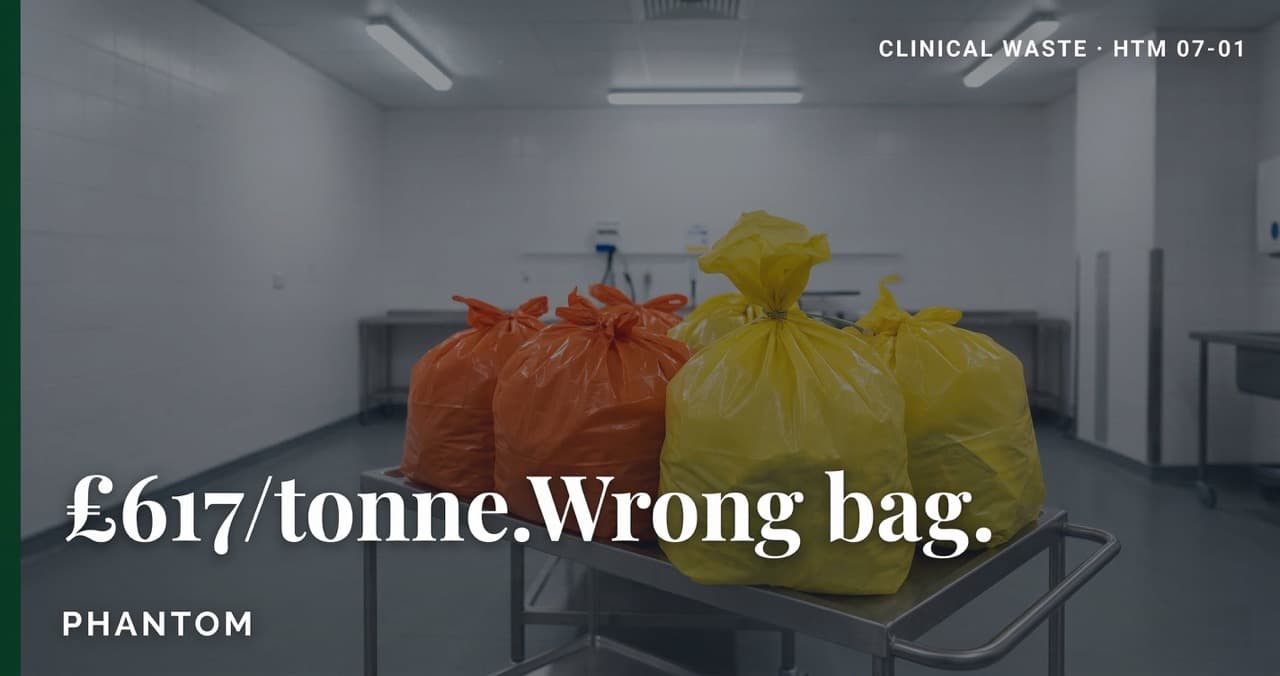
- Orange bags — Infectious waste, no medicinal contamination | EWC 18 01 03* | Alternative treatment OR incineration | £419/tonne avg.
- Yellow bags — Infectious waste contaminated with medicines or chemicals | EWC 18 01 03* + 18 01 06* | High-temperature incineration only | £617/tonne avg.
- Tiger-stripe bags (yellow/black) — Offensive/hygiene waste, non-infectious | EWC 18 01 04 | Energy-from-waste, landfill, or incineration | £298/tonne avg.
- Purple-lidded containers — Cytotoxic/cytostatic waste | EWC 18 01 08* | High-temperature incineration only | £617/tonne+
- Blue-lidded containers — Non-cytotoxic pharmaceutical waste | EWC 18 01 09 | Incineration | £450–£550/tonne
- Red bags — Anatomical waste | EWC 18 01 02 / 18 01 03* | Incineration only | £617/tonne+
This applies when you are generating waste in England under an Environment Agency permit obligation and procuring disposal through a licensed clinical waste contractor. It does not apply if you are generating waste classified under agricultural, veterinary, or research laboratory frameworks, which carry separate EWC chapters and disposal routes.
Scenario: A care home generates incontinence pads and used PPE from non-infectious residents on a standard ward. Correct action: segregate the incontinence pads and non-contaminated PPE into tiger-stripe bags (EWC 18 01 04), not orange bags. Result: disposal cost drops from £419/tonne to £298/tonne — a £121/tonne saving on every collection cycle, with zero additional regulatory risk.
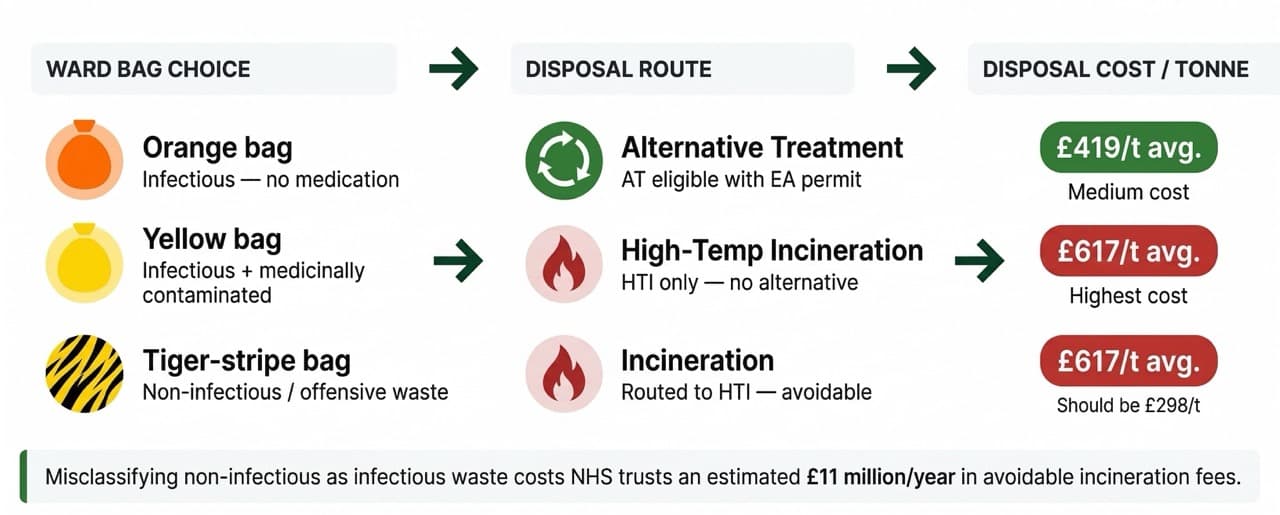
HTM 07-01 Clinical Waste Classification Reference
Correct bag / container, EWC code, disposal route, and alternative treatment (AT) eligibility by stream.
| Container | Waste Type | EWC Code | Disposal Route | AT? | Cost/Tonne |
|---|---|---|---|---|---|
Orange bag | Infectious — no medicinal contamination | 18 01 03* | AT or incineration | Yes | £419 |
Yellow bag | Infectious — medicinally contaminated | 18 01 03* + 18 01 06* | HTI only | No | £617 |
Tiger-stripe bag | Offensive / hygiene — non-infectious | 18 01 04 | EfW / landfill / incineration | N/A | £298 |
Purple-lid container | Cytotoxic / cytostatic waste | 18 01 08* | HTI only — dedicated | No | £617+ |
Blue-lid container | Non-cytotoxic pharmaceutical | 18 01 09 | Incineration | No | £450–£550 |
Red bag | Anatomical waste | 18 01 02 / 18 01 03* | HTI only | No | £617+ |
Orange-lid sharps | Sharps — no drug contamination | 18 01 03* | AT or incineration | Yes | £419 |
Yellow-lid sharps | Sharps — medicinally contaminated | 18 01 03* + 18 01 06* | HTI only | No | £617 |
HTI = High-Temperature Incineration. AT = Alternative Treatment (autoclave, hydrolysis). Cost figures based on NHS ERIC averages. EWC codes under UK Hazardous Waste Regulations 2005 (as amended). Sources: HTM 07-01, NHS Clinical Waste Strategy 2023, EA EPR 5.07.
Why Does HTM 07-01 Misclassification Cost NHS Trusts £11 Million a Year?
The £11 million annual figure is not an estimate — it is the NHS's own calculation, published in the 2023 NHS Clinical Waste Strategy. The mechanism is straightforward: when non-infectious waste enters infectious bins, it travels to the most expensive disposal stream. The volume inflates. The cost compounds with every collection cycle.
Direct Conclusion: Clinical waste bin audits consistently show that 59% of items found in orange clinical bins are non-clinical waste — predominantly packaging, paper towels, and non-infectious disposables. Every kilogram of that material is being incinerated at £419–£617/tonne when it should cost £298/tonne or less. For a 300-bed trust generating three tonnes of clinical waste daily, this misclassification inflates annual disposal spend by approximately £380,000. Reducing that single-use burden at source is covered in our guide to PPE and single-use plastic waste management.
The top five misclassification errors at ward level:
- Incontinence pads from non-infectious patients placed in orange bags instead of tiger-stripe
- Packaging waste (cardboard, plastic wrapping) entering clinical bins from procedure rooms
- All operating theatre waste defaulted to orange bags regardless of patient infection status
- Yellow bags used where orange bags are legally sufficient — routing non-medicinally contaminated waste to incineration-only streams
- Tiger-stripe bags not available at point of use, forcing staff to default to the nearest orange bin
This applies when waste is generated in a ward, theatre, or care setting where staff are selecting bag colour at point of use. It does not apply to high-risk specialties generating waste from ACDP Hazard Group 3 or 4 organisms, where orange or yellow bags are always mandatory regardless of infectious status.
Scenario: A study at St Mary's Hospital (Imperial College NHS Trust) found that all operating theatre waste was defaulting to orange clinical bags regardless of patient status or procedure type. After introducing tiger-stripe bags and point-of-use education materials, the trust achieved a 74.7% reduction in incorrectly streamed waste and a 57.1% cost reduction per kilogram disposed.
What Does an HTM 07-01 Sharps Misclassification Actually Cost?
Sharps are one of the most frequently over-classified waste streams in UK healthcare. The lid colour system is separate from the bag colour system — and getting it wrong routes sharps to a higher-cost incineration stream automatically, on every collection.
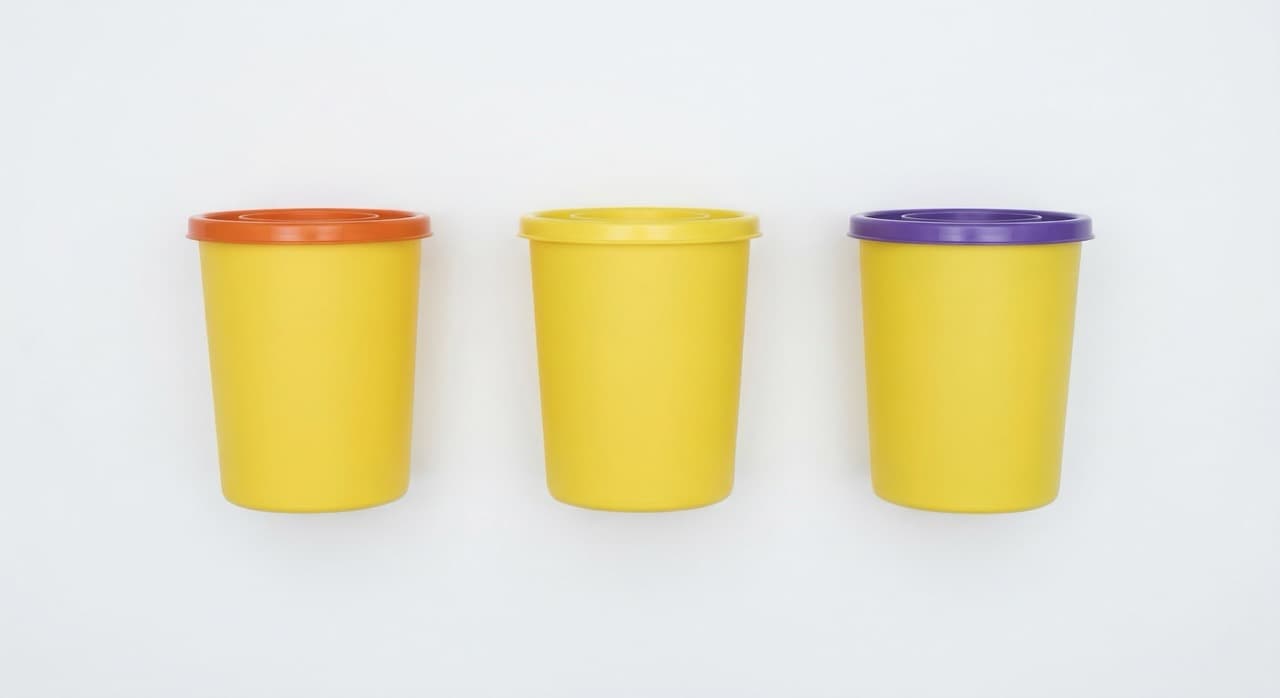
Direct Conclusion: UK sharps containers follow a lid-colour system that mirrors the bag system. Yellow-lidded sharps containers must go to high-temperature incineration at approximately £617/tonne. Orange-lidded sharps containers are eligible for cheaper alternative treatment at approximately £419/tonne. Defaulting to yellow-lidded containers when orange is legally appropriate costs £198/tonne more per cycle — on every sharps disposal movement.
The sharps lid system:
- Orange lid — Sharps with infectious but no medicinal contamination | Alternative treatment eligible | ~£419/tonne
- Yellow lid — Sharps contaminated with medicines or cytotoxic/cytostatic drugs | Incineration only | ~£617/tonne
- Purple lid — Sharps from cytotoxic/cytostatic drug administration | Incineration only | ~£617/tonne+
- Blue lid — Non-infectious sharps, no drug contamination | Incineration (non-hazardous route)
This applies when sharps are generated from standard clinical procedures — venepuncture, insulin injections, IV lines. It does not apply to sharps from chemotherapy administration, controlled drug preparation, or any procedure involving hazardous pharmaceutical agents, where yellow or purple lids are always mandatory.
Scenario: A GP surgery with 10 consulting rooms switching from yellow-lidded to orange-lidded containers for standard blood draw and vaccine administration sharps. Annual sharps volume: 200 kg. Cost shift from yellow (incineration, ~£617/tonne) to orange (alternative treatment, ~£419/tonne): saving of ~£40/year per surgery. Multiplied across 6,000 GP practices in England, the sector-level saving exceeds £240,000 annually.
How Much Does a STAATT Level III Validation Failure Cost a UK Facility?
Facilities running on-site alternative treatment — autoclaves, microwave systems, or hydrolysis units — operate under a strict EA validation framework. Failure to maintain current validation is not a procedural oversight. It is a criminal exposure under the Environmental Permitting Regulations 2016.
Direct Conclusion: On-site clinical waste treatment in England requires a bespoke Environmental Permit, and treatment operations cannot commence until the Environment Agency provides written approval of the commissioning validation report. STAATT Level III microbial inactivation is the mandatory minimum — demonstrating ≥6 log₁₀ reduction of all standard pathogens and ≥4 log₁₀ reduction of Geobacillus stearothermophilus spores under worst-case load conditions. Re-validation is required every 48 months. Operating outside permit conditions is a criminal offence under Regulation 38, carrying unlimited fines and up to five years' imprisonment.
The four stages where validation liability accrues:
- No permit at all — Treating clinical waste without a permit: immediate enforcement action, unlimited fine, mandatory stop-notice
- Permit in place but no written EA approval — Treatment commenced before EA sign-off: permit breach, enforcement notice, potential prosecution
- 48-month re-validation missed — Operating on an expired validation cycle: permit condition breach, exposure to spot inspection failure
- Process parameter changes post-validation — Changing temperature, cycle time, or load configuration without re-validating: retrospective breach, all treated waste potentially non-compliant
This applies when operating on-site alternative treatment under a bespoke EA permit. It does not apply to off-site treatment contracted to a licensed third-party operator, where the validation obligation rests with the contractor.
In my experience, the most common and most expensive failure at facilities transitioning to on-site treatment is the gap between commissioning the equipment and receiving written EA approval of the validation report. One care group installed an autoclave and began treating waste 11 days before the EA's written sign-off arrived. The enforcement consequence was a formal warning and a compliance schedule — forcing a full re-commissioning validation at additional cost. The 11-day shortcut became a 4-month delay. Always wait for the letter.
The compliance question after reading this section is almost always: "Do we need a permit for an on-site hydrolysis unit, and what does the EA approval process look like for a new technology?" That question is answered in full — with timelines, permit application requirements, and the EA's novel technology approval pathway — in UK Medical Waste Treatment Permits & IStAATT Validation. For a stage-by-stage cost breakdown of every node in the 10–20 month pathway, see the dedicated IStAATT Level III validation process UK guide.
How Does On-Site Treatment Break the Incineration Cost Chain?
The £617/tonne incineration cost is not fixed. It is the output of a decision chain — classification, collection, transport, treatment — that begins at ward level and ends with a contractor invoice. Each link in that chain is a cost lever. On-site treatment cuts the chain entirely.
Direct Conclusion: When a facility installs on-site clinical waste treatment, it removes three of the four cost drivers from the equation: contractor transport fees, off-site tipping fees, and the classification-to-route penalty that inflates costs through misclassification. Treatment cost shifts from £419–£617/tonne to approximately £11/tonne in operating costs, with capital payback typically achieved in 18–30 months depending on waste volume and current contract rates.
The four cost drivers on-site treatment eliminates:
- Off-site collection fees — typically £80–£150/tonne for scheduled NHS collections
- Tipping and gate fees — the bulk of the £419–£617/tonne headline contractor rate
- Classification-to-route penalty — misclassification that routes waste to incineration when cheaper routes were available
- Contract lock-in premium — four providers hold over 85% of the NHS incineration market, structurally limiting competitive pricing regardless of how well individual trusts segregate
This applies when a facility generates sufficient volume to justify on-site capital investment — typically ≥2 tonnes/week for a business case to close within 36 months. It does not apply to very small generators (dental practices producing under 10 kg/week of infectious waste) where the capital cost cannot be recovered at low throughput volumes.
Scenario: A 200-bed NHS community hospital generating 1.5 tonnes/week of mixed orange-bag infectious and tiger-stripe offensive waste at a blended incineration rate of £530/tonne. Install a PHANTOM on-site unit (3-tonne capacity per 30-minute cycle). Operating cost: approximately £0.011/kg. Annual saving versus off-site incineration: approximately £190,000. Capital payback: approximately 22 months.
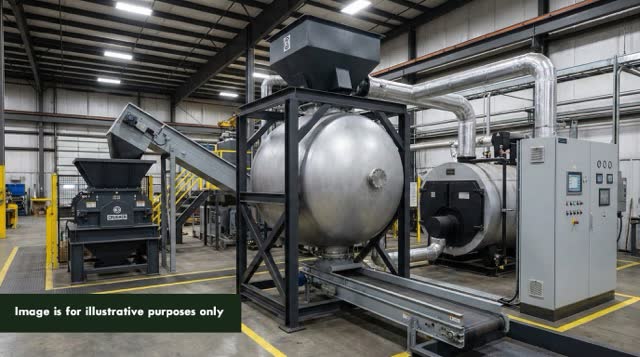
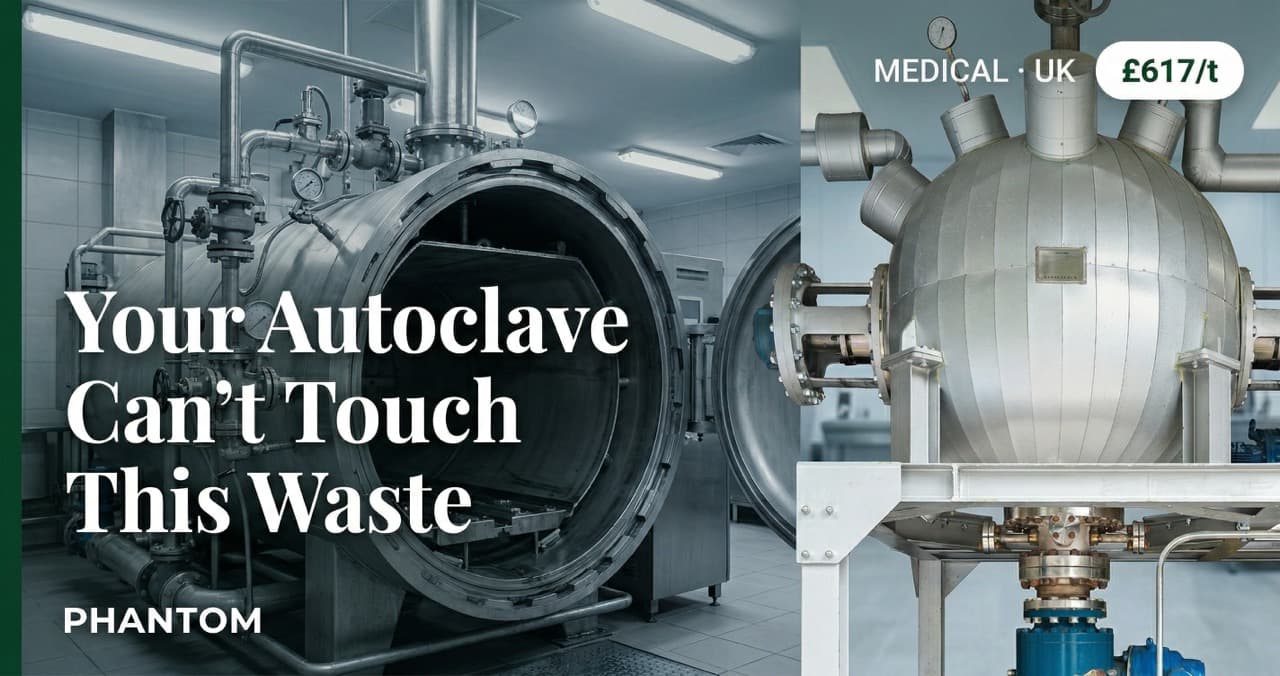
The PHANTOM subcritical water hydrolysis unit — a sealed, round-type pressurised processing vessel operating at high temperature and pressure. No stack emissions. No dioxins. No incineration contract dependency.
For a full technical and financial comparison of on-site treatment against autoclave and incineration alternatives, see Medical Waste TCO: Autoclave vs. Incineration vs. Hydrolysis — 10-Year Cost Analysis.
What Are the Environment Agency Permit Obligations for On-Site Clinical Waste Treatment?
The permit landscape for on-site clinical waste treatment is tighter than most facilities realise. Two standard rules permits that once applied to on-site autoclave treatment have been withdrawn or were never issued for new applications.
Direct Conclusion: Any UK healthcare facility wishing to treat clinical waste on-site in England must apply for a bespoke Environmental Permit from the Environment Agency. SR 2013 No.1 was withdrawn before it was issued. SR 2008 No.25 is not applicable to healthcare self-treatment. There is no waste exemption covering on-site autoclaving or hydrolysis of clinical waste. The T28 exemption applies exclusively to the sorting and denaturing of controlled drugs — it has no bearing on infectious waste treatment.
The bespoke permit process — five stages:
- Pre-application consultation with EA (strongly recommended — establishes site-specific requirements before investment is committed)
- Permit application with site plan, waste management plan, and technology specifications
- EA assessment — typically four months for straightforward applications
- Commissioning validation — STAATT Level III challenge testing under worst-case conditions
- Written EA approval — only at this point does lawful treatment commence
This applies when the facility is in England under EA jurisdiction. It does not apply to Scotland (SEPA), Wales (NRW), or Northern Ireland (NIEA) — each operates its own permit framework with different standard rules availability. See UK On-Site Medical Waste Treatment: Permits and Validation for the full cross-jurisdiction breakdown, including SEPA's precautionary classification default and the Special Waste Consignment Note system.
Scenario: A large care home group with 12 sites across England, each generating 300 kg/week of infectious waste at £550/tonne blended rate. Pre-application EA consultation completed Q2. Bespoke permit applications submitted for 3 pilot sites Q3. Commissioning validation completed Q1 of the following year. Lawful on-site treatment commences Q2. Annual saving across 12 sites at full rollout: approximately £1.8 million versus current incineration contracts.
What Is the Real Dioxin Compliance Risk for UK Clinical Waste Incinerators Post-2028?
The dioxin risk from incineration is not merely a historical concern. UK ETS expansion and retained Industrial Emissions Directive thresholds are creating a tightening compliance corridor that will directly affect NHS and private healthcare incineration contracts at renewal.
Direct Conclusion: UK clinical waste incinerators are bound by a dioxin and furan emission limit of 0.1 ng I-TEQ/Nm³ — retained from EU IED requirements. From January 2028, the UK Emissions Trading Scheme expands to cover clinical waste incineration and energy-from-waste operations, adding an estimated £48/tonne in carbon cost. Contracts signed at £500–£617/tonne will renew in a market where the true cost of incineration is structurally higher.
Three dioxin compliance risks the incinerator-dependent model carries forward:
- ETS cost pass-through — contractors will include carbon cost premiums in 2027–2028 contract renewals, increasing per-tonne rates by £40–£55 for EfW-routed waste
- Emission monitoring failure — dioxin monitoring is required at least twice per year; facilities close to the 0.1 ng threshold are at risk of exceedance under high-PVC load conditions
- Post-2028 regulatory tightening — the Environment Act 2021 created a pathway to unlimited Variable Monetary Penalties for permit breaches, removing the former £250,000 cap
This applies when your facility directly operates a clinical waste incinerator or holds a permit for on-site incineration. It does not apply to facilities that have transitioned entirely to alternative treatment — which carries no dioxin emission obligation and no ETS exposure. For a broader carbon impact analysis across waste treatment scenarios, see Manufacturing Waste: Carbon Footprint Impact.
In my experience working with NHS procurement teams on contract renewals, the 2028 ETS expansion is the single biggest unpriced risk in multi-year clinical waste incineration contracts signed in 2024 and 2025. The contractor's tender price is based on today's ETS scope. The renewal price will not be.
The Real Reason Your Incineration Contract Costs Keep Rising — And Why Training Won't Fix It
You now understand the mechanism: misclassification inflates the volume of waste routed to the most expensive disposal stream, and the cost overrun compounds with every collection cycle. Most facilities respond with training programmes, poster campaigns, and colour-coded bin reminders. These are not wrong — the St Mary's study showed a 74.7% reduction in incorrectly streamed waste after sustained intervention. But even in that study, correct segregation degraded over time without continued pressure, and the underlying contract remained unchanged.
The root cause runs deeper than ward-level behaviour. The NHS Clinical Waste Strategy's own data shows that four providers hold over 85% of the NHS incineration market — a concentration that structurally limits competitive pricing regardless of how well individual trusts segregate. Facilities paying £500–£617/tonne are not paying that rate because their bins are wrong. They are paying it because there is no competitive alternative at scale within the existing incineration infrastructure.
That is the problem PHANTOM's subcritical water hydrolysis process is designed to eliminate. By treating waste on-site — at the point of generation, under pressure, at temperature, in a sealed vessel with no stack emissions and no dioxin output — the classification-to-incineration pipeline ceases to exist. Waste enters the PHANTOM unit regardless of stream, treated at approximately £0.011/kg, and exits as sterile, non-hazardous, reduced-volume material. The contractor invoice goes to zero. The ETS exposure in 2028 becomes irrelevant.
Request a site assessment and cost comparison for your facility →
Frequently Asked Questions
Infectious clinical waste with no medicinal contamination should be placed in orange bags (EWC 18 01 03*), which are eligible for alternative treatment at approximately £419/tonne. Yellow bags (EWC 18 01 03* + 18 01 06*) are required only when waste is contaminated with medicines or chemicals, and must be sent to high-temperature incineration at approximately £617/tonne. The £198/tonne gap between routes is the primary misclassification cost penalty at ward level.
The £617/tonne rate applies to yellow-bag waste (medicinally contaminated infectious waste), cytotoxic waste, and anatomical waste — all requiring dedicated high-temperature incineration. NHS trusts pay this rate for waste that should be in cheaper streams because ward-level bag colour errors route non-medicinally contaminated waste to the incineration-only stream. NHS data estimates £11 million/year is lost to this misclassification across the sector.
Yes. All on-site clinical waste treatment in England requires a bespoke Environmental Permit from the Environment Agency. No standard rules permit or waste exemption currently covers on-site healthcare waste treatment. SR 2013 No.1 was withdrawn before issue. The T28 exemption covers only controlled drug denaturing. Treatment cannot legally commence until the EA provides written approval of the commissioning validation report.
STAATT Level III is the mandatory minimum for alternative treatment of infectious clinical waste in the UK, requiring ≥6 log₁₀ reduction of all standard pathogens and ≥4 log₁₀ reduction of Geobacillus stearothermophilus spores under worst-case challenge conditions. Validation must be renewed every 48 months. Operating on an expired cycle is a permit condition breach under Regulation 38 of the Environmental Permitting Regulations 2016.
On-site subcritical water hydrolysis treats clinical waste at approximately £0.011/kg (~£11/tonne) in operating costs, compared to £419/tonne for orange-bag alternative treatment contracts and £617/tonne for yellow-bag high-temperature incineration. Capital payback for a facility generating ≥2 tonnes/week is typically achieved in 18–30 months, depending on current contract rates and waste volume.
From January 2028, the UK Emissions Trading Scheme expands to cover clinical waste incineration and energy-from-waste operations. Contractors will pass carbon cost premiums through at contract renewal — estimated at £40–£55/tonne additional cost. Contracts signed at £500–£617/tonne will renew into a structurally higher-cost market. Facilities that have transitioned to alternative treatment carry zero ETS exposure.
Figures for disposal costs and NHS expenditure are sourced from the NHS Clinical Waste Strategy 2023, NHS ERIC data, and published EA permit guidance. All costs are indicative averages and will vary by contractor, location, and waste volume. Currency conversion: ~1.27 USD/GBP at time of publication. This article is for informational purposes only and does not constitute legal, financial, regulatory, or procurement advice. Consult a qualified clinical waste advisor and your Environment Agency regional team before making treatment decisions.