Article Series
TL;DR — UK On-Site Medical Waste Treatment: Permits & Validation
Installing any on-site medical waste treatment system in the UK (including hydrolysis or autoclaves) requires a bespoke Environmental Permit, strict waste segregation, and formal microbiological validation — there are no shortcuts or exemptions.
To legally operate an on-site treatment facility, NHS trusts and healthcare operators must clear four mandatory compliance layers:
- Environmental Permit: A bespoke permit from the Environment Agency, SEPA, or NRW is mandatory. There are no "standard rules" or T28 exemptions applicable to clinical waste treatment.
- HTM 07-01 Segregation: Only "Orange Bag" infectious waste can be treated on-site. "Yellow Bag" (chemically contaminated) waste must still go to high-temperature incineration — misclassification is a criminal offence.
- IStAATT Validation: Equipment must pass Level III microbiological efficacy testing (using biological indicators) before commissioning, and re-validate every four years.
- Digital Waste Tracking (DWT): By October 2026, all facilities must transition from paper consignment notes to the UK's mandatory Digital Waste Tracking system.
Applicable to: All hospitals, clinics, and laboratories in England, Wales, and Scotland seeking to move away from expensive off-site hauling and treat clinical waste on-site.
Example: If an NHS trust installs a subcritical water hydrolysis unit to process orange-bag infectious waste, the machine cannot be commissioned until the EA approves a bespoke Environmental Permit and an independent microbiologist validates a Log 6 reduction of G. stearothermophilus spores.
Read the full regulatory guide below for EPA 1990 legal liabilities, SEPA's specific Scottish rules, and the NHS 20:20:60 clinical waste strategy. Related: Infectious Medical Waste: Non-Incineration Guide · Hospital Single-Use Plastics & PPE Management
This article sits within a broader examination of infectious medical waste treatment options and non-incineration strategies for NHS facilities. If your organisation is evaluating the transition from off-site clinical waste contracts to on-site treatment — whether driven by the NHS Clinical Waste Strategy's 20:20:60 target, net zero commitments, or rising collection costs — the regulatory sequencing matters as much as the technology choice.
Introduction
Installing any on-site medical waste treatment system in the UK — autoclave, microwave, or subcritical water hydrolysis — triggers a mandatory Environmental Permit from your regulator. There is no lighter-touch standard rules route for treatment in England. Every installation requires a bespoke application, microbiological validation against IStAATT Level III standards, and — from October 2026 — mandatory Digital Waste Tracking.
What follows is a precise, citation-ready breakdown of every statutory layer your compliance team and estates engineers need to work through before the first batch enters the vessel.
1. The Statutory Framework: What Does "Must-Have" Actually Mean?
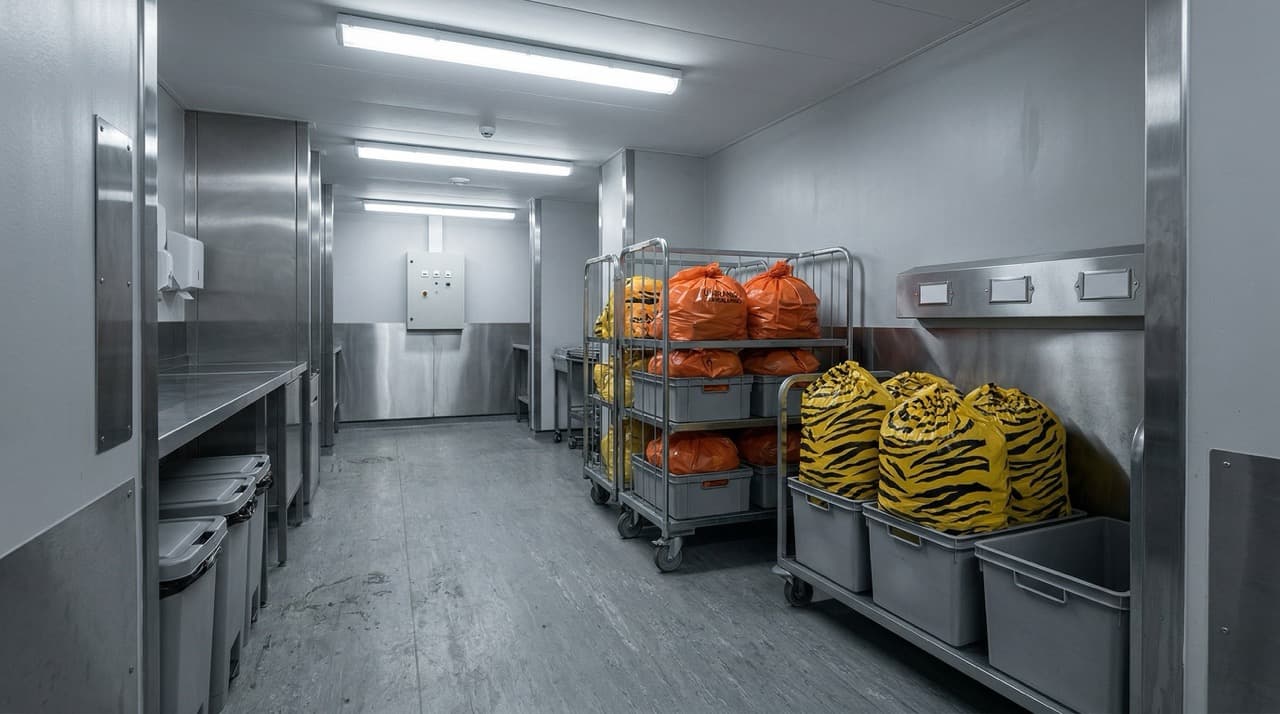
Operating on-site clinical waste treatment in the UK requires three mandatory compliance layers: an Environmental Permit, HTM 07-01 segregation compliance, and IStAATT Level III microbiological validation. All three must be active before a single batch enters the vessel.
The three must-have layers:
- Environmental Permit from EA (England), NRW (Wales), or SEPA/EASR (Scotland) — bespoke application, no standard rules shortcut for clinical waste treatment
- HTM 07-01 segregation — orange bag infectious waste only; yellow bag (pharmaceutical-contaminated) waste cannot be treated on-site under any alternative treatment system
- IStAATT Level III efficacy validation — independent microbiologist, ≥6 log₁₀ reduction of vegetative organisms, ≥4 log₁₀ reduction of G. stearothermophilus spores
Applies to: All healthcare facilities in England, Wales, and Scotland seeking to treat clinical waste on-site. Scotland operates under EASR from November 2025. Does NOT apply to facilities processing exclusively offensive/hygiene (tiger-stripe) waste — this is not regulated medical waste.
Example: A private hospital that installs a PHANTOM unit and begins treating orange-bag waste without a bespoke EA permit is in breach of Section 33 EPA 1990 — a strict liability offence carrying unlimited fines and up to five years' imprisonment.
1.1 What Legal Acts Apply?
Every healthcare waste producer and treatment operator in England, Wales, and Scotland falls under the Environmental Protection Act 1990 (EPA 1990). Sections 33 and 34 are non-negotiable: unlicensed waste treatment carries unlimited fines and up to five years' imprisonment on Crown Court conviction.
Section 33 prohibits the deposit, treatment, or disposal of controlled waste without an environmental permit. It is a strict liability offence — intent is not required for prosecution. Section 34 imposes the Duty of Care: every person in the waste chain must prevent escape, transfer only to authorised parties, and provide accurate written descriptions. Breach of the Duty of Care is a separate, unlimited fine.
Above EPA 1990 sit two permitting frameworks depending on jurisdiction. In England and Wales, the Environmental Permitting (England and Wales) Regulations 2016 (EPR 2016, SI 2016/1154) govern all regulated waste treatment facilities. In Scotland, operations have historically required authorisation under either the Pollution Prevention and Control (Scotland) Regulations 2012 or the Waste Management Licensing (Scotland) Regulations 2011 — now converging into the Environmental Authorisations (Scotland) Regulations 2018 (EASR), with full transition from November 2025 onwards.
Underpinning both frameworks: the Waste (England and Wales) Regulations 2011 give legal force to the five-step waste hierarchy. Under the Environment Act 2021, this hierarchy has been reinforced as a binding planning and procurement requirement across all sectors, including healthcare.
1.2 What Is HTM 07-01 and Why Does It Control What Enters the Vessel?
HTM 07-01 is the operational specification for NHS healthcare waste management. Published by NHS England on 7 March 2023, it defines which waste streams are eligible for alternative treatment on-site and which must go to high-temperature incineration. Putting the wrong stream into your on-site unit is a pre-acceptance audit failure, a permit breach, and a potential Section 33 offence simultaneously.
The clinical significance is the yellow/orange distinction. Two waste streams look similar at point of generation but diverge completely in terms of lawful treatment route:
- Yellow bags (EWC 18 01 03* — Hazardous): Infectious or potentially infectious waste also contaminated with chemicals, medicines, or pharmaceutical products. Includes medicated dressings and sharps used with cytotoxic agents. Mandatory high-temperature incineration. Not eligible for any alternative treatment.
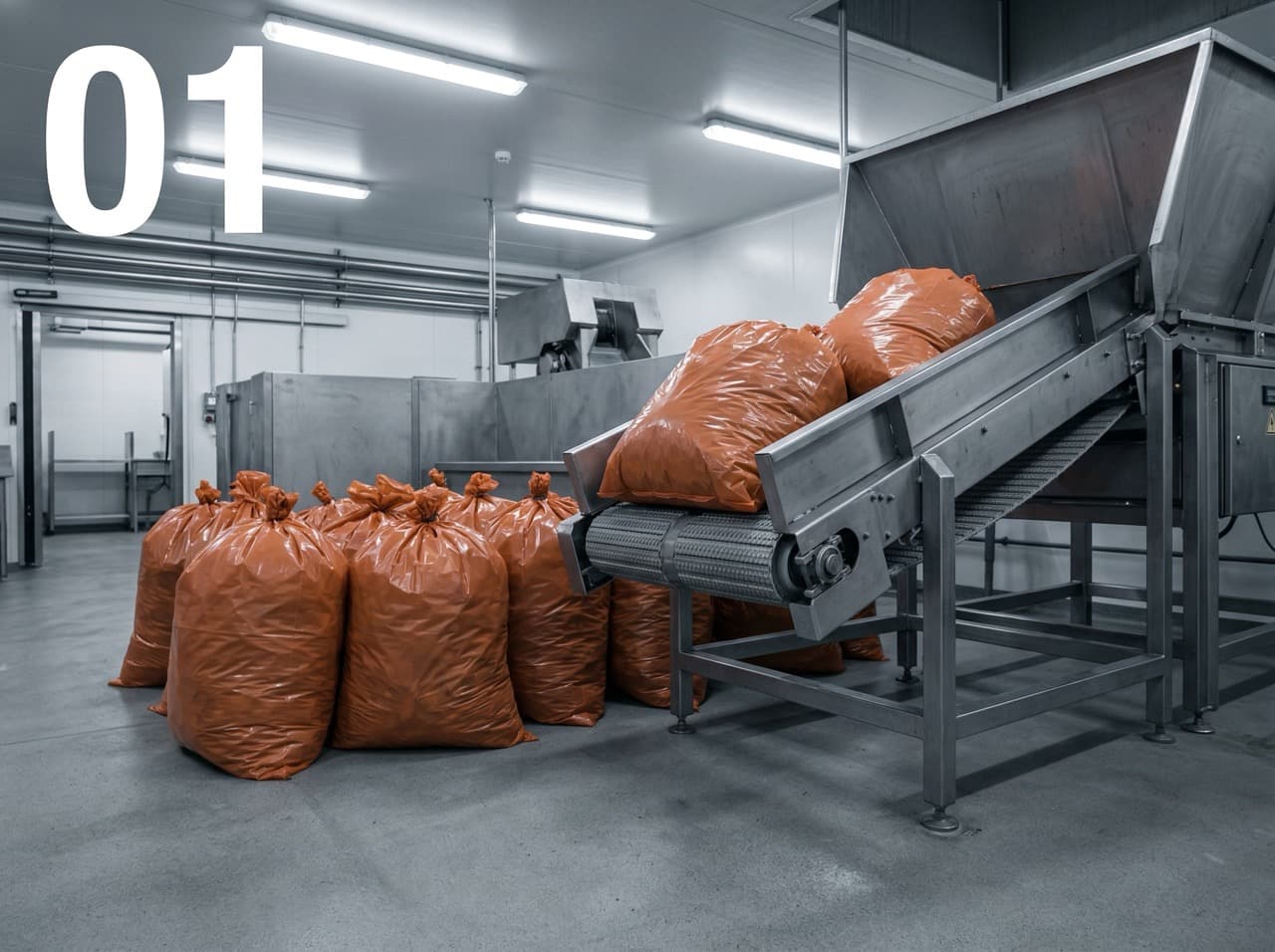
- Orange bags (EWC 18 01 03* — Hazardous): Infectious or potentially infectious soft waste contaminated with blood or bodily fluids, but without pharmaceutical contamination. Includes non-medicated dressings, gloves, and PPE from infectious areas. Eligible for on-site alternative treatment — this is the stream a hydrolysis unit processes.
- Tiger bags / yellow-black stripe (EWC 18 01 04 — Non-Hazardous): Offensive but non-infectious waste. Colostomy bags, incontinence pads, non-infectious PPE. No clinical treatment required; can go to energy-from-waste or deep landfill. For residential care settings where this stream dominates, see our nursing home incontinence waste disposal guide.
- Purple / cytotoxic (EWC 18 01 08* — Hazardous): Chemotherapy-contaminated waste. HTI only; no exceptions.
The NHS Clinical Waste Strategy (published March 2023) sets the headline target: by 2026, NHS clinical waste must achieve 20% incineration : 20% alternative treatment : 60% offensive waste. Achieving the 60% offensive waste classification requires HTM 07-01-compliant segregation at point of generation — a scale-up of orange-stream processing capacity whether off-site or on-site.
Engineering note: For subcritical water hydrolysis units processing orange-stream infectious waste, the pre-feed segregation protocol keeps your permitted EWC codes aligned with your permit schedule. A single yellow bag in an orange batch does not just create an infection risk — it creates a permit exceedance.
Phantom Ecotech // Compliance Reference
UK Clinical Waste: On-Site Treatment Eligibility
Per HTM 07-01 (2023 edition) & EA Appropriate Measures Guidance (Dec 2021)
EWC 18 01 03* (Absolute Hazardous)
Infectious soft waste — blood/fluid contamination, no pharmaceutical content. Dressings, gloves, PPE from infectious areas.
EWC 18 01 03* / 18 01 09
Infectious waste + pharmaceutical/chemical contamination. Medicated dressings, medicine-contaminated sharps.
EWC 18 01 04 (Non-Hazardous)
Offensive, non-infectious waste. Incontinence pads, colostomy bags, non-infectious PPE. EfW or deep landfill.
EWC 18 01 08* (Absolute Hazardous)
Chemotherapy-contaminated waste. No alternative treatment permitted under any circumstance.
Source: HTM 07-01 (2023), EA Appropriate Measures Guidance (Dec 2021)
Assess Your Waste Streams →2. Environmental Permitting: What Authorisation Do You Actually Need?
The answer for any clinical waste treatment operation in England is a bespoke Environmental Permit from the Environment Agency. There is currently no standard rules route. SR2008 No. 25 was withdrawn for new applications in 2021. Every new operator applies from scratch, with a typical timeline of 9–12 months.
2.1 Why Can't I Use a Standard Rules Permit or a Registered Exemption?
SR2008 No. 25 ("75kte clinical waste and healthcare waste treatment and transfer station") was withdrawn for new entrants following the Environment Agency's Standard Rules Consultation No. 23 in 2021. SR2013 No. 1 was also withdrawn — no permits were ever issued under it. The T28 exemption does not cover clinical waste treatment.
A common and operationally dangerous misconception warrants direct correction:
Waste Exemption T28 covers the sorting and denaturing of controlled drugs under the Misuse of Drugs Regulations 2001. It does not cover autoclaving, hydrolysis, microwave treatment, or any other processing of clinical infectious waste. An NHS trust attempting to treat orange-stream infectious waste under T28 is operating without authorisation — a Section 33 offence.
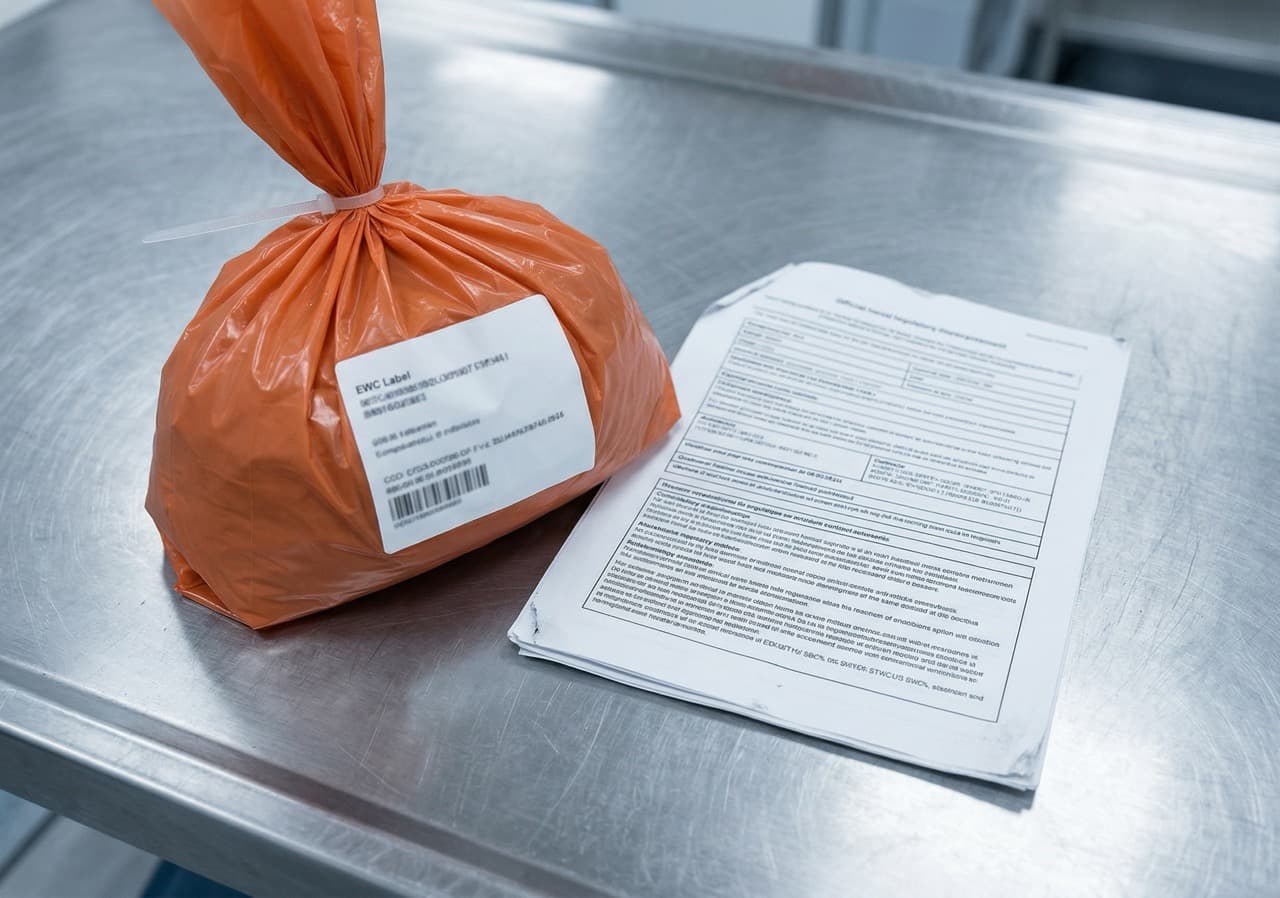
RPS 233 (Regulatory Position Statement 233) provides the only lighter-touch route, and it is narrow. It allows on-site autoclaving of microbiological laboratory waste only, at no more than 1 tonne per day, on the site of production. It does not extend to ward or theatre waste, and it does not cover any non-autoclave technology. RPS 233 is also due for EA review in August 2026.
The practical consequence: for any system treating general clinical waste — including subcritical water hydrolysis — a bespoke permit application to the Environment Agency (England), Natural Resources Wales (Wales), or SEPA/EASR authorisation (Scotland) is the only lawful route.
2.2 How Does Scotland's Regime Differ?
Scotland operates under a structurally different permitting framework now transitioning to EASR 2018. There are no standard rules permits for clinical waste treatment in Scotland — all authorisations are bespoke. The EASR transition from November 2025 creates a single framework, but with a materially different consignment note system that adds per-movement cost and pre-notification obligations absent in England.
For operators deploying subcritical water hydrolysis across multiple UK sites, three SEPA-specific obligations create genuine operational divergence from the EA regime:
First — the precautionary classification default. SEPA's published position is that healthcare waste should be assumed to be special (hazardous) until proved otherwise. The EA applies a case-by-case WM3 assessment. This is particularly relevant when managing high-volume streams like hospital single-use plastics and PPE waste, where proper classification directly impacts disposal costs and compliance under the precautionary principle.
Second — the Special Waste Consignment Note (SWCN) system. Every movement of special (hazardous) clinical waste in Scotland requires a SEPA-issued unique code (SA-prefix), purchased in advance at £15 (~$19) per note. Cross-border movements from Scotland to England require 72-hour pre-notification to SEPA. England uses self-generated consignment note codes at no per-note cost. For a facility processing dozens of consignments per week, the administrative and cost differential is non-trivial.
Third — EASR transition sequencing. From 1 November 2025, Scotland began migrating existing PPC permits and WMLs to EASR authorisations. Standard conditions for some smaller installations apply from 1 March 2026; waste exemptions must obtain new EASR registrations or permits by 1 November 2026.
On validation frequency: SEPA's published permit conditions (most clearly demonstrated in the Tradebe Queenslie Healthcare Waste Treatment permit, PPC/A/5002293, 2023) specify weekly testing for the first six months, then monthly thereafter — directly matching the EA's frequency table for plants processing over 500 kg per batch/hour. The genuine differences between Scotland and England are procedural and structural, not in monitoring stringency.
3. Digital Waste Tracking: The October 2026 Compliance Cliff
From October 2026, mandatory Digital Waste Tracking (DWT) replaces paper Waste Transfer Notes and Hazardous Waste Consignment Notes for permitted and licensed receiving sites in England, Wales, and Northern Ireland. Every on-site treatment facility operating under an Environmental Permit will be required to create digital movement records before waste moves — including movements within the same site. Scotland follows in January 2027.
3.1 What Does DWT Actually Change for an On-Site Treatment Operator?
DWT replaces paper consignment notes with a centralised government platform. Each waste movement receives a unique digital tracking ID logged in real time. For on-site treatment facilities, this creates an instant digital audit trail from point of generation to treatment confirmation — eliminating the manual Duty of Care paper chain that currently represents the weakest link in clinical waste compliance.
The DWT mandate is grounded in Section 58 of the Environment Act 2021, which inserts new Sections 34CA and 34CB into EPA 1990. DEFRA confirmed October 2026 as the mandatory start date in its February 2026 policy paper update.
The rollout timetable:
| Phase | Date | Scope |
|---|---|---|
| Private beta | Autumn 2025 | Invited receiving sites and software developers |
| Public beta | Spring 2026 | All permitted/licensed receiving sites |
| Mandatory — Phase 1 | October 2026 | Permitted/licensed sites: England, Wales, Northern Ireland |
| Mandatory — Scotland | January 2027 | Scotland |
| Mandatory — Phase 2 | October 2027 | Carriers, brokers, dealers, exempt sites |
Annual registration cost: £26 (~$33) per site. An API-first system (specifications at defra.github.io); spreadsheet submission available temporarily until at least October 2027.
For on-site hydrolysis operators, the DWT system delivers a specific compliance advantage: automatic Duty of Care record generation at the point of treatment, replacing the manual paper consignment note process. The NHS Clinical Waste Strategy identifies DWT as a strategic priority, calling for a live system tracking consignments from the point of generation through to disposal.
Practical note for engineering teams: DWT record-creation is required before waste moves, including movements within a permitted site. Build your waste management system integration — whether CAFM, CMMS, or a dedicated waste tracking platform — to trigger DWT record creation as part of the pre-feed process, not as a retrospective end-of-day reconciliation.
Facilities that have not begun the permit application process by Q1 2026 are at risk of not being operational before the DWT transition date. Contact our deployment team for a regulatory sequencing plan — EA permit applications, IStAATT validation scheduling, and DWT integration typically require 6–9 months from first contact.

4. Pre-Acceptance Audits and EWC Code Compliance
Pre-acceptance audits are a mandatory permit condition for all licensed clinical waste treatment and transfer facilities. The frequency is risk-scaled: hospitals generating ≥5 tonnes per year must be audited annually. The audit must be conducted on-site, in person. Records must be retained for three years.
4.1 What Do Pre-Acceptance Audits Actually Verify?
Pre-acceptance audits verify that each waste producer has correctly classified their waste, assigned the appropriate EWC code, used the correct HTM 07-01 colour-coded container, and is providing accurate written descriptions. On-site treatment shifts the "receiving facility" role to the generator's own operation — meaning the hospital or clinic operating the on-site system is subject to pre-acceptance audit requirements as both producer and operator.
The audit frequency table (Environment Agency, "Healthcare waste: appropriate measures for permitted facilities," updated December 2021):
- ≥5 tonnes/year (hospitals, acute care): annually, with a rolling 3-year cycle covering all departments
- <5 tonnes/year (dental, veterinary, GP): every 2 years, covering the entire practice
- Other healthcare waste producers: every 5 years
Physical presence is required — telephone or digital-only audits are not acceptable. Audit reports must document waste types, EWC codes, container colour coding, estimated quantities, hazardous properties, staff training records, and compliance with both HTM 07-01 and Technical Guidance WM3. Three-year record retention is mandatory.
The key Chapter 18 EWC codes your pre-acceptance documentation must correctly assign:
| EWC Code | Description | Hazardous? | Treatment Route |
|---|---|---|---|
| 18 01 01 | Sharps (non-hazardous) | No | Safe containment |
| 18 01 02 | Anatomical waste | Yes | HTI |
| 18 01 03* | Infectious waste requiring special handling | Yes (absolute) | AT or HTI |
| 18 01 04 | Offensive/non-infectious waste | No | EfW / landfill |
| 18 01 06* | Hazardous chemicals | Yes | HTI |
| 18 01 08* | Cytotoxic/cytostatic medicines | Yes | HTI |
| 18 01 09 | Non-hazardous medicines | No | Incineration |
(* = absolute hazardous classification under List of Wastes (England) Regulations 2005 — cannot be reclassified as non-hazardous regardless of dilution or mixing)
5. Validation and Efficacy Testing: IStAATT Is Non-Negotiable
To legally classify any non-incineration process as "alternative treatment" for infectious clinical waste in the UK, the equipment must demonstrate IStAATT Level III microbiological inactivation as a minimum. This requires a staged commissioning validation protocol involving biological indicators, an accredited microbiological laboratory, and an independent qualified microbiologist — all with prior written EA/SEPA approval.
Phantom Ecotech // Technical Reference
IStAATT Microbiological Inactivation Standards
Required by EA (England/Wales) and SEPA (Scotland) for all alternative treatment operations
Level III — Disinfection
Minimum for infectious clinical waste (orange-stream)
- ≥6 log₁₀ reduction: vegetative bacteria
- ≥6 log₁₀ reduction: fungi
- ≥6 log₁₀ reduction: lipophilic viruses
- ≥6 log₁₀ reduction: hydrophilic viruses
- ≥6 log₁₀ reduction: parasites
- ≥6 log₁₀ reduction: mycobacteria
- ≥4 log₁₀ reduction: G. stearothermophilus
- ≥4 log₁₀ reduction: B. atrophaeus spores
Level IV — Sterilisation
Required for laboratory biological cultures & high-risk waste
- ≥6 log₁₀ reduction: ALL organisms
- ≥6 log₁₀ reduction: G. stearothermophilus
- ≥6 log₁₀ reduction: B. atrophaeus spores
- Independent microbiologist supervision
- Accredited laboratory analysis required
- Prior written EA / SEPA approval
- 95% statistical confidence (UCI method)
- Re-validation: ≤4 year intervals
IStAATT standards adopted by EA & SEPA for all UK alternative treatment operations
Validate with Phantom →5.1 What Exactly Does IStAATT Level III Require?
IStAATT Level III requires at minimum: ≥6 log₁₀ reduction of vegetative bacteria, fungi, lipophilic and hydrophilic viruses, parasites, and mycobacteria; plus ≥4 log₁₀ reduction of Geobacillus stearothermophilus and Bacillus atrophaeus spores. Level IV escalates to ≥6 log₁₀ reduction across all organisms including spores — required for laboratory waste containing cultured biological agents.
These standards, maintained by the International Society on Analytical Assessment of Treatment Technologies (IStAATT), are referenced directly in the EA's "Healthcare waste: appropriate measures for permitted facilities" guidance and explicitly adopted in SEPA's AMSG 1.0 / WAS-G-EASR-09 guidance. Both regulators require identical pass criteria. For operators exploring a comprehensive comparison of medical waste non-incineration treatment technologies, understanding these specific Level III requirements is crucial for ensuring the chosen technology meets the validation threshold at commissioning.
The PHANTOM subcritical water hydrolysis system has been designed to meet IStAATT Level III validation requirements. For full technical validation documentation, see the PHANTOM system specifications page or request the validation report directly. For a complete breakdown of every stage, realistic week ranges, and cost brackets at each node, see the IStAATT validation timeline, cost and application guide.
5.2 What Does the Commissioning Validation Protocol Require?
Stage 1 validation must be completed and receive written EA/SEPA approval before operational processing of clinical waste begins. It requires a minimum of three separate treatment cycles at maximum rated capacity, using biological indicator spore strips containing ≥1 × 10⁶ spores, in a 5% heavy organic challenge load, with results achieving the required log reduction at 95% statistical confidence.
The full Stage 1 protocol:
- Pre-approval: Submit validation plan to EA/SEPA for written approval before any testing begins
- Challenge load preparation: Worst-case load at maximum batch size/throughput, minimum 5% heavy organic content by weight for wet-heat processes
- Biological indicators: Spore strips with certified D-values ≥1.8 min at 121°C (G. stearothermophilus, wet-heat). Minimum 1 × 10⁶ spores per strip, same batch, certified D-values
- Run cycles: Minimum 3 separate treatment cycles at worst-case parameters
- Laboratory analysis: Accredited microbiological laboratory; results must achieve required log reduction with 95% statistical confidence (upper confidence interval method)
- Independent supervision: Suitably qualified independent microbiologist throughout
- Validation report: Submit to regulator within 2 months of completion
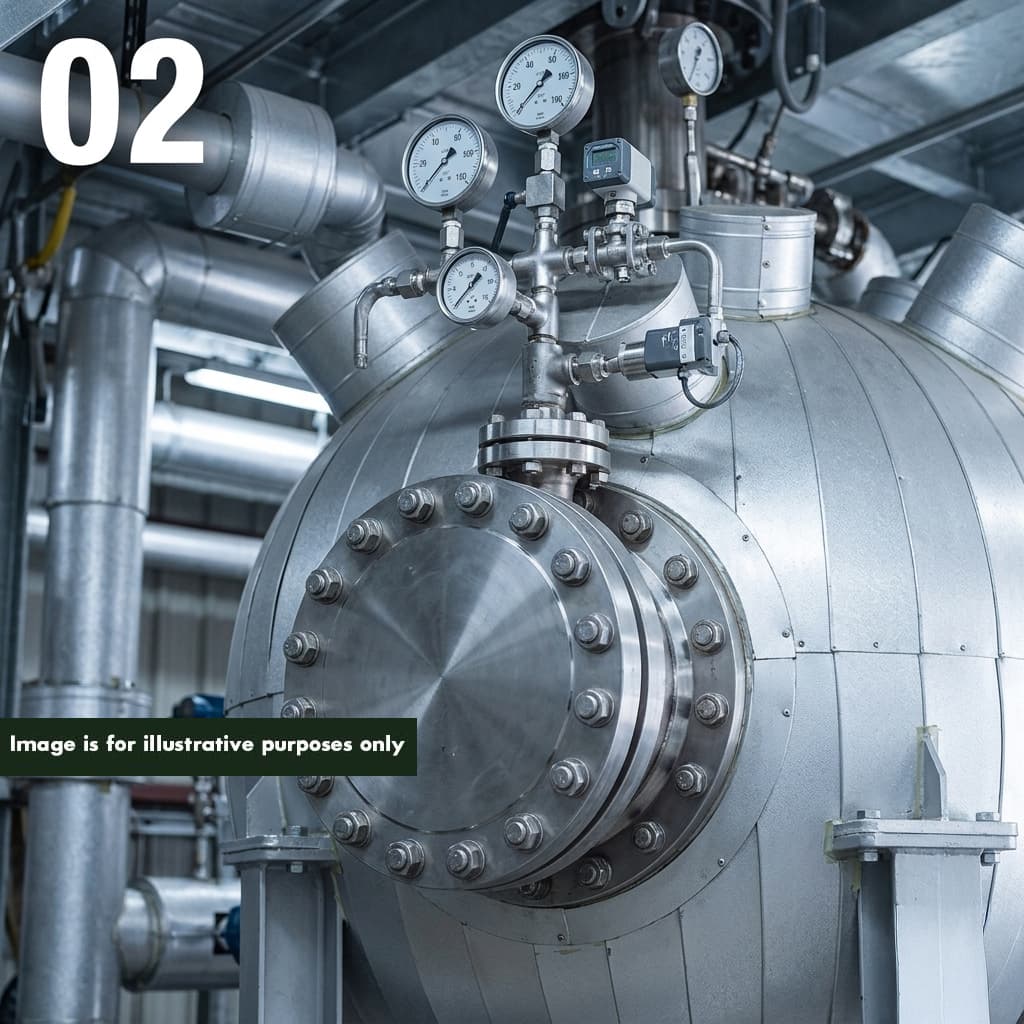
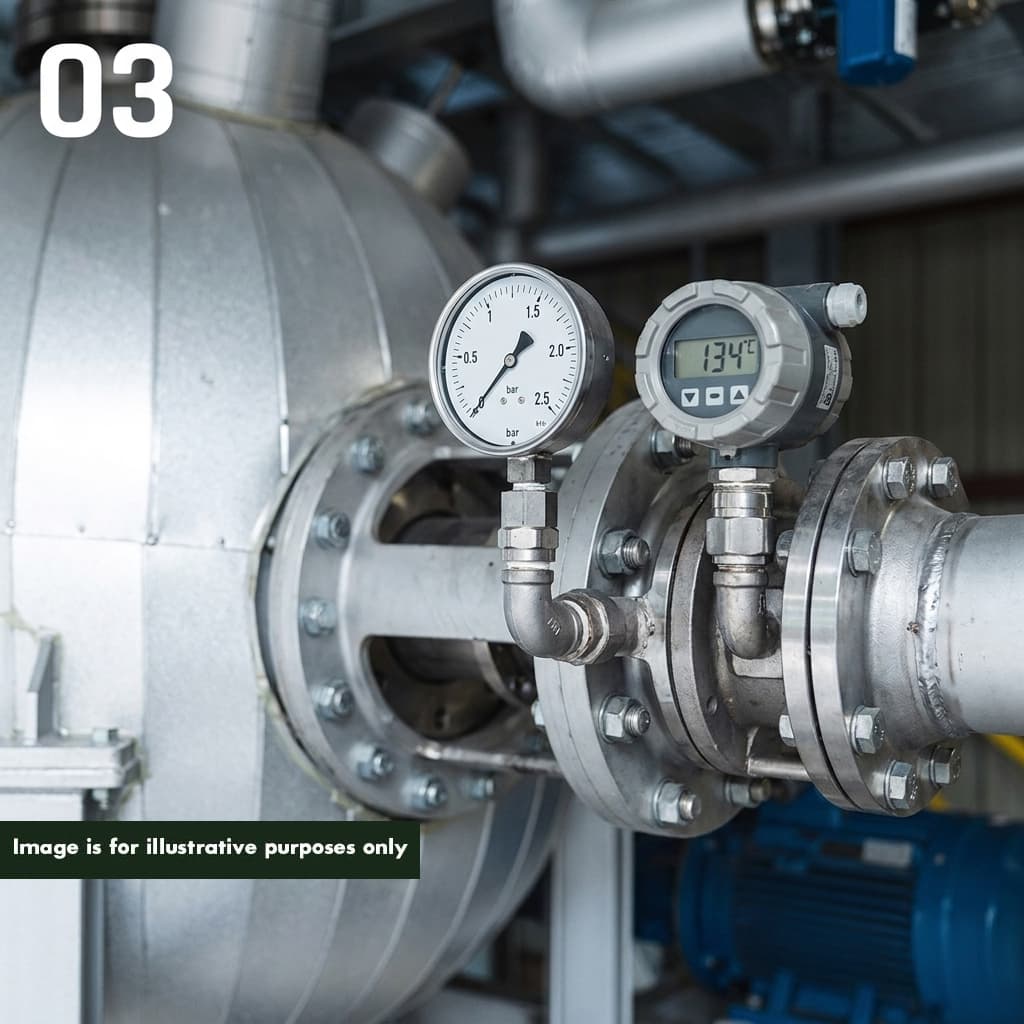
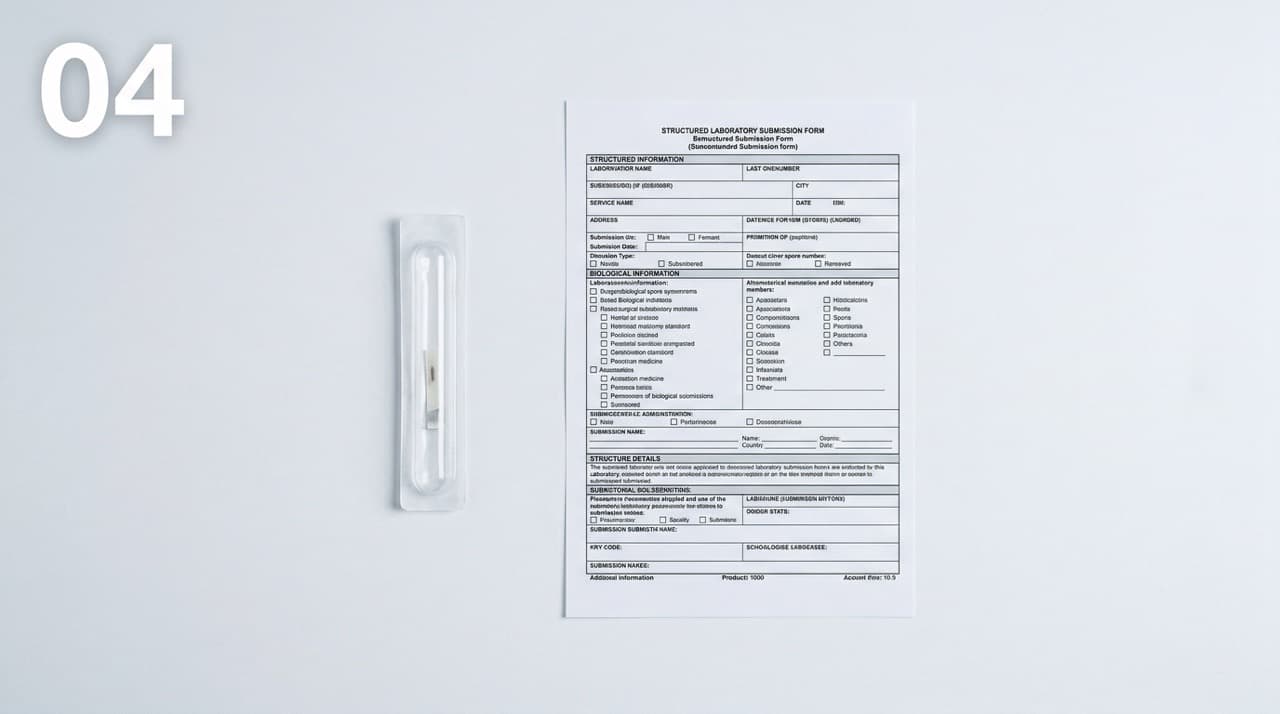
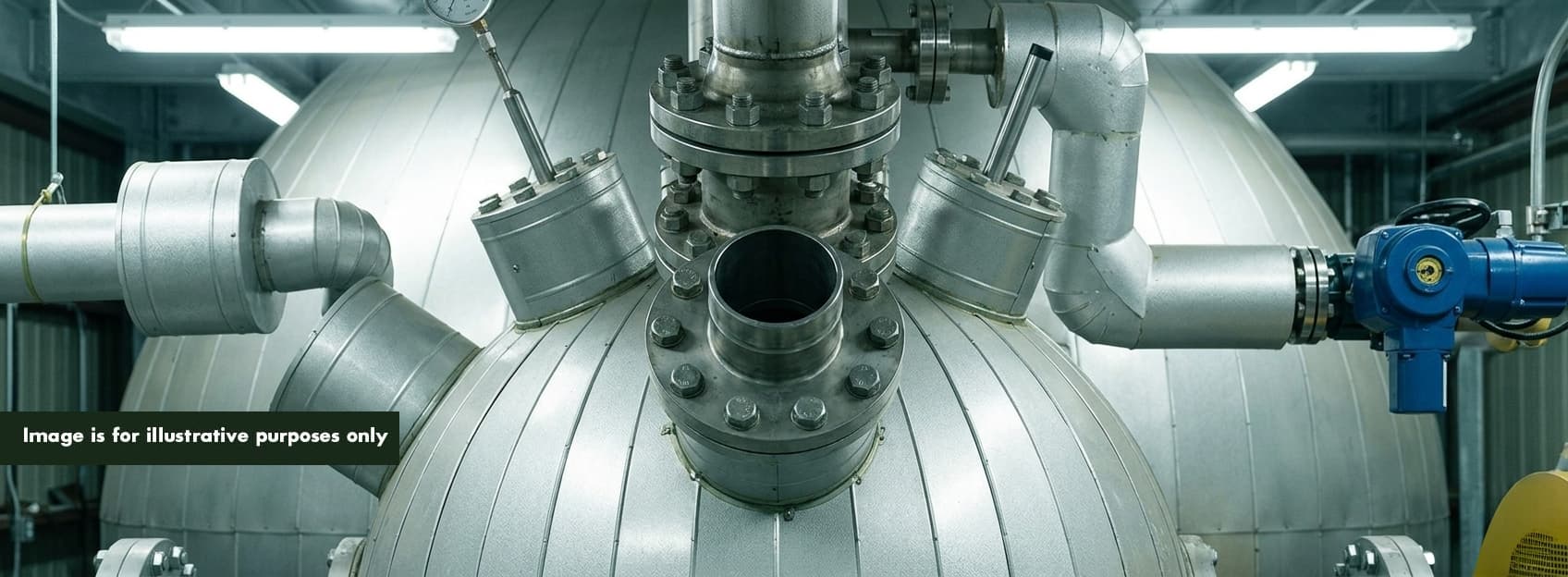
For subcritical water hydrolysis specifically: The process uses high-temperature pressurised water (wet-heat mechanism), so G. stearothermophilus is the primary biological indicator. The EA's appropriate measures guidance classifies hydrolysis systems under D9 (physico-chemical treatment) in the permit schedule. The subcritical water environment — which dissociates water into H⁺ and OH⁻ ions that cleave organic molecular chains — provides a physicochemical kill mechanism distinct from conventional steam sterilisation, but the validation protocol is identical.
5.3 What Triggers Re-Validation and What Is the Routine Monitoring Obligation?
Re-validation must occur at intervals of no more than four years, and must occur immediately following any process parameter changes, plant modifications, changes to waste types processed, or failures in routine efficacy monitoring. Operational suspension is mandatory until written re-approval is received.
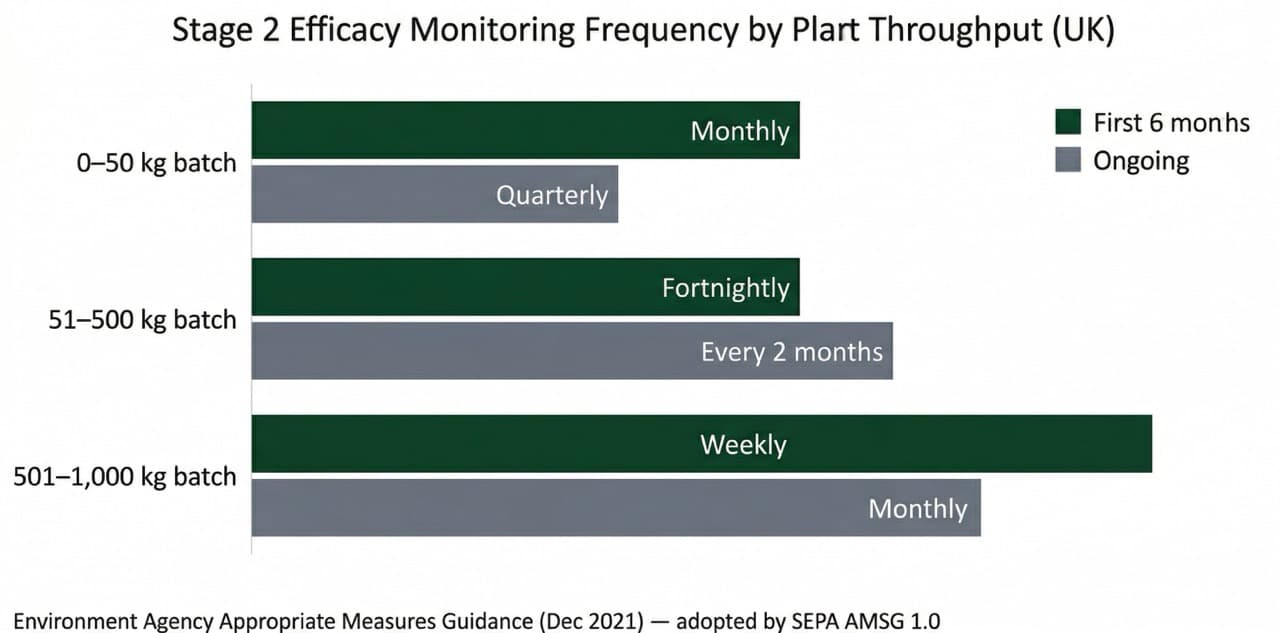
Routine Stage 2 efficacy monitoring (spore strip testing) frequencies, scaled by plant capacity:
| Batch/hourly throughput | First 6 months | Ongoing |
|---|---|---|
| 0–50 kg | Monthly | Quarterly |
| 51–500 kg | Fortnightly | Every 2 months |
| 501–1,000 kg | Weekly | Monthly |
For spore suspension testing (wet-heat processes at larger scale):
| Throughput | First 6 months | Ongoing |
|---|---|---|
| 0–250 kg | 6-monthly | Annually |
| 251–750 kg | 6-monthly | Annually |
| >750 kg | Quarterly | 6-monthly |
A key permit condition at SEPA-authorised facilities: if 5% or more of spore strips fail within the first six months or any subsequent calendar year, the plant must cease operations and revalidate before recommencing.
6. The Waste Hierarchy and NHS Net Zero
On-site treatment positions the facility at the highest practicable level of the statutory Waste Hierarchy under the Waste (England and Wales) Regulations 2011 and Environment Act 2021. By eliminating carbon-intensive transport, reducing volumes by ~60%, and producing recoverable outputs, it directly advances the NHS Net Zero target of achieving net zero carbon by 2040.
6.1 How Does the NHS 20:20:60 Target Change the Compliance Calculus?
The NHS Clinical Waste Strategy's 20:20:60 target mandates a structural shift away from the current incineration-heavy profile. The strategy projects £11 million (~$14 million) in annual revenue savings over ten years and a 30% reduction in carbon emissions from waste. Achieving 60% offensive waste classification requires HTM 07-01-compliant segregation at point of generation.
High-temperature incineration generates approximately 1,074 kg CO₂e per tonne of clinical waste. Off-site collection adds vehicle emissions for every consignment. On-site treatment with subcritical water hydrolysis eliminates transport emissions, reduces waste volume by approximately 60%, and converts processed organic matter into compost or fuel-grade outputs depending on input stream selection. This directly affects the 10-year total cost of ownership comparison between autoclave, incineration, and hydrolysis systems — where carbon cost exposure is a significant differentiator.
The Health and Care Act 2022 made sustainability a statutory board-level responsibility for NHS organisations. Waste management is no longer a facilities management issue alone — it is a board governance issue.
6.2 How Does CQC Inspection Relate to Waste Management Compliance?
CQC inspections assess waste management under Regulation 12 (Safe Care and Treatment) and Regulation 15 (Premises and Equipment) of the Health and Social Care Act 2008 Regulations. Inspectors check colour-coded waste charts, staff training records, container labelling, and segregation at point of generation. Non-compliance can trigger warning notices, enforcement action, and in severe cases, cancellation of registration.
The CQC's inspection focus on waste has sharpened since the Healthcare Environmental Services (HES) crisis of 2018–2019, which left NHS stockpiles of unprocessed clinical waste across England and Scotland. The lesson from HES: over-reliance on a single off-site contractor creates systemic vulnerability. On-site treatment capability provides resilience against contractor failure — a factor that CQC and NHS England now recognise in their estates resilience frameworks.

7. Common Compliance Failures: How to Pre-Empt Them
The three most common permit-threatening failures in clinical waste on-site treatment operations are: (1) introducing yellow-stream waste into an orange-stream AT system, (2) allowing spore test failure rates to reach 5% without triggering mandatory shutdown, and (3) failing to notify the regulator of process parameter changes before they trigger a re-validation requirement.
Based on the EA's published enforcement actions, SEPA inspection findings, and CQC inspection outcomes, the five most common root-cause failures in order of regulatory severity:
Gap 1 — Wrong-stream contamination (Yellow in Orange): Staff confusing medicated dressings or pharmaceutical-contaminated materials as orange-stream waste. Prevention: point-of-generation staff training audited annually; bag colour charts at every waste point; random batch sampling prior to feed.
Gap 2 — Validation expiry without re-commissioning: Four-year re-validation intervals pass without EA/SEPA notification. Prevention: enter re-validation deadline in your CAFM/permit management system 12 months in advance.
Gap 3 — Undeclared process modifications: Changing vessel temperature, cycle duration, or input waste types without notifying the regulator — each triggers a re-validation requirement. Prevention: all operational changes require a written change control assessment against permit conditions before implementation.
Gap 4 — Pre-acceptance audit gaps: Not auditing all ward/department waste producers on the rolling cycle, or accepting phone/email audit substitutes. Prevention: schedule annual site audit calendar at start of each year; retain all audit reports for minimum three years.
Gap 5 — Consignment note chain breaks: Incomplete or missing Hazardous Waste Consignment Notes for post-treatment residue disposal, or failure to transition to Digital Waste Tracking records by October 2026. Prevention: designate a named Duty of Care owner at each site with quarterly records review; begin DWT system integration no later than Q2 2026.
Phantom Ecotech // Pre-Deployment Checklist
UK On-Site Clinical Waste Treatment: Compliance Checklist
Check each item before your system goes live. All items are mandatory.
Compliance Score
0 / 10
8. Frequently Asked Questions
No. There is no standard rules route for clinical waste treatment in England since SR2008 No. 25 was withdrawn for new applications in 2021. Every treatment operation requires a bespoke permit from the EA (England), NRW (Wales), or an EASR authorisation from SEPA (Scotland). Operating without authorisation is a criminal offence under Section 33 EPA 1990, carrying unlimited fines and up to five years' imprisonment.
No. T28 covers only the sorting and denaturing of controlled drugs under the Misuse of Drugs Regulations 2001. It has no application to infectious clinical waste treatment. This is one of the most commonly misunderstood exemptions in healthcare waste management.
Yellow bags contain infectious waste also contaminated with chemicals or pharmaceutical products — mandatory high-temperature incineration, no alternative. Orange bags contain infectious waste without pharmaceutical contamination — eligible for on-site alternative treatment. If yellow-stream waste enters an orange-stream AT system, the treated residue is reclassified as inadequately treated hazardous waste, the EWC code assignment becomes incorrect, and the receiving consignee's permit may be breached. It is both an infection control failure and a regulatory failure simultaneously.
Yes. From October 2026 (England, Wales, Northern Ireland) and January 2027 (Scotland), DWT records are required for every waste movement at facilities operating under an Environmental Permit — including movements within the same site. Your waste management system must be capable of creating DWT records before waste enters the treatment unit.
No — not on a like-for-like capacity basis. SEPA's published permit conditions (most clearly demonstrated in the Tradebe Queenslie PPC permit, 2023) use identical frequency tables to the EA's guidance, scaled by plant throughput. The genuine SEPA differences are structural: the precautionary classification default, the Special Waste Consignment Note code-purchase system, and cross-border pre-notification requirements for movements from Scotland to England.
IStAATT Level III as a minimum: ≥6 log₁₀ reduction of vegetative bacteria, fungi, viruses, parasites, and mycobacteria; ≥4 log₁₀ reduction of G. stearothermophilus and B. atrophaeus spores. For laboratory biological cultures, Level IV (≥6 log₁₀ across all organisms including spores) is required. Both EA and SEPA apply these identical standards.
Stop Calculating the Risk. Install the Solution.
Every month spent assessing the permitting landscape for on-site treatment is another month of collection contracts, transport carbon, and incineration costs that on-site processing would eliminate. The regulatory pathway is defined. The validation standard is published. The October 2026 DWT mandate is confirmed.
The question is no longer whether to move to on-site treatment — the NHS Clinical Waste Strategy, the Environment Act 2021, and the net zero targets have answered that. The question is which technology delivers IStAATT Level III validation, the lowest operational carbon, and the most recoverable output fractions from a single treatment cycle.
Adopting the PHANTOM subcritical water hydrolysis system can often simplify meeting rigorous validation standards regardless of jurisdiction — because a system engineered for IStAATT Level III from the ground up requires fewer retrofit compromises than legacy equipment adapted to meet it. See also our detailed cost comparison of autoclave versus incineration versus subcritical hydrolysis for the full 10-year financial picture alongside the permit cost differential.
⚙️ Tanaka: The physics of subcritical water — H⁺ and OH⁻ dissociation under pressure — does not negotiate with pathogens. Neither should your compliance framework negotiate with inadequate technology.
Sources: Environmental Protection Act 1990; Environmental Permitting (England and Wales) Regulations 2016 (SI 2016/1154); Waste (England and Wales) Regulations 2011; Environment Act 2021; NHS England HTM 07-01 (2023 edition, PAR38); NHS Clinical Waste Strategy (March 2023); EA "Healthcare waste: appropriate measures for permitted facilities" (updated December 2021); SEPA AMSG 1.0 / WAS-G-EASR-09; Tradebe Queenslie PPC permit PPC/A/5002293 (2023); DEFRA Digital Waste Tracking policy paper (February 2026); Health and Care Act 2022; Environmental Authorisations (Scotland) Regulations 2018. GBP/USD conversion based on prevailing exchange rate at time of publication (~1.27 USD/GBP); actual rates will vary.
⚠️ Disclaimer: The regulatory information, permit requirements, and compliance guidance in this article are compiled from publicly available legislation, regulatory guidance, and published permit decisions, and are provided for general informational and educational purposes only. They do not constitute legal, compliance, or procurement advice. Regulatory requirements change; statutory timelines and permit conditions must always be verified directly with the Environment Agency, Natural Resources Wales, or SEPA before commencing any waste treatment operation. Phantom Ecotech and JEP Corporation accept no liability for decisions made in reliance on this article without independent professional and legal verification.