Article Series
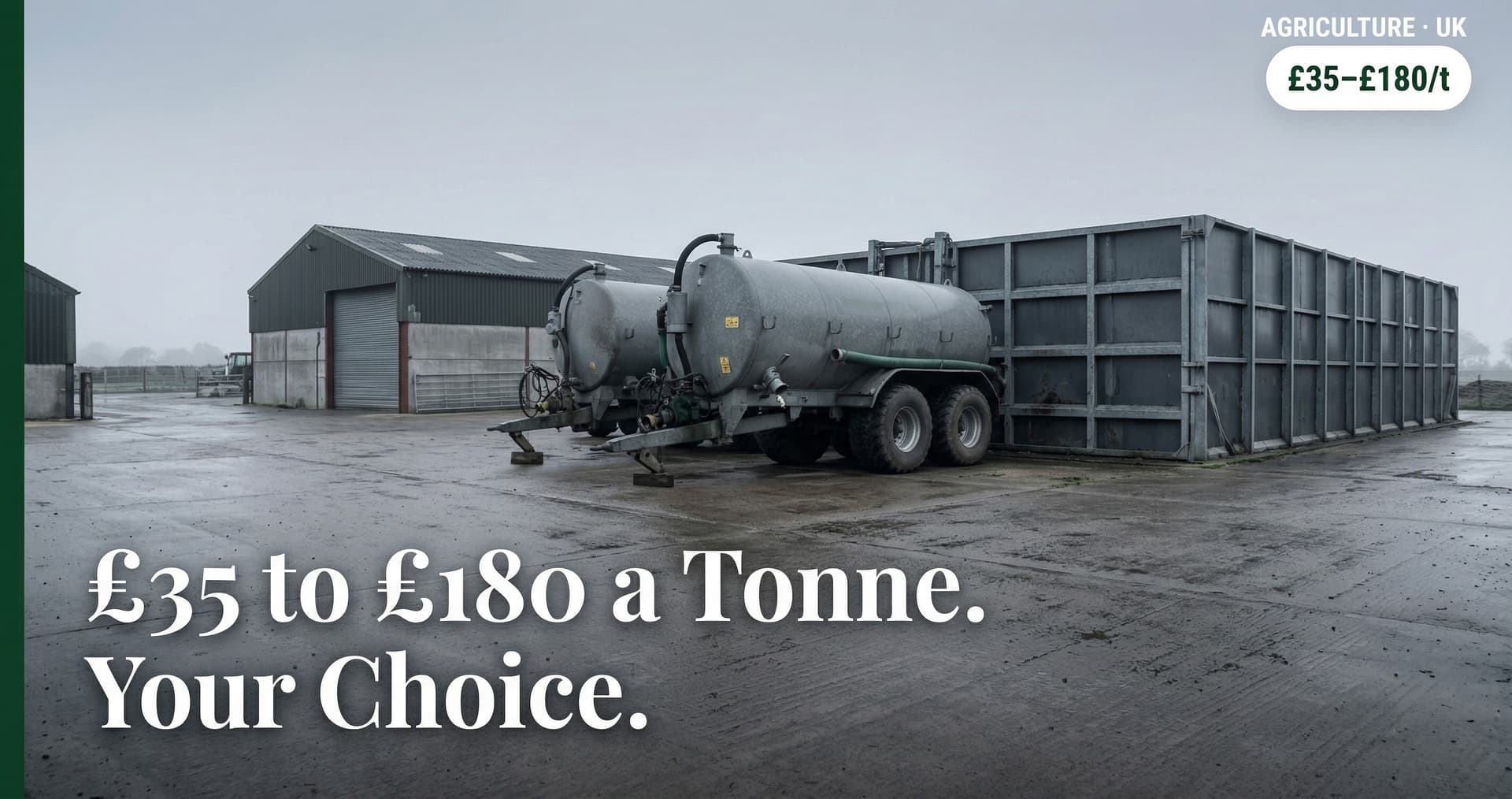
UK farms, livestock operations, fisheries, and slaughterhouses pay £35–£180/tonne to remove organic wet waste — then write cheques for synthetic fertiliser to buy back the same nitrogen they just hauled away. This is not a logistics problem. It is a structural design failure built into every conventional disposal route in the UK. Disposal costs have risen across every route simultaneously since 2022, driven by four independent statutory and market pressures arriving in the same three-year window.
UK farms, livestock operations, fisheries, and slaughterhouses are paying between £35 and £180 per tonne to remove organic wet waste while simultaneously writing cheques for synthetic nitrogen fertiliser — buying back, in bags, the same nutrient value they just paid to haul away. Before examining each disposal route's specific cost, it helps to understand the full picture of PHANTOM subcritical water hydrolysis — the technology reengineering how high-volume agricultural operators in the UK are answering this question.
Why Is UK Farm Waste Suddenly So Expensive to Dispose Of?
Farm operators managing high-volume organic wet waste in the UK are now paying structurally higher disposal costs than at any point in the previous decade, with no route offering meaningful long-term relief. Four independent pressures have arrived in the same three-year window.
UK agricultural waste disposal costs have increased across every route simultaneously — AD gate fees, landfill tax, rendering charges, and contractor haulage rates — driven by four independent pressures.
The four simultaneous pressures:
- Landfill tax escalation: The standard rate jumped to £126.15/tonne (~$160/tonne) from April 2025 — up 28% from £98.60/tonne in 2022. Total landfill cost including gate fee now runs £130–£152/tonne (~$165–$193/tonne). From 2028, waste incinerators enter the UK Emissions Trading Scheme, projected to add £20–£100/tonne to energy-from-waste gate fees.
- AD gate fee normalisation: WRAP's 2024/25 survey shows the median AD gate fee for food waste recovering to £24/tonne (~$30/tonne) after the 2022 anomaly (when surging biogas energy prices drove some contracts to negative £15/tonne). 43% of existing AD contracts renew before end of 2025, and plant operators are repricing as FIT/RHI subsidies expire.
- Contractor haulage inflation: NAAC 2024 data shows slurry spreading contractor rates up 8–13% year-on-year. Trailing shoe application runs £74.92/hour (~$95/hour) (+13.3%), FYM spreading at £3.52/tonne (~$4.47/tonne) (+8.6%). Overall contracting costs have inflated 3.5–4% annually since 2022.
- Rendering cost divergence: Category 1 ABP waste (specified risk material from slaughterhouses) now runs £150–£250+/tonne (~$190–$318/tonne) with zero value recovery. Category 2 (fallen stock, disease-control animals) runs £80–£150/tonne (~$102–$190/tonne). Only Category 3 (low-risk processing waste) retains modest value recovery potential.
This applies when a farm generates significant organic wet waste volumes — slurry, manure, fish or shellfish processing waste, or food-category rendering — above its on-farm spreading capacity or below its NVZ nitrogen loading headroom. It does not apply to inert farm waste streams (plastic, metal, glass) or wholly dry organic materials with established commodity markets.
Scenario: A 200-cow dairy farm in a designated NVZ in the East Midlands. Winter housing runs October–March. The farm generates approximately 3,200 m³ of slurry during winter housing alone. A wet January means the lagoon hits 95% capacity. Options: emergency hire of a contractor to haul at £5–£8/m³ (~$6–$10/m³), adding £4,800–£7,700 (~$6,096–$9,779) in unplanned cost — or accept an NVZ compliance risk spreading ahead of restrictions. Neither option recovers the £17,000–£20,000 (~$21,590–$25,400) annual nitrogen value locked in that slurry.
What Are UK Farms in Nitrate Vulnerable Zones Actually Paying for NVZ Compliance?
NVZ-designated farms in England (covering approximately 55% of English land) face mandatory 5–6 month slurry storage requirements, 150–182-day closed spreading windows, and — since December 2023 — unlimited penalty exposure from the Environment Agency. A breach no longer costs a fixed fine. It costs whatever the EA judges the offence to be worth.
The true cost of NVZ compliance is not the fine — it is the capital and operational expenditure required to stay out of enforcement reach, plus the revenue loss from nitrogen that cannot be applied because loading limits are already capped.
The core NVZ cost structure:
- Storage capital cost: New slurry infrastructure runs £8–£12/m³ (~$10–$15/m³) for earth-banked lagoons, £37–£38/m³ for slurry bags, £47–£59/m³ for above-ground concrete tanks. A typical dairy storage upgrade to meet 5-month NVZ requirements costs £150,000+ (~$190,500+). The Slurry Infrastructure Grant (Rounds 1 and 2, now closed) covered 50% of standard reference costs up to £250,000.
- Closed period haulage: Between 15 October and 31 January, stored slurry that exceeds on-farm capacity must go off-farm — typically to a neighbouring farm, an AD plant, or a storage contractor. Rates run £5–£8/m³ (~$6–$10/m³) for short-distance transport, though the economics collapse beyond 8–12 miles because slurry is ~95% water and carries insufficient nutrient density to justify long-distance hauling.
- Nutrient loading headroom loss: On farms already at or near 170 kg N/ha/year from livestock manure, there is no room to apply additional purchased nitrogen before hitting the cap. This forces expensive synthetic fertiliser purchase even when organic nitrogen is abundant in the store.
- Penalty exposure: Non-compliance is a criminal offence. Post-December 2023, penalties are unlimited. A consultation published in 2025 proposes automatic civil penalties of £10,000–£20,000 (~$12,700–$25,400) for specified obvious breaches, with a cap of £350,000–£500,000 (~$444,500–$635,000) per case.
This applies specifically to farms within designated NVZ boundaries under the Nitrate Pollution Prevention Regulations 2015 (SI 2015/668) in England, or equivalent regulations in Wales (where all land is now treated as NVZ under the 2021 Water Resources regulations, fully in force April 2024). It does not apply to farms entirely outside NVZ designations — though boundaries were most recently reviewed 2021–2024 and are subject to re-designation.
Scenario: A pig unit in East Anglia generating 4,000 m³ of slurry annually (1,000 pigs housed year-round). Required storage: 6 months. Actual storage available: 4 months. Compliance gap: 2,000 m³ of additional capacity. Capital cost to close the gap with slurry bags: ~£74,000–£76,000 (~$93,980–$96,520) before any grant. The alternative — emergency haulage of the 2,000 m³ deficit — runs £10,000–£16,000 (~$12,700–$20,320) annually, indefinitely.
How Much Fertiliser Value Are UK Livestock Farms Losing by Exporting Slurry Off-Farm?
At post-2022 stabilised fertiliser prices (ammonium nitrate at ~£334/tonne as of late 2024), the NPK replacement value of UK livestock manure runs from approximately £10/m³ (~$12.70/m³) for dairy slurry to £40–£55/tonne (~$51–$70/tonne) for poultry litter. Farms paying to haul slurry off-farm are destroying two value lines simultaneously.
Farms and livestock operations that haul slurry or manure off-farm are exporting a financial asset in a tanker — paying to remove nitrogen, phosphorus, and potassium that they will subsequently purchase back as synthetic fertiliser.
Nutrient replacement values by waste stream (AHDB published NPK content at current fertiliser prices):
- Dairy cattle slurry (6% DM): 2.6 kg total N, 1.2 kg P₂O₅, 2.5 kg K₂O per m³. Replacement value ~£10–£12/m³ (~$12.70–$15.24/m³).
- Cattle FYM: 6.0 kg N, 3.2 kg P₂O₅, 9.4 kg K₂O per tonne. Replacement value ~£18–£20/tonne (~$22.86–$25.40/tonne). At 20 tonnes/ha, this delivers ~£360–£400/ha of nutrient value.
- Pig slurry (4% DM): 3.6 kg N, 1.5 kg P₂O₅, 2.2 kg K₂O per m³. Replacement value ~£11–£13/m³ (~$13.97–$16.51/m³).
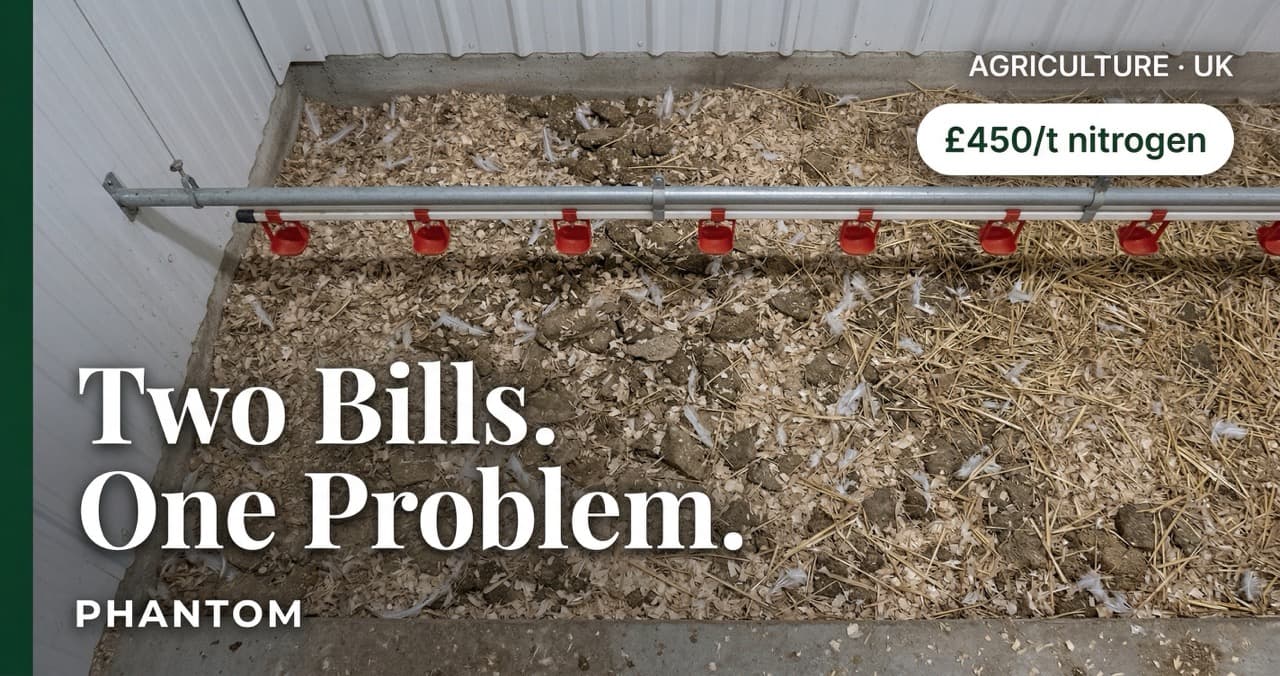
- Poultry litter (60% DM): 28 kg N, 18 kg P₂O₅, 18 kg K₂O per tonne. Replacement value ~£40–£55/tonne (~$50.80–$69.85/tonne) — the highest-value organic fertiliser in routine UK farm use.
- Fish and shellfish waste (Category 3): Nutrient-dense but highly variable; primarily valued for fishmeal and fish oil recovery (£500–£800/tonne for fishmeal), not NPK replacement. See our fishery and slaughterhouse wet waste treatment guide for full ABP stream analysis.
This applies when slurry or manure is exported off-farm, treated by a third party, or disposed of to AD — all routes that forfeit the nutrient value to the receiving farm or plant. It does not apply when manure is applied on-farm within NVZ loading limits at agronomically appropriate rates and timings, which is the optimal outcome but is increasingly constrained by NVZ capacity headroom and seasonal restrictions.
Scenario: A 500-cow dairy farm in the South West exporting 8,000 m³ of slurry annually to a neighbouring arable farm (receiving the nitrogen for free). The dairy farm pays £5/m³ (~$6.35/m³) for transport: £40,000 (~$50,800)/year in haulage. The nitrogen exported is worth approximately £80,000–£96,000 (~$101,600–$121,920) in replacement fertiliser value. Total double loss: £40,000 haulage cost + £80,000–£96,000 opportunity cost forfeited to the receiver.
Manure & Slurry Disposal Cost Calculator
Estimate your annual disposal cost and the fertiliser value being discarded — for UK farms in and outside NVZ designations.
UK Agricultural Waste Disposal Route Comparison
All major routes for high-volume organic wet waste — costs, direction, and key constraints as of 2025.
| Disposal Route | Cost (2025) | Trend | Key Constraint |
|---|---|---|---|
| Anaerobic digestion (food / farm waste) | £0–£35/t · £0–£15/m³ (slurry) | Rising ↑ | 43% of contracts repricing by end 2025; FIT/RHI windfall closing |
| Off-farm slurry haulage | £5–£8/m³ | +3.5–4%/yr ↑ | Uneconomic beyond 8–12 miles; rates up 8–13% YoY (NAAC 2024) |
| Energy from waste / incineration | Median £121/t | +£20–£100/t from 2028 ↑↑ | UK ETS inclusion 2028 — cost shock incoming |
| Landfill (where permitted) | £130–£152/t total | By statute ↑↑ | Tax now £126.15/t (April 2025). ABP raw material restrictions apply. |
| Category 1 ABP rendering | £150–£250+/t | Stable-high | Zero value recovery. Incineration-only output. |
| Category 2 ABP rendering | £80–£150/t | Stable-high | Limited value recovery; MBM to energy only. |
| Category 3 ABP rendering | £20–£60/t net | Variable ↕ | Tallow and fishmeal market prices determine gate fee. |
| PHANTOM on-site subcritical hydrolysis | CapEx + kerosene boiler OPEX only | No gate fees ✓ | No haulage. 60% volume reduction. Outputs: liquid fertiliser, compost, fuel fraction. ~30 min/cycle. |
Ready to model your specific operation's payback period? Our team works through disposal cost, fertiliser recovery value, and capital payback with UK farm owners and operations directors.
Get a Site Assessment →How Does the Scope 3 Supply Chain Audit Create a New Category of Farm Compliance Risk?
Arla, Müller, Tesco, Sainsbury's, and M&S have all activated farm-level emissions monitoring programmes tied directly to supplier pricing and contract terms. A farm that is fully NVZ compliant but cannot demonstrate on-site waste treatment progress is increasingly flagged as a high-transition-risk supplier — with real money at stake.
In advising agricultural operations on ESG risk, the conversation almost always starts in the wrong place. Farm owners focus on the Environment Agency inspection calendar. They should be focusing on the email from their milk buyer's sustainability team.
Consider a 600-cow dairy operation supplying a major processor that spent three years and £180,000 (~$228,600) upgrading its slurry lagoon to NVZ specification — proper covers, six-month capacity, impermeable lining, fully compliant. Then came the processor's annual Climate Check questionnaire. Line item 7: "Proportion of farm organic waste treated or processed before disposal (not land-spread)." Answer: zero. Score: red flag. The processor's sustainability team made it clear — politely but unambiguously — that farms unable to demonstrate progress on waste treatment outcomes, rather than merely disposal compliance, would face tiered milk price reviews from 2025 onward.
The NVZ compliance machine had cost £180,000 and still left them exposed to a supply chain penalty their agronomist had not flagged.
The Scope 3 exposure from waste disposal:
- Manure management methane is classified under Scope 1 for farms but feeds directly into processors' Scope 3 Category 1 (purchased goods and services) and Category 11 (use of sold products)
- Off-farm waste disposal costs flow into processors' Scope 3 Category 5 (waste generated in operations) when the waste is generated at farm level within the processor's supply chain
- Farms unable to demonstrate on-site waste treatment progress — as distinct from mere regulatory compliance — are increasingly flagged in supply chain audits as high-transition-risk suppliers
- The EU CSRD (which applies to Arla, Müller, and other EU-headquartered processors with UK supply chains) requires value chain emissions data; the UK FCA SDR phases in parallel requirements
Major processor sustainability programme status:
Arla has been collecting farm-level carbon data through its Climate Check programme since 2020, covering over 2,000 UK dairy farms audited by Ernst & Young. Arla's SBTi-validated target requires a 30.3% absolute Scope 3 reduction in milk by 2030, and 82.6% of its suppliers must have science-based targets by 2029. Müller's Advantage programme has enrolled 99.5% of its 500+ direct dairy farmers, with a 1p/litre payment incentive (~£20,000/year for a 2-million-litre producer) contingent on meeting emissions KPIs. Tesco has invested £1.5 million in on-farm environmental baselining. Sainsbury's requires high-emission suppliers to hold approved science-based targets by end of 2025. M&S targets a 42% Scope 3 reduction by 2030/31.
For a complete analysis of how agricultural waste disposal feeds into Scope 3 Category 5 reporting obligations and supply chain carbon audit failure states, see: Manufacturing Waste: Carbon Footprint Impact.
This applies when a farm or livestock operation supplies to a food manufacturer, processor, or retailer subject to CSRD, TCFD, or SBTi reporting obligations — which includes virtually every major UK dairy processor and supermarket chain. It does not apply to farms selling exclusively through local or spot markets with no contractual supply chain sustainability obligations.
Scenario: A dairy farm supplying 2 million litres/year to a Müller-contracted collection route. Müller's Fast Track programme places farms on quarterly KPI monitoring. Waste management score is one of four KPIs. A farm scoring red on waste management KPIs for two consecutive quarters receives a supplier review notification. The 1p/litre bonus at risk: £20,000 (~$25,400)/year — approximately 40% of the annual operating cost of an on-site waste treatment unit at the relevant scale.
Why Every UK Agricultural Waste Disposal Bill Is a Symptom of the Same Structural Problem
You now understand the specific cost lines: AD gate fees normalising upward as the 2022 biogas anomaly corrects, slurry haulage that becomes economically indefensible beyond 12 miles, rendering charges for Category 1 and 2 ABP waste that carry no recovery value, landfill tax rising to £126.15/tonne (~$160/tonne) and climbing by statute.
Here is the underlying cause: every one of these routes charges for the same thing — the biological and chemical breakdown of high-moisture organic material. Each route performs that breakdown somewhere other than your farm, using energy, equipment, and infrastructure that you are paying for through the gate fee or the haulage bill. The material arrives at your gate as a liability. It leaves your farm as a liability. You pay for the transformation at the other end.
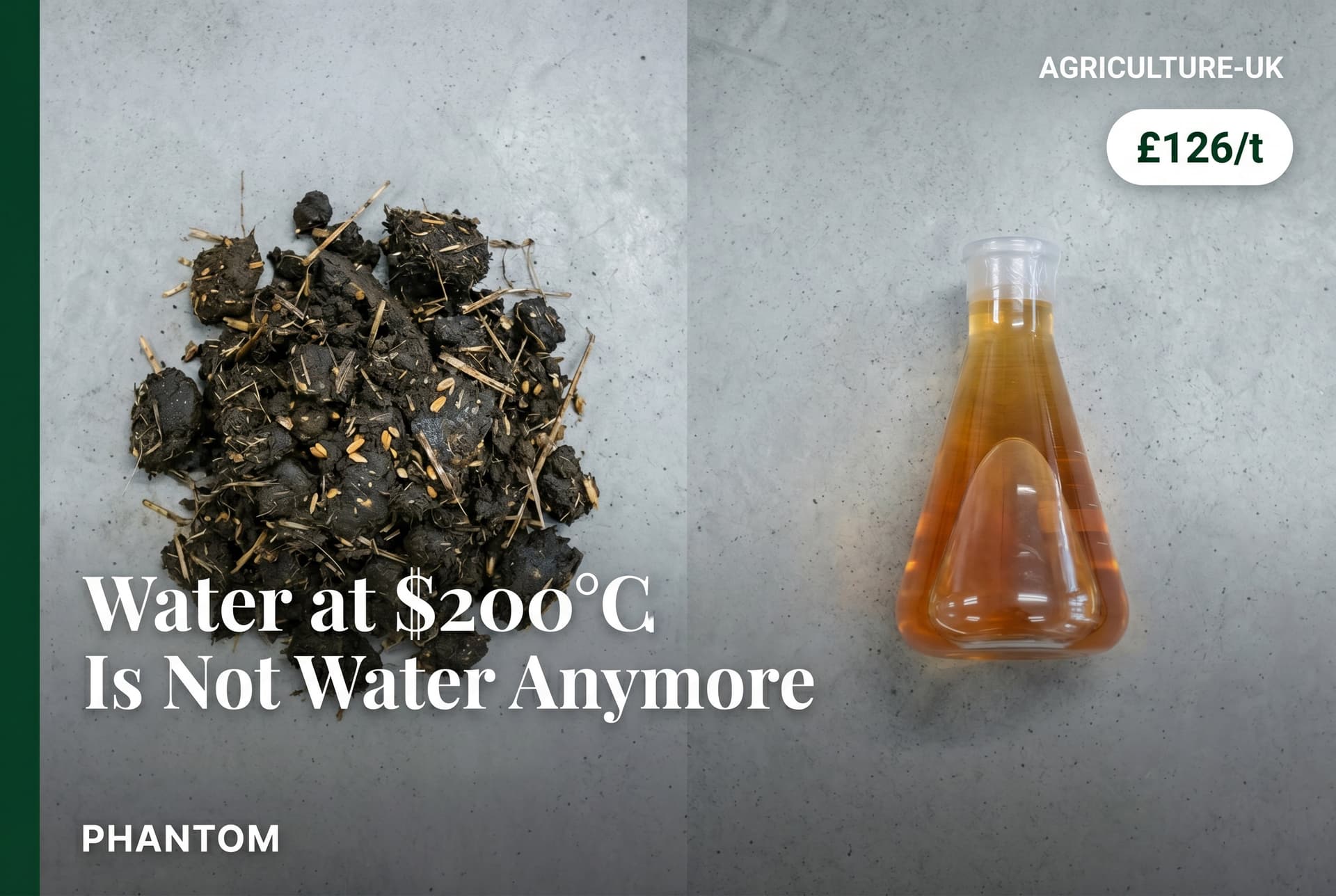
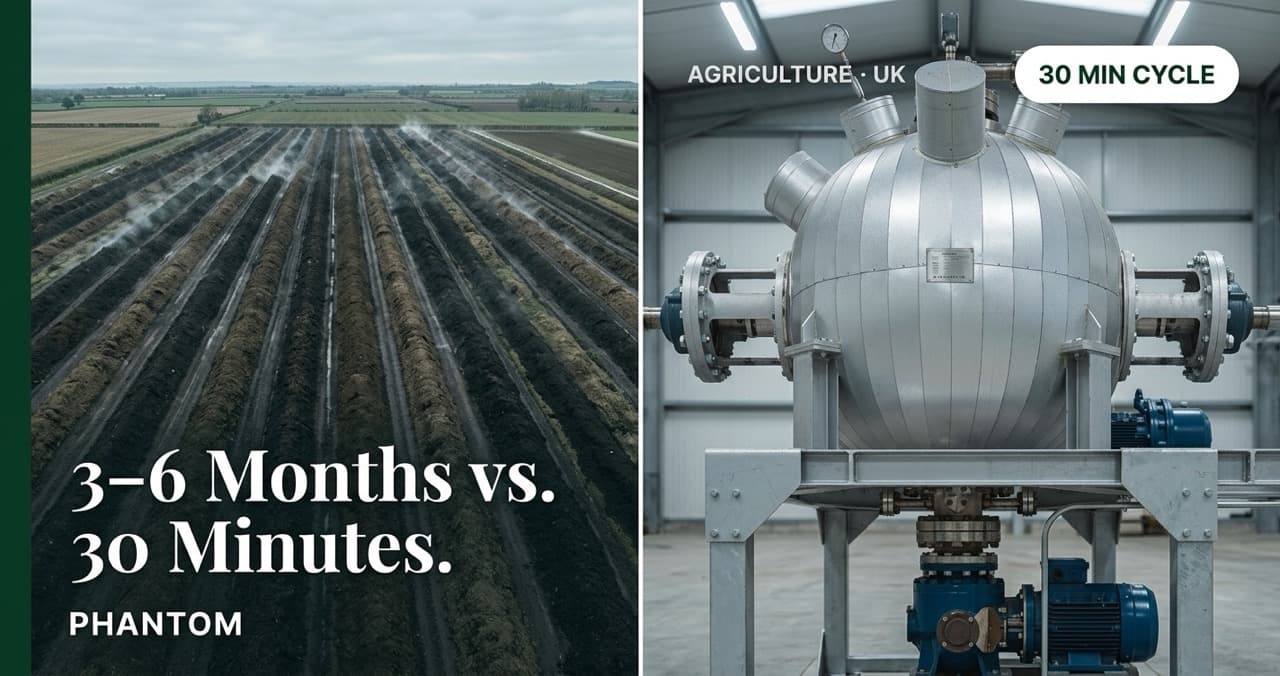
That structural relationship — where the economic and nutrient value locked in organic wet waste is systematically extracted by third-party processors rather than the farms that generate it — is precisely what PHANTOM subcritical water hydrolysis is engineered to break. By applying pressurised hot water at subcritical state on-site, PHANTOM performs the hydrolysis breakdown within 30 minutes per cycle, at the point of generation, with no stack emissions, no dioxins, no haulage cost, and no gate fee. The output is sterile, deodorised, low-molecular-weight material convertible to liquid fertiliser, compost, or fuel fraction — returning the value to your operation instead of the processor's margin.
For a detailed NVZ compliance ROI model including fuel OPEX, lagoon avoidance savings, and payback period by operation type, see: UK Farm Slurry Disposal Costs vs On-Site SWH: NVZ ROI Guide. For livestock manure conversion to certified organic fertiliser outputs, see: Turn Livestock Manure into Organic Fertilizer. For the liquid fertiliser side specifically, see liquid fertilizer production from organic waste and its crop-trial results.
Frequently Asked Questions
AD gate fees for food waste have risen from a 2022 anomaly low of £13/tonne (~$16.50/tonne) — some contracts went negative — to a median of £24/tonne (~$30/tonne) in 2024/25 (WRAP Gate Fees Report). Farm slurry typically attracts £0–£15/m³ as a co-digestion substrate. 43% of AD contracts are repricing by end of 2025 as FIT/RHI subsidies expire.
NVZ farms in England must not exceed a whole-farm average of 170 kg N/ha/year from livestock manure. A grassland derogation allows up to 250 kg N/ha where over 80% of the holding is permanent grassland. Closed spreading periods run 15 October–31 January for slurry on grassland and 1 October–1 April for pigs and poultry. Post-December 2023, penalties for breach are unlimited.
At current ammonium nitrate prices (~£334/tonne as of late 2024), dairy cattle slurry at 6% DM carries approximately £10–£12/m³ (~$12.70–$15.24/m³) in NPK replacement value. A 200-cow dairy herd produces nitrogen in slurry worth £17,000–£20,000 (~$21,590–$25,400)/year. Farms paying £5–£8/m³ to haul that slurry off-farm are destroying two value lines simultaneously: paying to remove the asset and then paying again to replace it.
Category 1 Animal By-Products (specified risk material, TSE-suspect animals) must go to incineration or rendering followed by incineration. Disposal costs run £150–£250+/tonne (~$190–$318/tonne) with zero value recovery. Category 2 runs £80–£150/tonne (~$102–$190/tonne). Category 3 (low-risk processing waste) carries a net cost of £20–£60/tonne (~$25–$76/tonne) depending on tallow and fishmeal market prices.
Yes. PHANTOM's subcritical water hydrolysis process handles mixed organic wet waste — slurry, manure, paunch and gut contents, fish offal, and Category 3 ABP — in the same vessel without pre-sorting. The process operates at around 250°C and 2–2.7 MPa (20–27 bar), conditions that sterilise pathogenic organisms (including prion proteins) and produce a sterile, deodorised output suitable for fertiliser or fuel applications. Category 1 and 2 ABP require separate regulatory approval via the national competent authority before on-site treatment.
Figures in this article are provided for informational purposes based on AHDB, NAAC 2024, WRAP Gate Fees Report 2024/25, and publicly available regulatory data. They do not constitute legal, financial, agronomic, or procurement advice. NVZ designations, storage requirements, spreading restrictions, and penalty frameworks are subject to change; verify current requirements with the Environment Agency, DAERA, or Natural Resources Wales as applicable. USD conversion at approximately 1.27 USD/GBP at time of publication.