Article Series
Autoclaving leaves 10% of your clinical waste untreated and sends the rest to landfill. For operators already familiar with non-incineration medical waste treatment, this article dives into the head-to-head technical comparison between autoclaving and subcritical water hydrolysis — covering operating parameters, waste stream compatibility, residue output, and total cost trajectory through 2028.
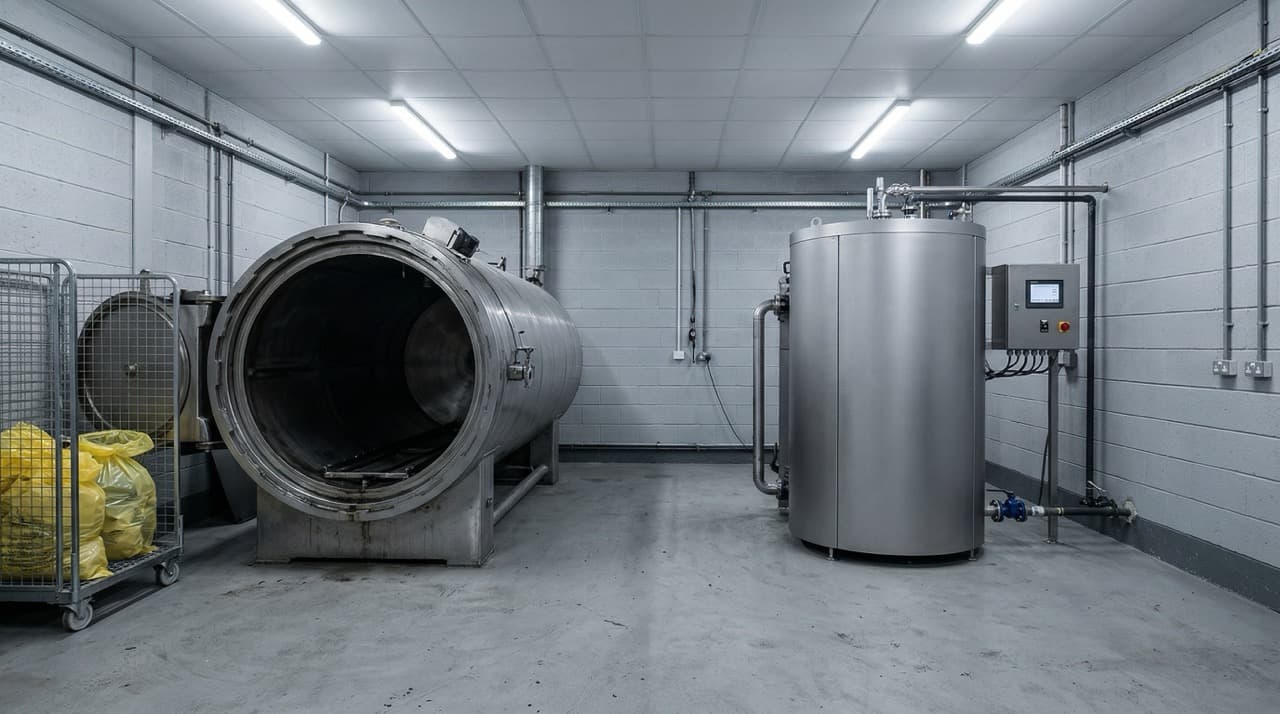
How Does Autoclave Temperature Compare to Subcritical Water Hydrolysis?
Subcritical water hydrolysis operates at 200°C and 20 bar pressure — 66°C hotter than the maximum autoclave cycle. That temperature gap is the difference between sterilising waste and breaking it down at a molecular level.

- Autoclaves run at 121–134°C and 1–3 bar, killing most bacteria through pressurised steam contact over 30–90 minutes
- SWH runs at 200°C and 20 bar, triggering hydrolytic decomposition of organic compounds — not just surface sterilisation
- Autoclave output is shredded, sterilised waste that still requires landfill disposal at £126.15/t (~$160/t) in 2025/26
- SWH output is a sterile, volume-reduced residue with potential soil amendment value — diverting material from landfill entirely
- Both technologies complete a cycle in approximately 30 minutes, but SWH processes a broader range of waste streams per cycle
This applies when you are processing infectious clinical waste (orange bag, HTM 07-01) and comparing real operating parameters. It does not apply if you are evaluating waste streams that require incineration by law, such as anatomical waste.
Micro-example: A 400-bed NHS acute trust generating 12 tonnes of orange-bag waste per month runs an autoclave at 134°C. Every tonne of autoclaved residue still goes to landfill at £126.15/t — costing £1,513.80/month in landfill tax alone. The same 12 tonnes processed through SWH at 200°C produces a sterile residue classified for land application, eliminating that landfill cost entirely.
Which Waste Streams Can an Autoclave NOT Process?
Autoclaves cannot treat approximately 10% of clinical waste. That 10% includes the most dangerous and expensive categories in the hospital waste stream.
- Prion-contaminated waste (CJD): Standard autoclaving at 134°C fails to completely denature prion proteins. CJD-contaminated material resists steam sterilisation and remains highly infectious post-treatment
- Cytotoxic and chemotherapy waste: Active chemical compounds survive steam sterilisation temperatures. HTM 07-01 requires incineration for all cytotoxic waste
- Pharmaceutical waste: Drug compounds are not deactivated by steam alone. Autoclaving pharmaceutical waste creates a disposal liability, not a solution
- Anatomical and pathological waste: Not approved for autoclave treatment under UK regulations
- Chemical aerosolisation risk: Autoclaves can aerosolise chemical compounds present in mixed waste, creating secondary contamination
This applies when you are evaluating whether a single on-site treatment system can handle your full clinical waste profile. It does not apply if your facility generates only standard infectious waste with no pharmaceutical or cytotoxic streams.
Micro-example: A regional cancer treatment centre generates 2.4 tonnes of cytotoxic waste per month alongside 8 tonnes of standard infectious waste. The autoclave handles the 8 tonnes — but the 2.4 tonnes of cytotoxic waste still ships to incineration at £617/t (~$783/t). That is £1,480.80/month in incineration fees for waste the autoclave physically cannot touch.
What Happens to the Residue After Each Treatment?
Autoclave residue goes to landfill. SWH residue has potential value as a soil amendment. That distinction changes the entire cost equation.
- Autoclaved waste is shredded and sterilised but not decomposed — it retains its original mass minus moisture, sent to landfill at £126.15/t rising to £130.75/t (~$166/t) from April 2026
- SWH residue is hydrolysed into a sterile, homogeneous material with reduced volume and mass — classified for potential land application rather than landfill
- Autoclaved sharps containers, plastics, and packaging retain their physical form — they occupy landfill space unchanged
- SWH breaks down organic polymers into simpler compounds, reducing total waste volume by up to 80%
- The liquid fraction from SWH contains recoverable nutrients, creating a potential revenue stream rather than a disposal cost
This applies when you are comparing total disposal cost over a 5-year contract. It does not apply if your primary concern is single-cycle throughput speed alone.
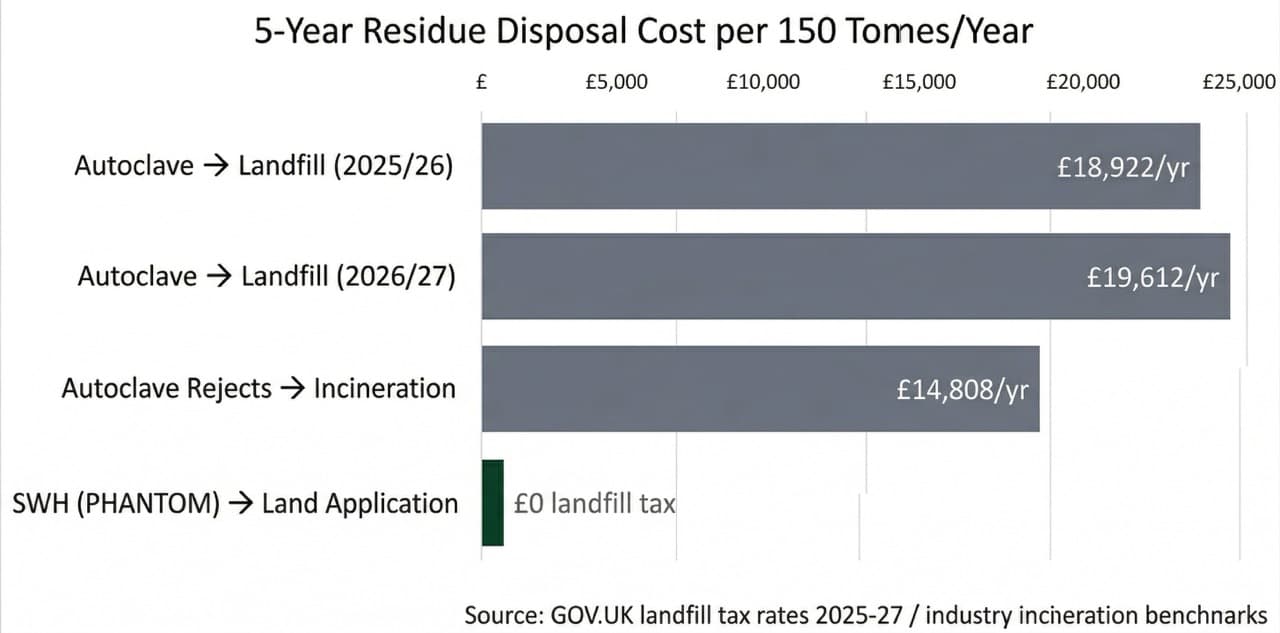
Micro-example: An NHS trust disposing of 150 tonnes of autoclaved residue per year pays £18,922/year (~$24,030/year) in landfill tax alone at £126.15/t. Over a 5-year contract, that is £94,612 in tax on waste that was already "treated." With landfill tax rising to £130.75/t from April 2026, the annual cost increases to £19,612/year — and the trajectory only steepens.
For a detailed financial model comparing all three treatment pathways, see the medical waste TCO comparison: autoclave vs incineration vs hydrolysis guide.
How Will UK ETS Carbon Pricing Change the Cost of Incineration by 2028?
From 2028, every UK waste incineration facility will surrender carbon allowances under the UK Emissions Trading Scheme. Industry estimates project gate fee increases of approximately £48/t.
- January 2026: Voluntary Monitoring, Reporting and Verification (MRV) begins for all energy-from-waste and waste incineration operators
- 2028: Full UK ETS compliance — operators must purchase and surrender carbon allowances for fossil-derived emissions (primarily plastics in waste stream)
- Estimated gate fee increase: ~£48/t, pushing yellow-bag clinical waste incineration from ~£617/t (~$783/t) toward £665/t (~$844/t)
- Facilities relying on incineration for their autoclave reject stream (cytotoxic, pharmaceutical, prion waste) will absorb this increase directly
- SWH produces zero combustion emissions — it sits entirely outside the UK ETS scope
This applies when you are planning waste infrastructure investment with a 5–10 year horizon. It does not apply if you are evaluating treatment options for a single waste audit cycle.
Micro-example: A private hospital group operating 6 facilities sends a combined 180 tonnes of clinical waste to incineration annually. At current rates (~£617/t), that costs £111,060/year (~$141,046/year). Post-2028 UK ETS compliance adds ~£48/t, pushing annual costs to £119,700/year — an £8,640 (~$10,973) increase with no change in waste volume or service level.
What Does a Side-by-Side Spec Sheet Look Like?
The table below compresses every decision-relevant parameter into a single comparison. SWH outperforms autoclaving on temperature, waste compatibility, residue value, and regulatory future-proofing.
| Parameter | Autoclave | Subcritical Water Hydrolysis (PHANTOM) |
|---|---|---|
| Operating temperature | 121–134°C | 200°C |
| Operating pressure | 1–3 bar | 20 bar |
| Cycle time | 30–90 minutes | ~30 minutes |
| Waste stream coverage | ~90% of clinical waste | Broader — includes organic pharmaceutical streams |
| Prion destruction | No — prion proteins resist steam sterilisation at 134°C | Higher temperature provides superior organic decomposition |
| Cytotoxic waste | Not approved | Hydrolytic breakdown of organic compounds |
| Residue destination | Landfill (£126–£131/t tax) | Potential land application (zero landfill tax) |
| Volume reduction | Minimal (shredding only) | Up to 80% mass reduction |
| Emissions | Steam venting, potential chemical aerosolisation | Zero combustion emissions, closed-loop system |
| UK ETS exposure | Indirect (autoclave rejects → incineration → UK ETS) | None — no combustion process |
| Carbon pathway | Neutral on treatment; landfill emissions on residue | Zero-emission treatment; residue diverted from landfill |
| Revenue potential | None — residue is a cost | Sterile residue and liquid fraction have soil amendment value |
This applies when you need a single reference document for a procurement committee or board paper comparing these two technologies. It does not apply if you are comparing either technology to incineration alone — see the non-incineration medical waste treatment guide for that analysis.
Micro-example: A facilities director at a 600-bed teaching hospital presents this spec sheet to the trust's capital investment committee. The committee flags two rows — prion destruction and UK ETS exposure — as the deciding factors. The autoclave cannot address either. The PHANTOM organic waste treatment machine addresses both.
Pro-Tip: Why "Good Enough" Sterilisation Is the Most Expensive Decision in Clinical Waste
In my experience advising healthcare trusts on waste infrastructure procurement, the autoclave is always the first technology that reaches the shortlist. It is familiar, it is proven for standard infectious waste, and the capital cost is lower than most alternatives. That familiarity creates a blind spot.
The root cause is not the autoclave itself — it is the assumption that sterilisation equals elimination. Autoclaving sterilises waste. It does not eliminate it. Every tonne of autoclaved residue still exists physically, still occupies landfill capacity, and still carries a rising tax burden that will hit £130.75/t (~$166/t) from April 2026. The 10% of waste streams that autoclaves cannot process — prions, cytotoxic compounds, pharmaceuticals — still ship to incineration at £500–£617/t. And from 2028, UK ETS carbon pricing will add another ~£48/t to every incineration invoice.
Subcritical water hydrolysis addresses the root cause. The PHANTOM organic waste treatment machine operates at 200°C and 20 bar — decomposing organic waste rather than merely sterilising it. The output is a sterile residue with soil amendment potential, not landfill-bound shredded waste. For a free feasibility assessment covering your facility's specific waste profile, throughput requirements, and 5-year TCO projection, speak to our team.
Frequently Asked Questions
No. Standard autoclaving at 134°C fails to completely denature prion proteins. CJD-contaminated material resists steam sterilisation and remains highly infectious post-treatment. Prion waste requires incineration or higher-temperature treatment.
200°C at 20 bar pressure — 66°C hotter than the maximum autoclave cycle. This triggers hydrolytic decomposition of organic compounds rather than surface sterilisation alone.
Landfill. Autoclaved waste is shredded and sterilised but retains its physical mass. UK landfill tax is £126.15/t (~$160/t) in 2025/26, rising to £130.75/t (~$166/t) from April 2026.
Indirectly, yes. The 10% of waste streams autoclaves cannot process still goes to incineration. From 2028, UK ETS will add approximately £48/t to incineration gate fees — a cost autoclave operators cannot avoid for their reject stream.
Both technologies complete a treatment cycle in approximately 30 minutes. SWH processes a broader range of waste streams per cycle, reducing the need for separate incineration contracts for pharmaceutical, cytotoxic, and prion-risk streams.
Sources: HTM 07-01 (NHS England, 2023 edition); GOV.UK Landfill Tax rates 2025–2027; HMRC OBR Autumn Budget 2024; UK Emissions Trading Scheme consultation documentation; industry incineration benchmarks (2025/26). Disposal rates based on UK industry averages.
Figures are for informational purposes only and do not constitute legal, financial, or procurement advice. ~1.27 USD/GBP.